The Amazon Colossus: How AI, Infrastructure, and Speed Are Building an Unassailable Empire
Amazon stands at an inflection point where its sprawling network of services, technology, and infrastructure is converging into something unprecedented in commercial history: a self-reinforcing global platform so deeply entrenched and broadly diversified that meaningful competition may soon become structurally impossible.
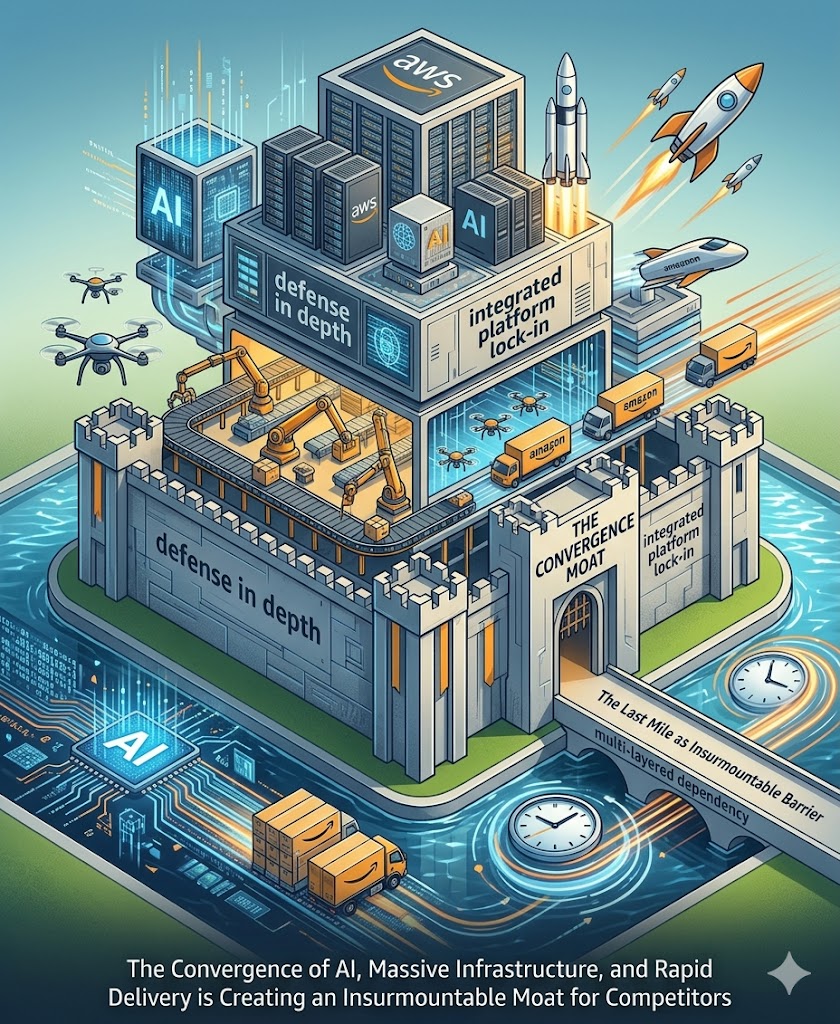
The company’s recent strategic moves reveal a coherent vision that extends far beyond retail. By aggressively expanding AWS data centers, embedding artificial intelligence throughout its operations, and pushing toward ubiquitous same-day delivery, Amazon is constructing what military strategists would call “defense in depth”—multiple overlapping layers of competitive advantage that compound rather than simply add together.
The AI-AWS Amplification Loop
Amazon Web Services has evolved from a side project to generate revenue from excess server capacity into the backbone of the modern internet. The division now represents a crucial strategic asset that creates unique advantages for Amazon’s retail business while simultaneously funding its expansion.
The company’s massive investment in AI infrastructure—including custom Trainium and Inferentia chips designed specifically for machine learning workloads—positions AWS to capture the enormous wave of enterprise AI adoption. Every company training large language models or deploying AI applications becomes an AWS customer, generating cash flow that Amazon reinvests into its retail operations.
But the relationship runs deeper than simple cross-subsidization. Amazon’s retail operations generate petabytes of behavioral data daily—search patterns, purchase histories, browsing behavior, delivery preferences. This data, processed through AWS infrastructure and increasingly sophisticated AI models, creates predictive capabilities that traditional retailers cannot match. Amazon doesn’t just respond to what customers want; it anticipates needs before customers articulate them.
The AI models improve inventory positioning, demand forecasting, and pricing dynamically across millions of products. They optimize the placement of fulfillment centers and determine which items to stock where. They personalize the shopping experience for hundreds of millions of customers simultaneously. And critically, every transaction generates new training data that makes the models more accurate, creating a flywheel effect that accelerates over time.
Traditional retailers cannot replicate this advantage because they lack both the technical infrastructure and the data volume. Walmart and Target cannot build AWS-scale cloud operations to monetize; they must purchase cloud services from Amazon, Google, or Microsoft, turning what should be a core competency into an operating expense paid to competitors.
The Last Mile as Insurmountable Barrier
Amazon’s push toward same-day delivery represents perhaps the most capital-intensive and strategically significant component of its moat-building strategy. The company now operates over 500 fulfillment centers globally, complemented by hundreds of smaller delivery stations positioned within dense metropolitan areas.
This infrastructure investment—easily exceeding $100 billion when fully accounted—creates time-based competition that legacy retailers cannot win. When Amazon can deliver most items within hours rather than days, the value proposition of physical retail locations diminishes precipitously. Why drive to a store, search for parking, navigate aisles, and wait in checkout lines when the same item appears at your door before dinner?
The economics are brutally clear. Amazon’s delivery network exhibits classic economies of scale and density. Each additional customer in a geographic area reduces the per-delivery cost for all customers. Each additional fulfillment center increases the percentage of the population reachable within two hours. The marginal cost of adding one more package to an existing delivery route approaches zero.
Traditional retailers face the opposite dynamic. Their physical stores represent fixed costs that don’t decline with additional customers. Each square foot of retail space costs the same whether it generates one transaction or one hundred. Store associates cost the same hourly wage regardless of customer volume. Real estate in premium locations becomes more expensive, not less, as retailers compete for visibility.
Walmart has attempted to leverage its extensive store network as micro-fulfillment centers, but this strategy faces fundamental limitations. Stores designed for customer browsing aren’t optimized for rapid order fulfillment. Retail employees aren’t trained or equipped for logistics operations. And crucially, Walmart’s stores must serve both in-person shoppers and online order fulfillment simultaneously, creating operational conflicts that dedicated fulfillment centers never face.
The Integrated Platform Lock-In Effect
Amazon’s competitive advantage extends beyond logistics and technology into something more insidious for competitors: multi-layered dependency that operates simultaneously across customers, merchants, and enterprises.
For consumers, Amazon Prime represents the cornerstone. Once a customer pays for Prime membership, the psychological switching cost becomes substantial. Prime video, Prime music, Prime reading, and free shipping create multiple touchpoints that reinforce daily engagement. The average Prime member spends roughly twice what non-Prime customers spend annually, and crucially, Prime members default to searching Amazon first rather than comparison shopping.
For third-party sellers, Amazon’s marketplace is essentially mandatory. Roughly 60% of Amazon’s retail sales now come from third-party merchants, who pay Amazon substantial fees for access to its customer base, logistics network, and payment processing. These sellers become dependent on Amazon’s platform while simultaneously training its algorithms and providing data about product demand, pricing elasticity, and consumer preferences.
The Fulfillment by Amazon (FBA) program deepens this dependency. Merchants send inventory to Amazon’s warehouses, where it becomes indistinguishable from Amazon’s own stock and eligible for Prime shipping. Merchants gain access to Amazon’s logistics superiority but surrender control over inventory, customer relationships, and data. They become structurally dependent on a partner that is simultaneously their competitor.
For software developers and enterprises, AWS creates similar lock-in through proprietary services that work seamlessly together but prove difficult to migrate away from. Companies build their entire technical infrastructure around AWS-specific services like Lambda, DynamoDB, and SageMaker. Moving to alternative cloud providers requires not just data migration but architectural redesign, often costing millions and risking operational disruption.
The Alexa Ambient Layer
Amazon’s voice assistant strategy, while seemingly tangential to retail dominance, represents another dimension of competitive entrenchment. Alexa-enabled devices now number in the hundreds of millions globally, positioned in homes, cars, and workplaces.
Voice interfaces fundamentally change purchase behavior by collapsing the search and comparison process. When customers ask Alexa to reorder products, they typically accept the suggested option rather than researching alternatives. Voice ordering removes the visual comparison shopping that happens on websites or in stores. It defaults to Amazon’s infrastructure unless customers explicitly specify alternatives—a small friction that dramatically influences behavior at scale.
As Alexa’s natural language processing improves through AI advancement, voice interfaces will handle increasingly complex purchasing decisions. Customers will delegate entire categories of shopping to AI assistants that optimize for their preferences, delivery windows, and price sensitivity. Amazon, controlling both the assistant and the fulfillment network, occupies a privileged position that competitors cannot easily challenge.
The Reinforcing Network Effects
What makes Amazon’s competitive position potentially unassailable isn’t any single advantage but how multiple advantages reinforce each other in a complex adaptive system.
More customers attract more third-party sellers seeking market access. More sellers increase product selection and competitive pricing. Better selection and prices attract more customers. Higher customer volume justifies more fulfillment center investment. More fulfillment centers enable faster delivery. Faster delivery increases Prime membership value. More Prime members generate more predictable revenue. Predictable revenue funds AWS infrastructure investment. AWS revenue subsidizes retail pricing and logistics expansion. Retail operations generate data that improves AI models. Better AI improves every operational dimension from inventory management to recommendation engines.
Each component strengthens others in a web of causation that becomes increasingly difficult to disrupt. Competitors cannot attack a single dimension—they would need to somehow replicate the entire system simultaneously, requiring capital investment and operational excellence across logistics, cloud computing, artificial intelligence, hardware manufacturing, content production, and marketplace management.
Traditional retailers like Macy’s, Kohl’s, and JCPenney lack the technical sophistication, capital resources, and talent to compete on any of these dimensions individually, much less collectively. Even well-capitalized competitors like Walmart, which has spent billions on e-commerce and delivery infrastructure, find themselves perpetually behind in technology sophistication and platform breadth.
The Global Expansion Dimension
Amazon’s international expansion follows a methodical pattern of replicating its integrated model in new markets. In India, the company has invested over $6 billion building fulfillment infrastructure, negotiating with merchants, and adapting to local preferences and regulations. In Europe, cross-border logistics enable efficient service across multiple countries from centralized fulfillment networks.
The company’s willingness to sustain substantial losses during market entry—effectively using AWS profits to subsidize retail expansion—gives it an unfair advantage over local competitors who must generate profits to survive. Amazon can operate at break-even or losses for years while building market share and infrastructure, knowing that once dominance is established, economics will eventually turn favorable.
This patient capital approach, funded by AWS and increasingly profitable North American retail operations, allows Amazon to overwhelm competitors through sustained investment that other companies cannot match. It transforms competition from operational execution into financial endurance—a contest Amazon almost always wins.
The Regulatory Question
The only meaningful constraint on Amazon’s trajectory toward total dominance may be regulatory intervention. Antitrust authorities in the United States and Europe have begun scrutinizing Amazon’s dual role as marketplace operator and competitor, its use of seller data to inform private label products, and its bundling of Prime benefits to maintain market power.
However, regulatory action faces substantial obstacles. Amazon’s integration creates genuine consumer benefits through lower prices, faster delivery, and greater convenience. Regulators must balance competitive concerns against tangible consumer welfare. Breaking up Amazon—separating AWS from retail, or marketplace from private label—might reduce competitive concerns but would also sacrifice the efficiencies that integration creates.
Moreover, Amazon’s political influence grows with its economic power. The company now employs over 1.5 million people globally, with substantial presence in politically important regions. It has become critical infrastructure for small businesses, web services, government agencies, and consumers. Any regulatory action risks economic disruption and political backlash.
The Path Forward
Amazon’s trajectory suggests a future where the company doesn’t merely dominate retail but becomes something more fundamental: a layer of infrastructure underlying the global economy. Its logistics network becomes the circulatory system for physical goods. Its cloud services become the computational substrate for digital services. Its AI capabilities become the intelligence layer automating commerce.
For traditional retailers, the strategic question has shifted from “How do we compete with Amazon?” to “How do we survive in an Amazon-dominated world?” The honest answer may be uncomfortable: focus on niches where experience matters more than convenience, where tactile interaction drives purchase decisions, where local relationships create switching costs, or where regulatory constraints limit Amazon’s reach.
The competitive moat Amazon is constructing isn’t a single defensive barrier but a complex system of reinforcing advantages spanning technology, logistics, data, capital, and network effects. Each dimension deepens over time. Each makes the others more valuable. Together, they create a competitive position that may prove genuinely unassailable—not through any single innovation but through patient, methodical integration of capabilities that compound into overwhelming structural advantage.
The future Amazon envisions isn’t one where it merely wins retail competition. It’s one where the distinction between Amazon and commerce itself becomes increasingly difficult to perceive. That may be the most formidable moat of all: becoming so deeply embedded in the infrastructure of daily life that competition becomes structurally impossible and alternatives become literally unimaginable.
About the Author