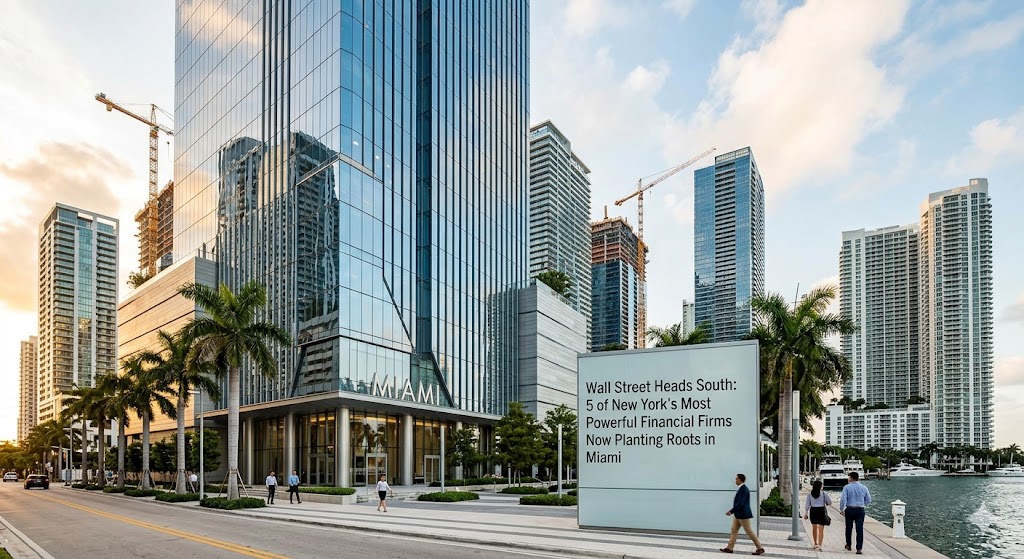
Wall Street Heads South: 5 of New York’s Most Powerful Financial Firms Now Planting Roots in Miami
The numbers no longer lie. Miami is not a financial satellite of New York — it is becoming a financial destination in its own right. What began as a pandemic-era lifestyle experiment has calcified into a structural shift. Office leases have been signed, headquarters towers are rising from Brickell Bay Drive, and some of the most powerful names in global finance have quietly moved from exploratory to committed. The story is no longer about who is thinking about coming to Miami. It is about what they are building now that they are here.
Below is a deep look at five of the most prominent New York-rooted financial institutions that have not just dipped a toe in Miami’s waters, but are expanding their footprints in ways that are permanently reshaping the city’s commercial skyline.
1. Citadel — Building a Supertall to Match Its Ambitions
No firm better symbolizes Miami’s financial transformation than Citadel, the hedge fund and market-making colossus founded by billionaire Ken Griffin. Griffin purchased a 2.5-acre parcel at 1250 Brickell Bay Drive for a record $363 million, where he plans to build a 54-story headquarters tower encompassing 1.3 million square feet of office space, a 212-room luxury hotel, and 23,600 square feet of retail space.
The scale of the commitment is without precedent in Miami’s commercial real estate history. The building is planned to rise 1,032 feet above the bayfront, placing it among the tallest structures on the East Coast outside of New York City, with a total footprint of 1.7 million square feet across the first phase alone. A second phase envisions an additional 408,000-square-foot office building, and a third phase would add a 100-unit residential tower — a campus, in effect, that would anchor the Brickell Financial District for generations.
While that tower rises, Citadel is anything but idle. Griffin’s firm has expanded its presence at 830 Brickell — the most prestigious office tower in Miami — to eight floors totaling approximately 130,000 square feet, making it the single largest tenant in the building. And in January 2026, Griffin went further still, reportedly acquiring a nearly 400,000-square-foot, 10-story office building in Miami’s Wynwood neighborhood for approximately $180 million, adding a cultural and creative dimension to what is becoming a multi-neighborhood corporate real estate empire.
Griffin has praised Miami as “the future of America” and has described the city’s deficit of Grade A office space as both a challenge and an opportunity: “If we build it, they will come.” With Citadel expecting to reach 450 employees in South Florida, it’s clear this is no longer a Chicago firm with a Miami outpost — it is a Miami firm building the infrastructure to prove it.
2. Blackstone — The World’s Largest Alternative Asset Manager Stakes Its Claim
Blackstone, the world’s largest alternative asset manager, significantly expanded its Miami investment and real estate operations in 2024, adding to a presence in the city that first crystallized when the firm signed on as an anchor tenant at 830 Brickell. The 640,000-square-foot tower attracted Blackstone as one of its first major financial tenants, alongside Microsoft, Thoma Bravo, and several leading law firms, with 90 percent of its tenants relocating from major markets like New York or Los Angeles.
For Blackstone — a firm managing well over $1 trillion in assets across real estate, private equity, credit, and hedge fund strategies — Miami represents more than a lifestyle concession to executives who prefer Florida’s tax climate. It represents a calculated bet on where the next generation of investment talent wants to live and work, and where the firm needs to be to recruit and retain them.
Cushman & Wakefield broker Brian Gale, who represents 830 Brickell, noted that many new-to-Miami tenants were initially conservative in their initial takedowns of space, only to realize quickly that the city is a real market where people genuinely want to be — and then expanded accordingly. Blackstone fits this pattern precisely. The firm established a foothold, observed the ecosystem develop around it, and has continued deepening its South Florida operational presence as the market has validated its early conviction.
The broader significance of Blackstone’s Miami presence extends beyond square footage. When the world’s preeminent alternative asset manager signals confidence in a market by placing investment professionals and operational leadership there, it functions as a quality signal that accelerates the arrival of every subsequent firm weighing the same decision.
3. Apollo Global Management — Brickell First, Second HQ Next
Apollo Global Management’s Miami story is one of organic growth evolving into institutional commitment. Apollo first established its Miami presence at 701 Brickell, one of the city’s landmark office addresses, with its entry into the market citing access to talent already in South Florida or wanting to be there as the primary driver. At the time of signing, Apollo managed $481 billion in assets and was openly targeting $1 trillion in assets under management — a growth ambition that requires footprints in markets where talent density and client proximity intersect favorably.
That initial lease was always likely to be the beginning of a longer expansion arc. In April 2026, Apollo announced plans to establish a formal second U.S. headquarters, with South Florida — alongside Texas and Nashville — among the leading candidates under active consideration. The announcement came as New York’s political environment around taxation generated fresh scrutiny of high-income financial services employment, and as the Sun Belt’s grip on finance talent continued to tighten.
The practical logic behind Apollo’s Miami calculus is straightforward. Brickell office rents, while elevated at $125 to $150 per square foot, remain competitive with or below average Manhattan asking rates, and Florida’s corporate and personal tax structures offer measurable structural advantages for both the firm and its employees. For a firm of Apollo’s scale — with a workforce spread across private equity, credit, insurance solutions, and wealth management — distributing operational capacity across multiple geographies is not just a lifestyle accommodation. It is a resilience and talent strategy.
That tax-driven calculus is not exclusive to mega-firms like Apollo — it increasingly shapes decisions for smaller operators across the state as well. Our breakdown of tax planning strategies for South Florida small business owners unpacks the same structural advantages in practical, actionable terms for founders and finance leads navigating the 2025 filing season.
4. Goldman Sachs — Following the Wealth South
Goldman Sachs has long maintained the posture of a firmly New York institution — and it remains one, with its largest workforce still anchored in Manhattan and its investment banking and capital markets franchise centered on Wall Street. But the migration of high-net-worth clients to South Florida has compelled the firm to follow the money, and its South Florida expansion reflects exactly that logic.
Goldman Sachs expanded its asset management and wealth division in West Palm Beach with more than 100 traders and financial professionals establishing a presence in Palm Beach County, putting Goldman’s senior investment talent within proximity of the billionaire and centimillionaire clients who have made Florida their primary residence in significant numbers. This 2024 expansion added high-paying financial roles across Palm Beach County, signaling that Goldman is not simply planting a flag for reputational purposes but actually deploying revenue-generating talent where client demand is concentrated.
The backdrop to Goldman’s Florida expansion is significant. A major report found that roughly a third of New Yorkers who left the city relocated to Miami-Dade, Palm Beach, and Broward Counties, accounting for approximately $10 billion in adjusted gross income transferred out of New York City. That is not a rounding error — it is a massive reallocation of the precise demographic Goldman serves at the highest level of its wealth management practice. Following that capital southward is not optional for a firm competing aggressively in the ultra-high-net-worth segment.
Goldman’s South Florida presence is part of a broader multi-city geographic expansion that includes a $500 million campus under development in Dallas. The pattern is consistent: Goldman is systematically placing talent where the talent and the clients both want to be, rather than insisting that everyone come to 200 West Street.
Where Goldman’s wealth advisors now sit is no accident — it tracks precisely with the geography of South Florida’s ultra-high-net-worth clients. Explore the Palm Beach to Miami luxury high-rise corridor to see why this 70-mile stretch of coastline has become the most concentrated enclave of billionaire residences and waterfront boardrooms on the planet.
5. Millennium Management — Consolidating and Growing in Brickell
Millennium Management, the multi-strategy hedge fund founded by Izzy Englander and one of the most influential trading platforms in global finance, was among the earliest Wall Street firms to establish a meaningful Miami presence. The firm opened offices in Miami’s Brickell Financial District, drawn by the same combination of talent availability, tax efficiency, and lifestyle factors that drew its hedge fund peers southward.
As of 2025, Millennium employed 53 investment professionals in Miami — one of the largest concentrations of any hedge fund operating in the city, and the firm has continued to use its South Florida operations as a meaningful node in its global multi-pod trading architecture. The firm has since consolidated its Miami offices while managing its investment headcount there, a pattern that reflects less a retreat than a maturation — trading multiple smaller locations for a more deliberate, consolidated institutional presence.
Millennium now employs over 6,500 people globally, managing one of the largest pools of hedge fund capital in the world, with its multi-strategy platform capturing the majority of net inflows across the industry. Its Miami operation sits within that global framework as a genuine investment hub, not merely an administrative satellite. The firm’s commitment to Brickell reinforces the district’s identity as a place where real investment decisions are made — not just where executives sleep between New York trips.
Millennium’s concentration of investment professionals in Brickell mirrors a parallel migration reshaping South Florida’s technology sector as well. Read our analysis of why tech professionals are leaving Silicon Valley for South Florida to understand how the same tax, lifestyle, and talent-density forces pulling Wall Street south are now recruiting the engineers and founders who will build the region’s next economy.
The Bigger Picture: Brickell Is Not a Satellite Anymore
The trend of companies relocating to Miami has stabilized, but the businesses that have moved to the city have hired more people, expanded their operations, and grown more confident — and now they need significantly more space. That arc — initial caution followed by rapid organic expansion — is visible in virtually every major financial firm that has established a Miami presence.
Miami’s office market has bucked the national trend of high vacancy rates, with Brickell’s newest and most prestigious buildings achieving record occupancy even as rents climbed to levels previously associated only with Manhattan. The city is no longer competing on price alone — it is competing on quality, culture, and ecosystem depth.
The broader Orlando regional economy, and by extension the Florida economic zone it anchors, now represents a $233 billion market growing at rates that have outpaced the national average for four consecutive years. Miami sits at the apex of that growth story, and the Wall Street firms planting flags in Brickell are not doing so because Florida is cheap. They are doing so because they believe it is where the next chapter of American finance will be written — and they intend to be at the center of it when it is.
The same wealth gravity reshaping Brickell’s office towers is simultaneously rewriting South Florida’s residential high end at a historic pace. Discover how Boca Raton’s ultra-luxury home market has become the residential counterpart to Miami’s financial boom, giving relocating executives a coastal enclave that matches the ambition of the headquarters rising 45 miles south.
Sources: Commercial Observer, Bisnow South Florida, IBTimes, Fox Business, Millionluxury.com, CRE Daily, The Real Deal Miami, Goldman Sachs Wealth Management reports, CBRE 2026 HQ Relocation Report
About the Author