April 28, 2026
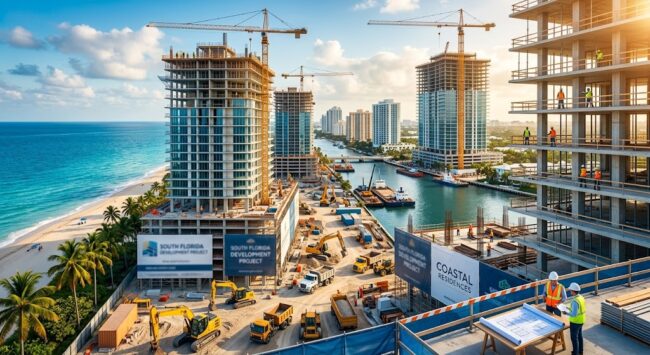
Stand on a balcony in Hallandale Beach. Then drive up A1A to Hollywood. Cut over to Fort Lauderdale’s Las Olas Boulevard. Push north into Pompano Beach, Deerfield Beach, Boca Raton, Delray Beach, and finally West Palm Beach. By the time you’ve made the loop, you’ll have seen something genuinely staggering:
South Florida is being rebuilt at a scale this region has never experienced before.
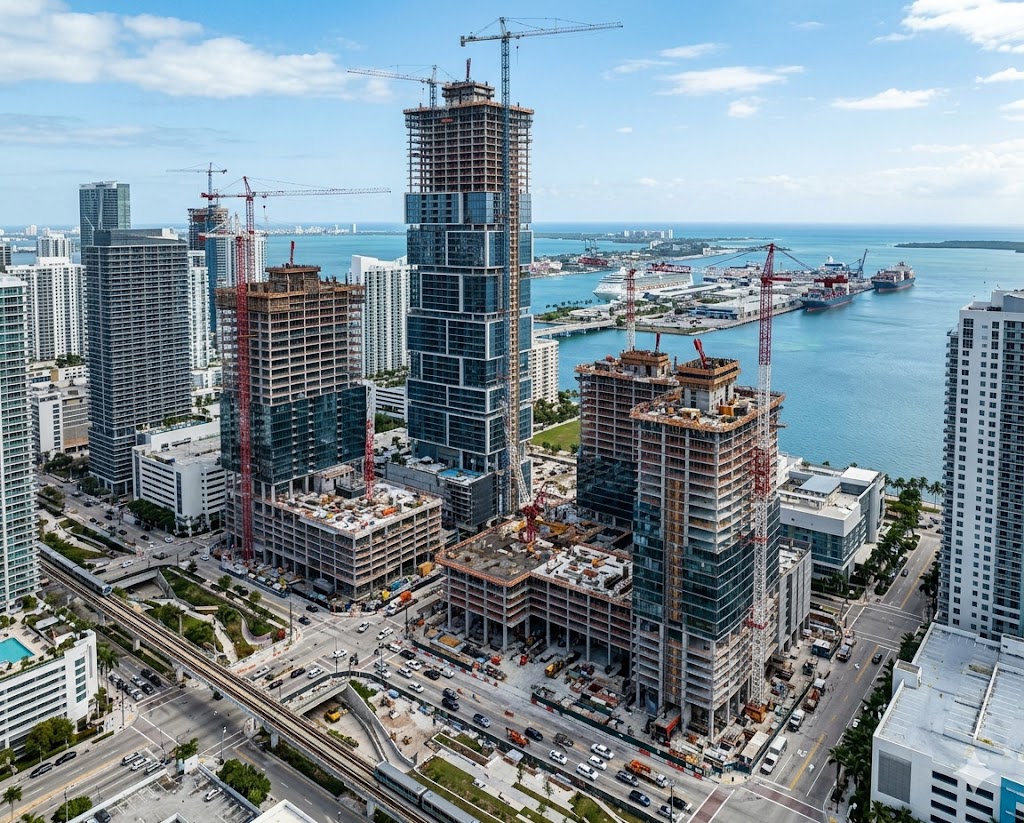
Not Miami specifically — the entire 100-mile coastal corridor running from Hallandale Beach to Jupiter is in the middle of a sustained construction surge that’s reshaping skylines, infrastructure, transportation, and the daily lives of nearly seven million residents. The numbers behind it are eye-watering:
- Andare Residences by Pininfarina rising 540 feet on Las Olas — the tallest residential building Broward County has ever built — backed by a $230 million construction loan from Related Group.
- Oasis Hallandale, a 10-acre, three-phase, $197 million mixed-use development with twin 25-story Arquitectonica-designed glass condo towers.
- Shorecrest West Palm Beach, Related Ross’s 27-story curvilinear waterfront condominium at 1901 North Flagler Drive.
- The $1+ billion Broward County Convention Center expansion, including 525,000 square feet of new meeting space, a landmark waterfront restaurant, and the 29-story, 800+ room Omni Fort Lauderdale Hotel rising next door.
- Broward County Rail (BCR) North, a planned 15.5-mile passenger rail line running along the Florida East Coast Railway corridor connecting Fort Lauderdale, Oakland Park, Pompano Beach, and Deerfield Beach — projected to deliver economic growth, raise property values, and ease traffic across one of America’s most congested coastal corridors.
- The Hollywood Arts Hub addition celebrating the Hollywood Art and Culture Center’s 50th anniversary, funded through Broward’s 2019 General Obligation Bond.
- The massive I-595 resurfacing and I-75 widening packages reshaping South Florida’s interstate backbone.
- Major A1A seawall and stormwater infrastructure projects in Hollywood designed to harden the coast against sea-level rise.
- Flats Flagler Gateway — a 12-story Class A multifamily project in Fort Lauderdale’s Flagler Village, supported by a $68.5 million construction loan.
- Hundreds of luxury home developments across Boca Bridges, Lotus Palm, The Bridges, Seven Bridges, Royal Palm Polo, Tuscany Delray, Casa Costa, Villamar, Capistara, and Aspen Glen in Boynton Beach, Boca Raton, and Delray Beach.
And that’s before we even count the dozens of Miami-Dade towers, the Brightline rail expansions, the PortMiami and Port Everglades upgrades, the Miami International Airport modernization, and the massive private development pipeline pouring through Wynwood, Brickell, Sunny Isles, Bal Harbour, and Miami Beach.
But here’s the question almost nobody outside the construction industry asks: how does any of this actually get built? What ensures that a $230 million tower in Las Olas doesn’t end up half-finished after the developer’s lender pulls funding? What protects taxpayers when Broward County signs a $50 million infrastructure contract? What keeps the small subcontractors in Pompano and Pembroke Pines from getting wiped out when a prime contractor goes bankrupt mid-project?
The answer — quietly, invisibly, indispensably — is construction bonds.
If South Florida is going to keep growing through the late 2020s and into the 2030s, the bonding industry is going to have to keep doing its largely unseen, largely unsung job. Let’s break down exactly how it works, why it matters, and what every South Florida developer, contractor, supplier, and resident should understand about the financial scaffolding holding this region’s growth together.
What Construction Bonds Actually Are
A construction bond — also known as a surety bond or contract bond — is a three-party financial guarantee that ensures a construction project will be completed according to its contract terms. The three parties involved are:
- The Principal — the contractor doing the work.
- The Obligee — the project owner requiring the bond. In South Florida, that might be the City of Fort Lauderdale, Broward County, Palm Beach County, the Florida Department of Transportation, the South Florida Water Management District, a school district, or a private developer or construction lender.
- The Surety — the bonding company that financially backs the contractor’s promise to perform.
If the contractor defaults — meaning they walk off the job, declare bankruptcy, do shoddy work, fail to pay subcontractors, or otherwise fail to deliver — the surety steps in. The surety either pays damages, hires a replacement contractor, finances the project to completion, or some combination of all three. Maximum exposure is capped by the bond amount, typically 100% of the contract price on Florida public works projects.
The simple takeaway: construction bonds are the reason a half-built South Florida tower doesn’t sit decaying for a decade like a tropical version of the abandoned skyscrapers you sometimes see in distressed cities. When a contractor on a bonded job fails, somebody finishes the project. Always.
The Four Bonds Driving South Florida Construction
Across the Tri-County region, four bond types power the construction economy:
- Bid Bonds. Submitted with the bid. Guarantees that the winning contractor will sign the contract on the bid terms and provide the required performance and payment bonds. Without bid bonds, contractors could lowball public bids, win the work, and then walk away when reality bites — chaos that South Florida’s high-stakes public works regime cannot tolerate.
- Performance Bonds. Guarantees the contractor will complete the project on time, on spec, and at the required quality level. If they fail, the surety either gets it done or pays the cost difference.
- Payment Bonds. Guarantees that subcontractors, laborers, and material suppliers get paid even if the prime contractor fails. This is the bond that protects the small, often family-owned South Florida subcontractor businesses doing the actual work on the region’s biggest jobs.
- Maintenance Bonds. Cover defects and warranty issues for one to two years post-completion. Critical on infrastructure projects where defects can take months to emerge.
Every one of those bond types is in active use right now on South Florida projects from Hallandale Beach to West Palm Beach.
Brian’s Take: South Florida’s Coastal Construction Risks Are Different — and Bonding Is How the Region Manages Them.
Building in South Florida means building against salt air, hurricane season, rising tides, sandy soils, and some of the toughest building codes in America — a risk profile no other major U.S. metro stacks together quite the same way. The reason South Florida’s biggest projects keep getting delivered despite that gauntlet is because the bonding industry has learned to underwrite for these specific challenges, and the contractors who survive their underwriting are the ones genuinely capable of building here.
— Brian
The Florida Legal Framework Powering South Florida’s Boom
South Florida’s $20+ billion construction pipeline doesn’t run on faith. It runs on a tightly defined legal framework that requires bonds on virtually every meaningful public project — and on most major private ones.
Section 255.05: Florida’s Little Miller Act
The cornerstone of Florida public works bonding is Section 255.05 of the Florida Statutes, commonly known as Florida’s Little Miller Act. It’s the state-level mirror of the Federal Miller Act (40 U.S.C. § 3131), which mandates bonding on federal contracts of $100,000 or more.
For state and local public projects across South Florida, Section 255.05 lays out:
- Public contracts of $100,000 or less may be exempt from bonding entirely.
- Contracts between $100,000 and $200,000 — the public agency may waive bonding at its discretion.
- Contracts of $200,000 or more — payment and performance bonds are required, generally in an amount equal to 100% of the contract price.
- Counties and municipalities can elect to waive bonding on contracts of $200,000 or less, though most major South Florida agencies require bonding regardless.
When you stack that against the reality that Broward County, Miami-Dade County, and Palm Beach County collectively run combined annual public construction budgets in the low tens of billions — across schools, libraries, parks, water and wastewater, transportation, public safety facilities, ports, airports, courthouses, and emergency operations — the practical implication is overwhelming. Virtually every meaningful public construction project in South Florida is bonded. There’s no other way.
Section 337.18: FDOT and Transportation Bonds
Florida transportation projects operate under their own bonding regime via Section 337.18 of the Florida Statutes:
- A surety bond is required of the successful bidder in an amount equal to the awarded contract price.
- FDOT may waive bonding for non-critical contracts of $250,000 or less.
- For mega-projects of $250 million or more, FDOT can use a hybrid model combining surety bonds with letters of credit, U.S. bonds and notes, parent company guarantees, or cash collateral.
South Florida sees a constant stream of FDOT-bonded work: the I-595 Resurfacing project, the I-75 widening package, the A1A seawall and stormwater infrastructure in Hollywood, the U.S. 441 / I-595 interchange improvements in Plantation, the North Fork New River canal improvements spanning Plantation, Fort Lauderdale, Lauderhill, and Davie, the upcoming Broward County Rail North corridor, and dozens of bridge, drainage, and intersection projects from Homestead to Jupiter. Every one of them required contractors to walk into a surety underwriter’s office, present comprehensive financials, and prove they could be trusted with public infrastructure dollars.
Chapter 713: Florida’s Construction Lien Law for Private Projects
Public projects aren’t the only bonded work. Chapter 713 of the Florida Statutes — Florida’s Construction Lien Law — also creates bonding tools for the private side of South Florida’s market:
- Section 713.23 lets private developers use a payment bond as an alternative to facing potential lien claims from subcontractors and suppliers.
- Section 713.245 authorizes “Conditional Payment Bonds” with specific protections.
For South Florida’s luxury developers — the teams behind Andare Residences on Las Olas, Shorecrest in West Palm Beach, Oasis Hallandale, the new oceanfront condominiums in Sunny Isles and Bal Harbour, the dozens of pre-construction towers in Hollywood, Pompano Beach, and Boca Raton — payment bonds are how owners keep clean title and keep construction lenders comfortable enough to fund the work.
How Bonds Translate South Florida’s Renderings Into Reality
Now let’s connect the legal framework to what’s literally happening across the region.
Bonds Pre-Qualify Every Major Contractor in the Tri-County Market
Before a surety company will issue a bond on a South Florida project, they conduct rigorous underwriting. CPA-prepared financial statements. Work-in-progress reports. Project history at the size and complexity of the new work. Banking relationships. Subcontractor depth. Personal indemnity from the contractor’s principals.
The surety effectively functions as a financial gatekeeper, screening out contractors who don’t have the experience, balance sheet, or operational depth to deliver. In a region where individual projects routinely exceed $100 million and where the unique challenges of building on coastal Florida soil — with sea-level rise concerns, hurricane wind loads, and salt-air corrosion considerations — demand specialized expertise, this gatekeeping is essential. The reason South Florida’s massive projects keep delivering at world-class quality is that the bonding industry quietly raised the bar for who’s allowed to build them.
Bonds Protect Public Funds Across South Florida
When Broward County issues bonds and contracts to build a $1+ billion Convention Center expansion, when Palm Beach County funds a new public school, when the South Florida Water Management District contracts a flood control project, when Miami-Dade builds a new police facility, when the Florida Department of Transportation widens a major interstate — construction bonds are how those public dollars don’t get vaporized. If the contractor fails, the surety pays. Not the taxpayer.
Across the United States, surety companies have collectively paid billions of dollars over the decades on bonded projects where contractors failed. Without bonding, every one of those losses would have hit project owners — and ultimately taxpayers — directly. In a high-volume building region like South Florida, where so much infrastructure is currently being modernized to handle population growth, climate resilience, and tourism demand simultaneously, the insurance value of the bonding system is enormous and almost completely invisible to the average resident.
About the Author