The Perpetual Pessimism Industry
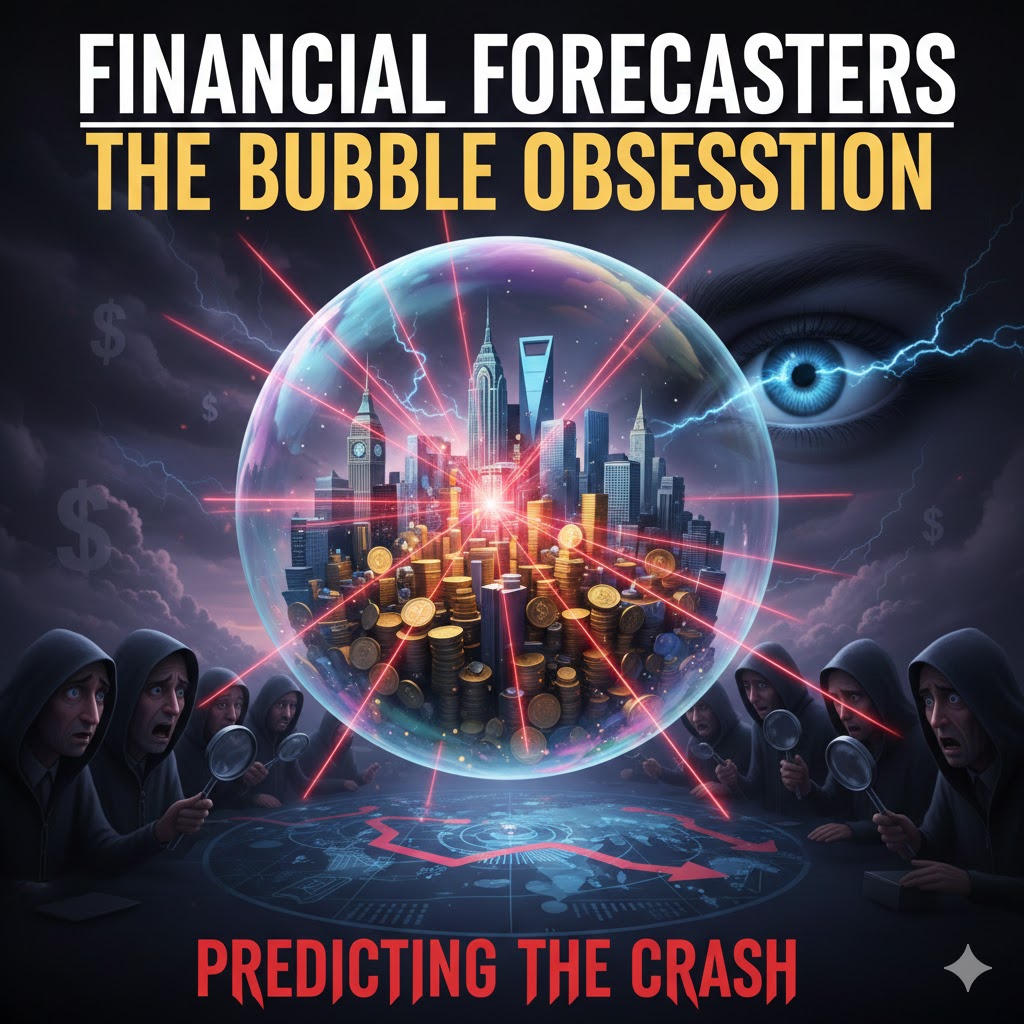
Financial media has cultivated a peculiar breed of expert: the professional catastrophist. These individuals have built entire careers on predicting the next great collapse, the imminent bubble burst, the inevitable reckoning. Turn on any financial news channel, scroll through investment newsletters, or browse economic commentary, and you’ll find them—analysts warning that this time, finally, the music will stop and everyone will be left without a chair.
The business model is ingenious in its simplicity. Predict doom constantly, and eventually you’ll be right. When that moment arrives, trumpet your prescience from every available platform. When you’re wrong—which is most of the time—simply move the goalposts, claim the collapse is merely delayed, or quietly shift focus to the next predicted disaster. Accountability is conveniently absent in a world where today’s failed prediction is forgotten in tomorrow’s news cycle.
The Dismal Track Record of Disaster Forecasters
If we judged meteorologists by the standards we apply to financial forecasters, weather prediction would have been abandoned as pseudoscience decades ago. Yet somehow, economists and market analysts who consistently fail to predict actual downturns—while falsely predicting dozens of phantom crashes—maintain their credibility and platform.
The data is damning. Research has shown that professional forecasters fail to predict recessions with any reliability. A study of economic predictions found that experts failed to anticipate 148 of the 150 recessions that occurred worldwide between 1992 and 2014. Even one year before these recessions began, forecasters saw them coming in fewer than one-fifth of cases.
The problem intensifies with those who specialize in bubble predictions. Mark Twain supposedly said he’d been through terrible things in his life, some of which actually happened. Market pessimists live this reality in reverse—they’ve predicted terrible crashes that never materialized, yet somehow remain convinced the next one is imminent.
Peter Schiff predicted in 2008 that the dollar would collapse and gold would soar to $5,000 per ounce. Neither happened. Nouriel Roubini, after correctly predicting the 2008 crisis, spent the following decade predicting imminent crashes that didn’t occur. Marc Faber has been predicting market collapses since the 1980s. Nassim Taleb has warned of impending disaster so frequently that his predictions have become background noise.
More Florida Business News Articles:
• Explosive Growth: Residual Market Policies Soar Twofold in Five Years Driven by Weather Shifts
• Trump’s Florida Truth Social Corporation Goes Public
• West Palm Beach Metabolic Assessment with Senolytix
• Supreme Court Showdown: Oklahoma Battles Its Highest Criminal Court in True Crime Drama
• Press Releases for Your Florida-Based Business
Innovation’s Constant Companion: Fear
History reveals a striking pattern. Every significant technological advancement has been accompanied by predictions of economic catastrophe. The phenomenon isn’t limited to financial markets—it extends to social commentary, political discourse, and academic analysis. Progress, it seems, makes people deeply uncomfortable.
When electricity began entering homes, experts warned of devastating fires and moral decay. The telephone would destroy personal privacy and face-to-face communication. Motion pictures would corrupt youth and undermine traditional values. Radio would make people lazy and disconnected from reality. Each medium that followed—television, video games, the internet, smartphones—faced similar condemnations.
In financial terms, each industrial revolution triggered warnings of unsustainable speculation. The canal boom of the 1790s ended in crisis, leading experts to warn against the railroad boom of the 1840s. When railroads proved transformative, skeptics declared the automobile industry a dangerous bubble. Electric utilities, aviation, radio broadcasting, plastics, semiconductors—each sector faced predictions of collapse as they emerged.
The dot-com era provides the most recent and frequently cited example. Yes, many internet companies with absurd valuations and no business model failed spectacularly. But the skeptics who declared the entire internet revolution a bubble were catastrophically wrong. Amazon survived. So did eBay. Google was founded during the bust and became one of history’s most valuable companies. The internet didn’t disappear; it became the fundamental infrastructure of modern economic life.
Fl News and Business Info:
• My Favorite Sound in the World
• Lakeland’s Hero: 1-Tom-Plumber Offers 24/7 Emergency Plumbing Rescue
• John To Go Expands Portable Restroom Service in Florida
• Hurricane Milton and Helene Home Insurance Dispute Law Firm
• Can news website links help increase Google search rankings?
Why Artificial Intelligence Isn’t Following the Bubble Playbook
The current wave of skepticism targeting artificial intelligence follows a predictable script. High valuations? Check. Massive capital investment? Check. Widespread hype? Check. Therefore, the reasoning goes, we must be in a bubble destined to pop. But this analysis is superficial and ignores critical distinctions.
Revenue Reality, Not Vaporware
Unlike previous bubbles where companies had business plans but no business, AI is generating actual revenue and cost savings today. Microsoft reported that GitHub Copilot, its AI coding assistant, was being used by over 1.8 million paid subscribers as of early 2024. That’s not speculation—it’s measurable commercial adoption. Companies using AI for customer service are reporting 30-50% reductions in response times and handling costs. Drug discovery processes that once took years are being compressed into months using AI-assisted research.
The pharmaceutical industry provides particularly compelling evidence. AI has already discovered new antibiotic compounds, identified drug candidates for diseases like ALS, and optimized clinical trial designs. Insilico Medicine used AI to identify a drug candidate for idiopathic pulmonary fibrosis in under 18 months, a process that traditionally takes four to five years. This isn’t a promise of future value—it’s documented progress with measurable outcomes.
The Infrastructure Remains Valuable Regardless
Even if specific AI companies fail or valuations correct, the physical and intellectual infrastructure being created has enduring utility. NVIDIA’s GPUs, Microsoft’s data centers, and Google’s tensor processing units will continue serving computational needs across countless applications. The parallel to historical infrastructure buildouts is instructive but more robust than critics acknowledge.
When the British railway mania collapsed in the 1840s, it left behind a comprehensive rail network that powered industrial expansion for a century. The fiber optic cables laid during the dot-com boom—often cited as wasteful overinvestment—became the backbone for streaming video, cloud computing, and mobile internet, enabling trillions of dollars in economic value. Today’s AI infrastructure will similarly enable future innovations we haven’t yet imagined.
Exponential Adoption Signals Genuine Utility
Bubble technologies typically see slow, speculative adoption followed by crashes before real use cases emerge. AI is experiencing the opposite trajectory. Within two months of launch, ChatGPT had 100 million users—the fastest consumer technology adoption in history. Instagram took 2.5 years to reach that milestone. Facebook took 4.5 years. The iPhone took two years.
More significantly, enterprise adoption is accelerating. A 2024 survey found that 65% of organizations were regularly using generative AI, nearly double the previous year’s figure. This isn’t experimental dabbling—companies are integrating AI into core business processes. Legal firms are using it for document review, manufacturers for quality control, retailers for inventory optimization, and financial institutions for fraud detection.
Cross-Sector Integration Creates Resilience
Historical bubbles typically concentrated in narrow sectors. The tulip mania involved flowers. The South Sea Bubble centered on a single trading company. The dot-com crash primarily affected internet and technology stocks. Even the housing bubble, while devastating, was fundamentally about real estate and related financial instruments.
AI is fundamentally different. It’s a general-purpose technology being deployed across virtually every industry simultaneously. Healthcare institutions are using AI for diagnostic imaging. Agricultural companies are optimizing crop yields. Energy firms are improving grid efficiency. Educational institutions are personalizing learning. Entertainment companies are creating content. This diversification means that even if AI disappoints in some applications, success in others can sustain the underlying technology’s value proposition.
Financial Fundamentals Differ From Historical Bubbles
The companies leading AI development aren’t speculative startups surviving on venture capital fumes. Microsoft, with its $3 trillion market capitalization, generated $211 billion in revenue and $88 billion in operating income in 2023. Google’s parent company Alphabet produced $307 billion in revenue with $84 billion in operating income. These companies can afford to invest tens of billions in AI research while maintaining profitability.
Contrast this with the dot-com era, when companies like Pets.com, Webvan, and eToys burned through hundreds of millions without viable paths to profitability. Or the 2008 housing bubble, built on subprime mortgages issued to borrowers with no ability to repay. The financial foundation supporting AI development is fundamentally sound.
The Cost of Crying Wolf
Perhaps the most insidious effect of perpetual pessimism is the opportunity cost it creates. When every innovation is declared a bubble, when every market advance is pronounced unsustainable, rational actors might logically conclude they should avoid participating. This instinct, while seemingly prudent, has proven financially catastrophic for those who heeded it.
Investors who listened to bubble warnings and avoided tech stocks in 2010 missed over a decade of extraordinary returns. Those who followed advice to avoid “overvalued” markets after 2013 sat in cash while the S&P 500 more than doubled. The cautious souls who believed cryptocurrency was a total scam missed opportunities for substantial gains, regardless of ongoing volatility.
More damaging than individual investment decisions is the broader chilling effect on innovation funding. If every new technology is presumed to be a bubble, capital becomes scarce for genuinely transformative ventures. Risk-averse decision-making by investors, corporate leaders, and policymakers can create a self-fulfilling prophecy where innovation slows not because technologies lack promise, but because fear of bubble accusations restricts necessary investment.
Distinguishing Skepticism From Cynicism
None of this argues for blind optimism or uncritical acceptance of every new technology. Markets do become overheated. Valuations do sometimes disconnect from fundamentals. Corrections are inevitable and healthy. Some AI applications will fail. Some companies will disappoint. Certain use cases will prove less valuable than anticipated.
The distinction lies between thoughtful skepticism and reflexive pessimism. Skepticism asks critical questions: What problem does this solve? Who’s willing to pay for it? How sustainable are current margins? What competitive advantages exist? These are valuable inquiries that separate sustainable businesses from speculative excess.
Cynicism, by contrast, begins with the conclusion that anything new must be a bubble and works backward to justify that position. It cherry-picks historical examples while ignoring successes. It emphasizes risks while dismissing tangible evidence of value creation. It mistakes past patterns for immutable laws.
The Enduring Power of Human Progress
Ultimately, the consistent failure of bubble predictors reflects a deeper truth about human civilization. We are, despite setbacks and occasional excess, remarkably good at creating value through innovation. Technologies that genuinely improve productivity, enhance capabilities, or solve important problems tend to succeed over time, even when their development involves speculation and market volatility.
The printing press disrupted scribes. The mechanical loom threatened textile workers. The automobile displaced horse-related industries. Each innovation faced resistance, sparked fear, and triggered predictions of disaster. Each ultimately created far more value and opportunity than it destroyed.
Artificial intelligence sits firmly in this lineage. It represents not a speculative mania but the next phase of a centuries-long project: using tools to amplify human capability. The specific trajectory is uncertain—which companies will lead, which applications will prove most valuable, how quickly adoption will occur. But the fundamental direction is clear.
The professional pessimists will continue their warnings. They’ll point to every stumble as validation and dismiss every success as temporary. They’ll be wrong far more often than they’re right, just as they’ve always been. And when the next transformative technology emerges, they’ll dust off their bubble playbook and start again.
The rest of us would do well to ignore them. Not because we should be recklessly optimistic, but because their track record has earned them irrelevance. Innovation isn’t always smooth, markets aren’t always rational, but betting against human ingenuity has been a losing proposition for as long as markets have existed. That’s unlikely to change now.
About the Author