Your Brain Is Lying to You About Risk How negativity bias is quietly killing your best ideas — and what South Florida business owners should do about it
Picture this: You’re sitting at your desk on a Tuesday evening, and an idea surfaces. Maybe it’s a new service offering you’ve been turning over for months. Maybe it’s a completely different market you could reach with what you already do well. For a moment, it feels exciting — the kind of clarity that doesn’t come often. Then, almost immediately, the mental prosecution begins. The market probably isn’t ready. You don’t have the bandwidth. Someone has likely tried it already. What if your existing clients notice you’re distracted? What if you invest real time and it goes nowhere? Within ten minutes, the idea is back in the drawer, and you’ve returned to whatever was on your screen before.
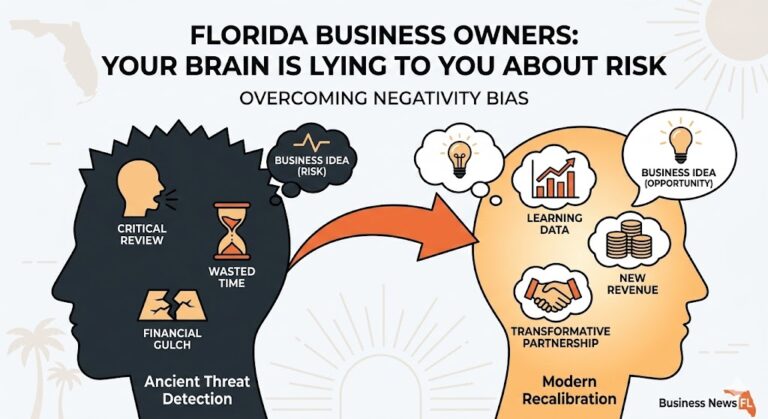
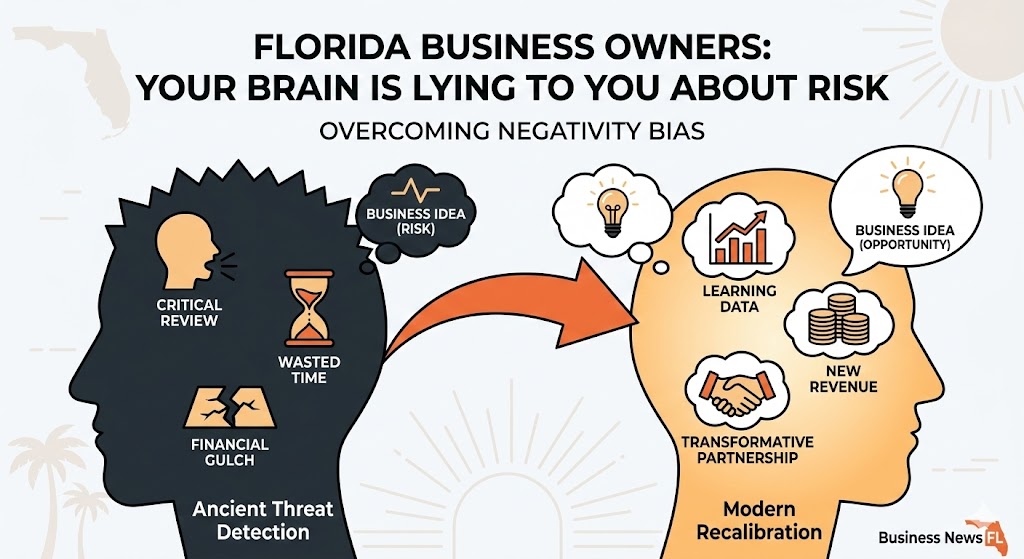
Here’s what’s worth understanding about that sequence of events: the voice that killed your idea wasn’t reason. It wasn’t experience. It wasn’t even genuine caution. It was a neurological inheritance from ancestors who lived in a world where a bad decision could end your life before sundown. That mechanism kept the human species alive for hundreds of thousands of years. Today, in the context of a business idea that costs almost nothing to test, it is working directly against you.
For South Florida’s business owners — operating in one of the most internationally connected, culturally dynamic, and fast-moving economies in the Western Hemisphere — this ancient wiring carries a modern price tag that most people never stop to calculate.
Wired for Danger: Where Negativity Bias Comes From
Negativity bias is among the most thoroughly documented phenomena in psychological research. The core finding is consistent across decades of study: the human brain assigns significantly more weight to negative experiences, outcomes, and information than to positive ones of equivalent magnitude. Negative events are processed more deeply, remembered more vividly, and felt with roughly twice the emotional intensity of comparably scaled positive events.
This is not a personality trait or a sign of pessimism. It is structural — wired into the architecture of how human brains evolved to process the world. And the reason it exists is straightforward: for the vast majority of human history, the cost of missing a threat was catastrophically higher than the cost of overreacting to one.
Consider the environment our ancestors navigated daily. A sound in the underbrush might be nothing. Or it might be a predator. If you assumed it was nothing and you were wrong, the outcome was fatal and final. If you assumed it was a threat and you were wrong, you wasted a burst of adrenaline and ran for nothing. In a world structured by that asymmetry, the brains that survived were the ones that erred dramatically on the side of threat detection — that treated ambiguous signals as danger, that scanned for what could go wrong before cataloguing what could go right, that weighted negative possibilities far above their statistical likelihood because the downside of being wrong was simply too severe.
Those are the brains that got passed down. Those are the brains we’re all running on today.
The legacy shows up everywhere once you start looking for it. It’s why a single critical comment in a performance review can overshadow fifteen positive ones. It’s why potential losses motivate behavior more powerfully than equivalent potential gains — a well-established principle in behavioral economics known as loss aversion. It’s why a business owner can close a strong quarter and spend the following week mentally replaying the one difficult client conversation rather than the ten wins. The brain is doing exactly what it was designed to do. The problem is that the design spec is roughly 200,000 years out of date.
The Modern Mismatch: Threat Detection Without the Threats
The trouble isn’t that negativity bias exists. The trouble is that the human brain has no automatic mechanism for recalibrating it to the actual stakes of the situation at hand. The same neurological hardware that once protected our ancestors from genuine mortal danger now activates with nearly identical intensity when you consider cold-emailing a prospect, testing a new pricing structure, or sharing a half-formed idea with a trusted colleague over cafecito in Wynwood.
When you sit down to honestly evaluate a new business idea — to weigh the genuine pros against the genuine cons — your negativity bias doesn’t function as a neutral risk filter. It functions as a prosecutor with a predetermined verdict. It makes bad outcomes feel vivid, textured, and near. It makes good outcomes feel abstract and distant. It disproportionately inflates the apparent probability of low-likelihood negative scenarios while compressing your intuitive sense of how likely success actually is.
Think about how this plays out in practice. A Coral Gables entrepreneur considers launching a complementary service line. The upside is concrete — additional revenue, deeper client relationships, insight into an adjacent market, a competitive differentiator in a crowded landscape. But the negativity bias immediately populates the risk column with scenarios that feel urgent and plausible: What if execution gets messy and existing clients notice a dip in attention? What if the new offer gets mixed reception and muddies the brand? What if a larger competitor spots the opening and moves faster? These concerns, even if they carry a realistic probability of 5 to 10 percent, receive something closer to 70 or 80 percent of the mental energy in the evaluation. The pro and con list looks balanced on paper. In practice, the cons have been written in a much larger font.
The analysis feels like careful thinking. It is actually pattern-matched threat response dressed up in the language of strategy.
More Interesting Articles for South Fl Business:
• Why Florida Businesses Should Avoid Pricing Services on a Per-Hour Basis
• Florida Google Pay Per Click FAQ’s
• The Boy Who Cried Crash: Why Market Prophets Keep Getting It Wrong
• Florida’s leaders in Public Relations, Law and Construction Education
• Florida Specialty Contractors Dynamic Construction Landscape
Not All Downside Is Equal: The Immaterial Risk Problem
Here is where the gap between our evolved wiring and our actual circumstances becomes most consequential: in a remarkable number of idea-stage business decisions, the real downside of moving forward is genuinely, objectively immaterial.
Strip away the emotional weight for a moment and ask concretely: what does it actually cost to test a new service concept with a small group of existing clients? What is the true exposure of sending a thoughtful outreach message to a potential strategic partner you met at a Brickell networking event? What does it cost to build a simple one-page offer, share it with five people whose judgment you trust, and see what comes back? In the vast majority of cases, you’re talking about a few hours of focused time, perhaps a modest amount of money for a basic experiment, and a small quantity of professional goodwill. If the test doesn’t pan out, you gather information and redirect. There is no bankruptcy filing. There is no permanent damage to your professional reputation. There is no material loss you wouldn’t recover from quickly.
What there is — and what the brain consistently refuses to categorize correctly — is emotional risk. The fear of looking foolish to people whose opinions you respect. The discomfort of being uncertain about an outcome you’ve committed to pursuing. The particular sting that comes from trying something publicly that doesn’t work.
But here is the distinction that changes everything: emotional risk and material risk are not the same thing. Negativity bias collapses them into a single category and processes both with the same alarm intensity. The business owner in Doral who is afraid her new offer might get a lukewarm reception is not facing the same threat as the hunter who misread the sound in the underbrush. The stakes are incomparably lower. The consequences of being wrong are temporary, recoverable, and ultimately instructive. The brain, without deliberate intervention, will not make this distinction on your behalf. It is your job to make it consciously.
Before dismissing any idea on the grounds that it feels risky, ask one question as specifically as you can: if this fails, is the outcome actually material? If the answer is no, you’ve identified something important — you are not weighing risk. You are managing an emotion. And emotions, unlike financial ruin, are something you can work through.
The Idea Economy: Why South Florida’s Moment Makes Asymmetric Upside Even More Powerful
South Florida’s economy has undergone a transformation over the past decade that is still not fully appreciated by the people living and working inside it. The region that the rest of the country long associated with beaches, nightlife, and retirement communities has quietly become one of the most consequential business addresses in the Americas.
Miami is now a serious global financial hub, with a concentration of private equity, venture capital, family offices, and international banking that rivals cities three times its size. Brickell’s skyline tells one part of the story. The flood of firms relocating from New York, Chicago, and San Francisco tells another. Beyond finance, the region has developed genuine depth in technology, healthcare, logistics, real estate innovation, and the creative industries. The Port of Miami and Port Everglades together make South Florida one of the busiest trade corridors in the hemisphere. And the region’s unique position as a gateway between North America, Latin America, and Europe gives South Florida entrepreneurs access to a breadth of markets that businesses in almost any other American city simply do not have.
All of this matters for how you should think about risk, because the economics of idea-based risk-taking in this environment are exceptionally favorable.
When a capital-intensive business fails — a restaurant, a manufacturing operation, a retail buildout — the owner absorbs a real and specific financial loss. The risk is symmetric: money went in, and less came back. Negativity bias, in that context, is flagging something legitimate. But when a South Florida business owner tests a new consulting framework, explores a technology-enabled service offering, pitches a bilingual marketing concept to a Latin American client base, or builds out a digital product for an underserved regional niche — the risk structure looks completely different. The downside is bounded and recoverable. The upside, however, can be genuinely transformative and, given the market access available here, potentially scalable across multiple countries and cultures.
That asymmetry is the key insight. When downside is capped and upside is unbounded, the rational move is to increase your volume of attempts. Pursue as many serious, well-considered idea-stage experiments as you can intelligently manage. If ten experiments yield two meaningful wins, the math is strongly in your favor. If twenty yield four wins and one breakthrough, the math is extraordinary. The idea that you should sit on a potentially high-value concept until the conditions feel ideal is a strategy that sounds prudent and produces compounding underperformance. Every untested idea is an option you let expire — and in a market moving as fast as South Florida’s right now, expired options don’t come back around.
A Framework for Taking More Idea Risk — Without Being Reckless
None of this is an argument for abandoning judgment. It is an argument for developing a more calibrated and honest assessment process — one that accounts for the systematic bias your brain brings to evaluation and deliberately corrects for it.
Separate material from immaterial risk. When an idea surfaces, resist the urge to immediately start evaluating it. First, spend two minutes honestly answering one question: what does the realistic worst case actually look like, in specific and concrete terms? Not the catastrophic worst case your negativity bias will volunteer immediately, but the likely worst case. If the answer centers on emotional discomfort — embarrassment, awkwardness, the mild frustration of a failed experiment — name it clearly as an emotional risk, not a financial one. That single act of categorization will change how you proceed.
Audit your probability estimates before trusting them. Negativity bias doesn’t just amplify the intensity of bad outcomes — it inflates their perceived likelihood. If a scenario you’re worried about has a realistic probability of 5 percent, but you’re allocating 40 percent of your decision-making energy to it, your assessment is distorted. Force yourself to assign rough probabilities to the scenarios in your analysis and examine whether the weight you’re giving them actually corresponds to how likely they are to occur.
Build a live idea pipeline and keep it moving. Instead of treating each idea as a high-stakes individual bet that must clear a significant internal threshold before you act, treat your pipeline as a portfolio of small, fast, low-cost experiments running continuously. South Florida’s density of networking events, industry conferences, startup communities, and cross-cultural business relationships gives you unusual access to fast, informal feedback. Use it. The goal is not to find the one perfect idea and execute it flawlessly. The goal is to run enough experiments that the wins, which will come, have a chance to surface.
Reframe explicitly what a failed experiment means. In an idea-driven economy, a well-designed experiment that doesn’t produce the hoped-for result is not a failure — it is paid tuition toward a better understanding of your market. The business owners who build the most durable advantages are not the ones who avoid failure most skillfully. They are the ones who cycle through small, inexpensive failures most efficiently, extract the signal from each one, and apply it forward. Ask any of the founders who built something meaningful in Miami or Fort Lauderdale in the last ten years and you will hear some version of this story.
The Opportunity Cost No One Calculates
There is a cost to excessive caution that never appears on a profit and loss statement and rarely gets discussed in the same breath as financial risk. It is the compound cost of the ideas you didn’t pursue, the markets you didn’t enter, the offers you never made, the partnerships you never initiated, the experiments you shelved before they had a chance to teach you something.
This invisible ledger accumulates quietly. A year passes and your business is doing reasonably well — revenue is stable, clients are satisfied, operations are under control. But it is also, in some essential way, exactly the same business it was twelve months ago. The ceiling hasn’t moved. The options haven’t expanded. And somewhere in a mental drawer is a collection of ideas that never got a fair trial because your brain presented the emotional discomfort of attempting them as though it were something far more dangerous than it actually was.
South Florida right now is not a market that rewards waiting. It is a market that rewards movement. The talent relocating here is hungry. The capital flowing into this region is looking for places to land. The Latin American and Caribbean client base accessible from here represents an enormous and underleveraged opportunity for businesses willing to build toward it. The entrepreneurs who position themselves to take advantage of this moment are not going to be the ones who waited until the risk felt fully manageable — because in a market moving this fast, that moment never arrives.
They are going to be the ones who understood clearly what was and wasn’t actually at stake. Who learned to tell the difference between a real threat and an evolutionary alarm that no longer matches the environment it’s firing in. Who built the habit of moving quickly on small experiments, failing cheaply when necessary, and compounding the wins over time.
Your negativity bias is not going away. It is too deeply embedded to be switched off by an act of will. But it can be worked with consciously — named, examined, and deliberately corrected for. When you do that work, when you ask honestly whether the risk is material or emotional, when you stop trusting inflated probability estimates, when you build the habit of relentless low-cost experimentation, you will find that the ideas you’ve been protecting yourself from were never as dangerous as they felt.
Most of the time, the idea sitting in your notebook costs almost nothing to test. The risk isn’t financial. It’s emotional. And in South Florida’s market, right now, that is a risk very much worth taking.
About the Author