The South Florida luxury market in 2026 looks different than it did during the pandemic-era surge — calmer, more selective, more analytical — but the fundamentals that made the region a global wealth destination haven’t softened. If anything, they’ve deepened. The tri-county “golden triangle” of Miami-Dade, Broward, and Palm Beach is now the deepest million-dollar housing marketplace in the country, with more million-dollar listings than New York City for the first time in at least a decade. Trophy sales above $10 million are running near record pace. Cash buyers continue to dominate the top tiers.
What’s changed is the posture of the buyer. The frenzy is gone. In its place is something more durable: discipline, scarcity-awareness, and a market that rewards specificity over speed.
The Headline Numbers
A few data points frame where the market sits in early 2026:
- 2025 closed with 361 residential sales above $10 million across the tri-county region — the second-highest total in South Florida’s history, behind only the 2021 record.
- Q1 2026 luxury transaction volume jumped sharply across all three counties, according to The Keyes Company / Illustrated Properties luxury report. Miami-Dade luxury single-family transactions rose 19.6% year-over-year; Palm Beach County jumped 21.1%; Broward County rose 8.9%.
- Average tri-county luxury single-family prices rose 3.3% year-over-year to $2.57 million.
- The Miami-Fort Lauderdale-West Palm Beach metro is now #1 in the U.S. for million-dollar homes for sale, overtaking New York in late 2025.
- Luxury listings (top 10%) sit at 4.9× the local median price — a sharper luxury-to-mainstream gap than the national pattern.
- Median days on market for luxury listings: 93 days, reflecting a more deliberate pace at the top end.
- Mortgage rates near 6.38% as of late March 2026, with Miami Realtors projecting movement toward the high-5% range by year-end.
The composite picture: high volume, healthy pricing, longer marketing windows, and a buyer pool willing to wait for the right asset.
The Three Counties Behave Differently
National coverage tends to blur South Florida into a single market. In practice, Miami-Dade, Broward, and Palm Beach are running on different fundamentals.
Miami-Dade: The International Condo-Forward Market
Miami carries the luxury condo segment for the region. Average luxury single-family price held essentially flat year-over-year at $3.17 million, while luxury condo transactions surged 15.9% to 504 closings in Q1 2026, with average prices rising 3.4% to $2.92 million.
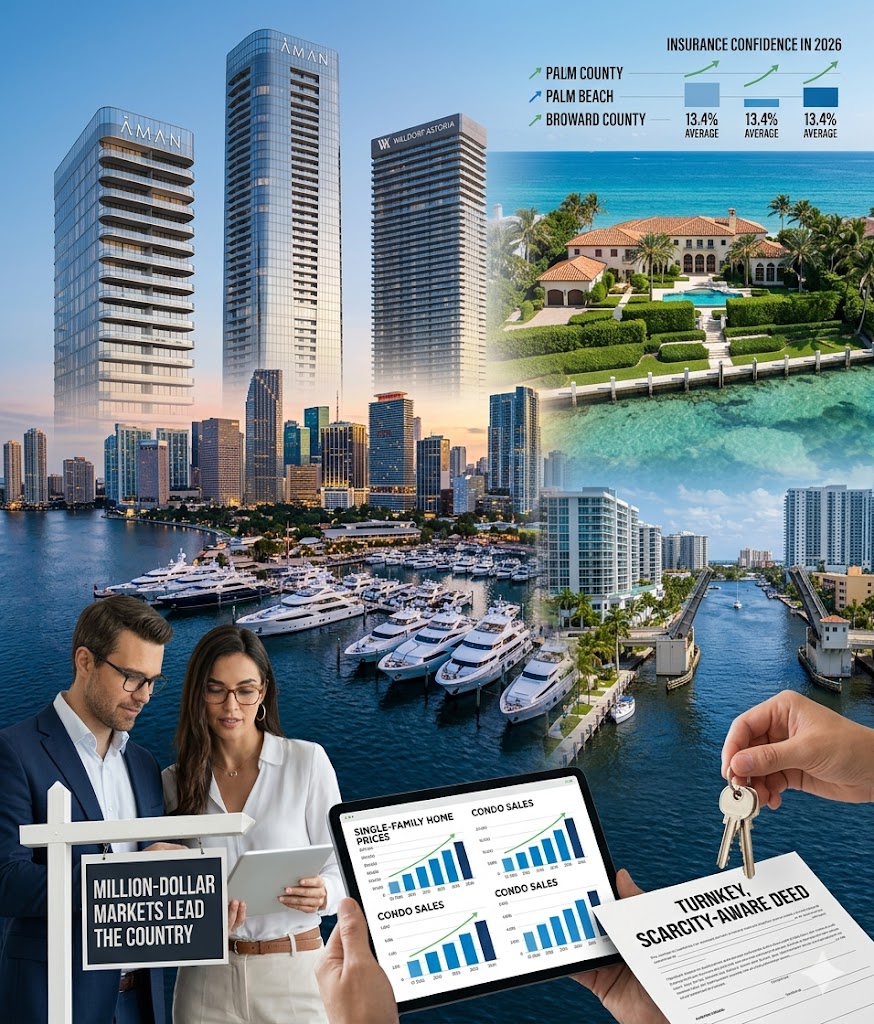
The Miami story in 2026 is increasingly about branded residences and ultra-luxury new construction. The Surf Club’s Seaway North project at 9165 Collins Avenue — just 10 units, average sale price of $38.6 million — was approaching a $400 million sellout in early May 2026. Branded residences from Waldorf Astoria, Aman, Mr. C, and similar global hospitality names continue to redefine the top end of the market, with five-star service models, private wellness clubs, and concierge healthcare programming becoming standard expectations rather than differentiators.
Miami’s mid-tier condo market is a different story. Inventory has built up, particularly in older buildings, and Florida’s updated condominium law — driven by the Surfside collapse aftermath — has created warrantability and reserve-adequacy issues that complicate financing for buildings without proper structural reserves. For ultra-luxury new construction, this hasn’t been an issue. For older, value-tier condos, it remains a meaningful drag.
Brickell, South of Fifth, Coconut Grove, and Bal Harbour continue to lead the borough’s hot-spot list.
Palm Beach County: Scarcity, Cash, and Legacy Wealth
If Miami sells on global cosmopolitanism, Palm Beach sells on scarcity. The county led South Florida’s overall sales activity in March 2026 with single-family sales up 14.3% and condo sales up 11.2% year-over-year — outpacing both Miami-Dade and Broward.
Palm Beach Island itself remains a category of its own, governed by stringent town-level zoning, planning, and development controls. Buyers experience this as preservation of character; the actual mechanism is policy-enforced scarcity. Add the Palm Beach social calendar, legacy wealth, and trophy properties that increasingly behave like heirloom assets rather than transactable commodities, and you get a market driven by liquidity and conviction more than leverage.
Palm Beach County’s luxury single-family average rose 5.1% year-over-year to $2.84 million in Q1 2026, with 2,028 transactions — a 21.1% jump. Cash transactions remain unusually concentrated at the top end, and West Palm Beach luxury home prices have risen approximately 187% from 2015 to 2025, the fastest decade-long appreciation among major U.S. markets per Redfin data. New developments like Mr. C Residences West Palm Beach signal that lifestyle-branded condo living is moving from periphery to core in the county.
Boca Raton, in particular, continues to draw families and retirees — beneficiaries of Northeast wealth migration — into established gated communities.
Broward: The Quiet Outperformer
Broward is the smallest of the three luxury markets but is having a credible 2026. Luxury single-family sales rose 8.9% year-over-year, with average prices up 8.6% to $2.3 million. The luxury condo segment surged 18.6% in transactions, with average prices rising 15.5% to $1.99 million.
Fort Lauderdale’s waterfront, Las Olas, Lighthouse Point, and Pompano Beach are the names that come up most. Pompano in particular has emerged as one of the rare South Florida coastal areas where new oceanfront development is happening at price points below Miami Beach or Palm Beach norms — drawing value-conscious buyers who are priced out of the more established luxury enclaves.
What’s Driving Demand
Several structural forces continue to underwrite the South Florida luxury thesis in 2026:
Tax migration. Florida has no state income tax. With the November 2025 election of a New York City mayor running on income tax surcharges for high earners, brokers across South Florida have reported renewed inquiry volumes from Manhattan, Brooklyn, and Westchester. California, Illinois, and New Jersey continue to send affluent buyers as well.
Corporate relocations. The Miami-Fort Lauderdale-West Palm Beach mega-region ranked #2 nationally in CBRE’s 2026 Corporate HQ Relocation Momentum rankings. Florida ranked #1 for economic performance in the 2026 Rich States, Poor States report. The financial services migration that began with Citadel’s move to Miami has continued to broaden.
Population growth. Florida is projected to add approximately 838 new residents per day through 2030, or roughly 305,000 per year — a demographic tailwind unmatched by most other U.S. luxury markets.
International buyers. International participation remains structurally important, especially for new development. Latin American capital — particularly from Brazil, Argentina, Mexico, and Colombia — continues to gravitate toward Miami. European and Canadian buyers are increasingly active across Palm Beach and the Treasure Coast.
Limited waterfront supply. The supply constraint at the very top end is real and physical. Trophy waterfront parcels are not being created.
The Insurance Picture: Genuinely Better in 2026
For the first time in several years, Florida’s homeowners insurance market is providing tailwinds rather than headwinds at the luxury level. According to industry reporting, 17 new homeowners insurers entered the Florida market, and 83 rate-decrease filings were expected to take effect in January 2026, with average reductions around 13.4% across Miami-Dade, Broward, and Palm Beach.
This doesn’t eliminate underwriting complexity — waterfront estates, older buildings, and properties with hurricane-exposure profiles still face challenging quotes — but it does materially improve confidence at the margin. Buyers who could not get satisfactory coverage at any price in 2023–2024 are now finding policies, and ownership cost models that were uncertain are becoming more legible.
For buyers, the practical implication: insurance strategy is now part of the luxury purchase. Title clarity, sea-wall and structural diligence on waterfront properties, and insurance-aligned underwriting all matter as much as the view.
Learn more about Boca Raton Real Estate Developer Marc Elkman:
Marc Elkman Empire Development
Marc Elkman Florida Press Release
Trophy Buyer Behavior in 2026
Several behaviors stand out among the buyers driving the top end of the market this year:
- Negotiation has returned to the conversation. A widely reported Palm Beach waterfront mansion closed at just over $66 million after a meaningful price cut. The point isn’t the specific deal — it’s that price discovery has returned to ultra-luxury, and a willingness to negotiate is no longer a signal of distress.
- Premiums are paid for certainty. Fully turnkey homes, well-managed buildings with predictable assessments, and protected view corridors command sharper premiums than they did during the surge years.
- Price per square foot has cooled. Miami’s luxury condo PPSF in Q3 2025 landed near $995 — up 2.7% year-over-year, but down meaningfully from Q2 2025’s $1,078. Buyers are scrutinizing finish quality, layout efficiency, and operating costs more rigorously than they did 24 months ago.
- Days on market have lengthened. Median time-to-sell at the top tier sits around 93 days. Sellers pricing above the realistic band are choosing a longer marketing runway, not necessarily mispricing the asset.
- Tax planning is now part of the timing. Federal estate and gift tax exemption levels are scheduled to step down after 2025 as the 2017 tax law provisions sunset. Florida’s homestead and Save Our Homes cap (limiting annual assessment increases on homesteaded property to 3% or CPI, whichever is lower) compounds favorably for long-hold primary residents. Domicile decisions and real estate decisions are increasingly moving in tandem.
Beyond Miami and Palm Beach: The Treasure Coast and Vero Beach
For buyers seeking Hamptons-style coastal exclusivity at relative-value prices, Vero Beach has emerged as one of the strongest cash luxury markets in the country. Median sold prices for luxury single-family on the barrier island sit around $1.5 million-plus, with $10 million-plus oceanfront compounds drawing strong cash buyer interest. John’s Island, Grand Harbor, and the broader Indian River County coastline are increasingly framed as a wealth-preservation alternative to Palm Beach.
Naples, on the Gulf side, completes Florida’s “golden triangle of luxury” alongside Miami and Palm Beach — different climate exposure, different aesthetic, similar buyer profile.
What Could Disrupt the Story
A balanced view requires acknowledging the risks:
- Climate and insurance. Hurricane exposure remains the structural overhang on coastal Florida real estate. The 2026 insurance improvements help, but a major storm season could re-tighten markets quickly.
- Interest rate volatility. Most of the ultra-luxury market is cash-driven, but the supporting tier ($2M–$10M) is rate-sensitive. A move higher in mortgage rates could cool transaction volumes in the broader luxury segment.
- Condo law compliance. Florida’s post-Surfside structural reserve requirements have created real financial stress for older condo associations. Buyers in non-trophy buildings face genuine due diligence work.
- Federal tax changes. Sunset of the 2017 tax law provisions could shift estate and gift tax planning calculus in ways that ripple through high-end real estate decisions.
- Migration moderation. The COVID-era migration surge has normalized. Continued growth is expected but not at pandemic-era rates.
The Bottom Line
The South Florida luxury market in 2026 is in a healthier place than the surge years that preceded it. Prices are appreciating modestly rather than vertically. Buyers are present and active but disciplined. Cash continues to dominate the top tiers. Inventory at the million-dollar-and-above level is the deepest in the country. Insurance is improving. Tax migration continues. International buyers are still showing up.
What this market rewards now is specificity — clarity about what you’re buying, why, and how it fits into a longer financial picture. The buyers winning in 2026 aren’t necessarily the most aggressive ones. They’re the ones who know which neighborhood, which building, which orientation, and which operating profile fits their life and their balance sheet.
For sellers, the implication is the inverse: pricing precision matters more than ever. Trophy assets at credible prices still move. Properties priced above the realistic band sit longer — not because the market is broken, but because the buyer pool has gotten smarter about what it’s paying for.
South Florida hasn’t lost its place on the global luxury map. It’s just stopped racing.
Disclaimer (repeated): This article is for informational purposes only and does not constitute financial, investment, legal, tax, or real estate advice. Market data, transaction figures, forecasts, and developer or community references are drawn from publicly reported sources at the time of writing and may have changed. Mention of specific developments, brokerages, brands, or neighborhoods is for informational context only and does not constitute endorsement. Real estate is a regional and asset-specific business; before making any purchase, sale, or investment decision, consult a Florida-licensed real estate broker, real estate attorney, tax advisor, and financial planner familiar with your circumstances. Past performance does not guarantee future results.
About the Author