By Brian French
The Magic City isn’t just competing with the Bay Area anymore. It’s rewriting the rulebook.
Something seismic is happening along Florida’s Gold Coast, and it’s playing out in boardrooms, SEC filings, and luxury real estate transactions from Brickell to West Palm Beach. The story of Silicon Valley — the scrappy garages, the world-changing IPOs, the gravitational pull that drew the world’s best engineers and entrepreneurs to a 30-mile corridor in Northern California — is not over. But it is no longer the only story being told.
A new chapter is being written 3,000 miles away, in a city better known for its white sand beaches and Art Deco architecture than its venture capital term sheets. And increasingly, the people writing it are exactly the kind of tech founders, engineers, investors, and executives who, just five years ago, would have considered anywhere outside the Bay Area a career compromise.
They’re not compromising. They’re upgrading. Here’s why.
The Numbers Don’t Lie Anymore
For years, Miami’s tech ambitions were easy to dismiss. The scene was real but embryonic — a few relocated founders, some co-working spaces in Wynwood, the kind of ecosystem that generated more hype than actual exits. That era is definitively over.
Miami now ranks 16th among the world’s best startup ecosystems, with a total ecosystem valuation of $95 billion and more than 2,500 active startups. Venture capital funding in the Miami metro surged to $4.6 billion in 2024 — a 35% increase over the prior year. In the first half of 2025 alone, South Florida startups drew $2 billion in VC across 161 deals, putting the region on track for its best funding year since the 2022 peak. South Florida captured 71% of all Florida venture dollars in that period, ranking the Miami-Fort Lauderdale metro 7th nationally for both deal value and deal count.
These are not the numbers of a city flirting with tech. These are the numbers of a city that has arrived.
A Henley & Partners World’s Wealthiest Cities Report found that both West Palm Beach and Miami surpassed New York City as the world’s fastest-growing wealth hubs. West Palm Beach saw a 112% increase in millionaire growth over the last decade. Miami came in at 94%. The money has already moved. The talent is following.
The Heavyweights Have Landed
When individual founders relocate, it makes a blip. When the institutions follow, it makes history.
The list of high-profile names who have planted flags in South Florida reads like a who’s-who of the global financial and tech elite. Ken Griffin relocated Citadel from Chicago. Peter Thiel and Jeff Bezos made Miami personal bases. Stephen Ross is investing $10 billion to transform West Palm Beach into a full-stack innovation ecosystem — building Class A office towers, recruiting private schools, and committing $50 million to establish a Vanderbilt University graduate campus focused on finance, technology, engineering, and AI, set to open in 2029.
Most recently and perhaps most symbolically, Palantir — the $300 billion AI powerhouse — announced in February 2026 that it was moving its headquarters from Denver to Aventura, Florida, making it the largest publicly traded company based in South Florida. The move was the company’s second major relocation in six years, after it left Palo Alto for Denver in 2020. CEO Alex Karp had cited a values clash with Silicon Valley culture then; the move to Florida signals something more concrete: this is where the future is being built.
Meanwhile, Wells Fargo announced plans to relocate its Wealth and Investment Management headquarters — a unit that generated $16 billion in revenue last year — to West Palm Beach, calling it a strategic expansion into a market it believes is still growing. A quantum computing company chose Boca Raton over Silicon Valley for its research campus. Griffin and Ross have jointly launched “Ambition Accelerated,” a campaign to incentivize even more businesses to relocate to what they are deliberately branding as Florida’s Tech Gold Coast.
When Palantir picks your city over Palo Alto, it is no longer a lifestyle trend. It’s a strategic statement.
The Tax Math Is Brutally Simple
Let’s talk about money — because that, more than anything, is the most honest driver of this migration.
California has a top marginal income tax rate of 13.3%. That is the highest in the United States. On a $500,000 annual salary, a tech professional in San Francisco pays roughly $66,500 in state income tax alone. In Florida, that number is zero. The state has no personal income tax — and Florida’s corporate tax rate of 5.5% compares favorably to California’s 8.84%.
For founders, the calculus gets even more dramatic. A liquidity event — a company sale, an IPO, a secondary — that triggers a $10 million capital gain costs a California resident over $1.3 million in state taxes. The same event in Florida costs nothing at the state level. This is not a minor consideration. For serial founders building companies with the explicit intent of exiting, Florida is not just attractive — it is financially transformative.
The proposed California billionaire wealth tax, floated in late 2025 as a one-time 5% levy on the state’s wealthiest residents, accelerated the conversation considerably. Even California Governor Gavin Newsom called it “really damaging to the state.” The Legislative Analyst’s Office estimated the state could collect tens of billions but warned it would likely lose other tax revenue as residents departed. The billionaires who gathered at Art Basel Miami in December did not wait to find out.
The Cost Advantage Goes Beyond Taxes
The personal tax savings get the headlines, but the operational cost advantages are equally compelling for founders and companies.
Office rents in Miami average around $450 per square foot — less than half the rate of comparable space in Silicon Valley. The Boca Raton Innovation Campus — a massive Class A tech and innovation hub — saw over 300,000 square feet of leasing activity in late 2025 alone, with ServiceNow pre-leasing nearly 212,000 square feet in a single deal at a West Palm Beach office tower that became the top South Florida office lease of the year.
Housing costs, while elevated compared to pre-pandemic South Florida, remain dramatically lower than the Bay Area. The median home price in Miami is a fraction of San Francisco’s — where the median has stubbornly held above $1.3 million for a decade. A tech professional earning $200,000 in the Bay Area might rent a two-bedroom apartment in a mediocre part of town. That same salary in Miami or Fort Lauderdale buys a waterfront condo, a newer construction home, or a lifestyle that simply isn’t available at any price in Northern California. As of late 2025, the Corcoran Group reported a 60% surge in sales of $3M–$10M single-family homes in Miami’s beach markets — a direct reflection of the caliber of buyer arriving from the coasts.
Related Insights
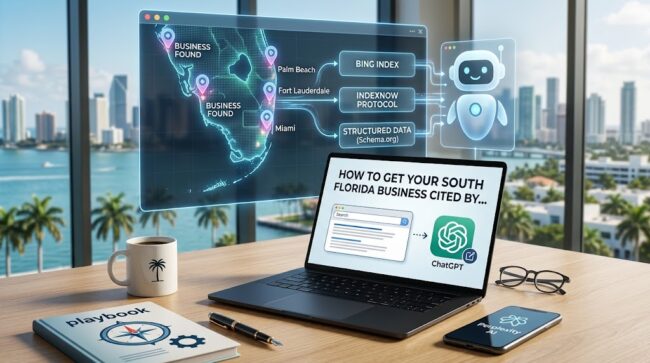
As tech professionals and founders continue to choose Florida over traditional hubs, the infrastructure supporting this migration is evolving just as rapidly. The AI revolution sweeping through Florida is fundamentally changing how local industries operate, from finance to logistics. This shift is particularly evident in the region’s emergence as a global crypto and blockchain hub, providing the decentralized backbone for the next generation of startups. For business owners, staying competitive in this new landscape means integrating these tools today—whether through tailored AI chatbot services to scale operations or by implementing high-performance digital marketing strategies that resonate with the wave of high-net-worth arrivals.
“Silicon Beach” Is Building Its Own Identity
Here’s what separates Miami’s tech scene from past challenger cities: it isn’t trying to be Silicon Valley. It is building something genuinely different.
Miami’s emerging tech industries map directly onto its geographic and demographic advantages. The city is the world’s most natural gateway to Latin America — a continent of 650 million people with some of the world’s fastest-growing middle classes and a desperate need for fintech, edtech, healthtech, and infrastructure technology. No other tech hub on Earth sits at this intersection. VCs in San Francisco pitch companies on winning the US market and then expanding internationally. VCs in Miami pitch companies on building for the Americas from day one.
The results are visible in the deal flow. Fintech is South Florida’s dominant vertical, attracting $691 million in VC in the first half of 2025 alone. Climate tech startups in the Miami metro raised $391 million in the same period, already surpassing all of 2024 — bucking the national trend of declining clean energy investment. AI-focused companies are surging: the $830 million that flowed to AI startups in the Miami metro in just the first half of 2025 nearly matched all of 2024’s AI investment. Major VC names — a16z, SoftBank, Founders Fund, Techstars — all have active Miami presence. The ecosystem has achieved the critical mass where capital attracts talent attracts deals attracts more capital.
Miami has also established itself as the crypto and blockchain capital of the United States, with Bitcoin conferences, web3 summits, and blockchain infrastructure companies clustering here in a way that reflects both the city’s entrepreneurial appetite and its government’s willingness to engage rather than regulate reflexively.
The Talent Pool Is Catching Up
The perennial knock on Miami as a tech hub has always been talent: you can move founders here, but can you build engineering teams? The city has spent the last four years working to answer that question — and the answer is increasingly yes.
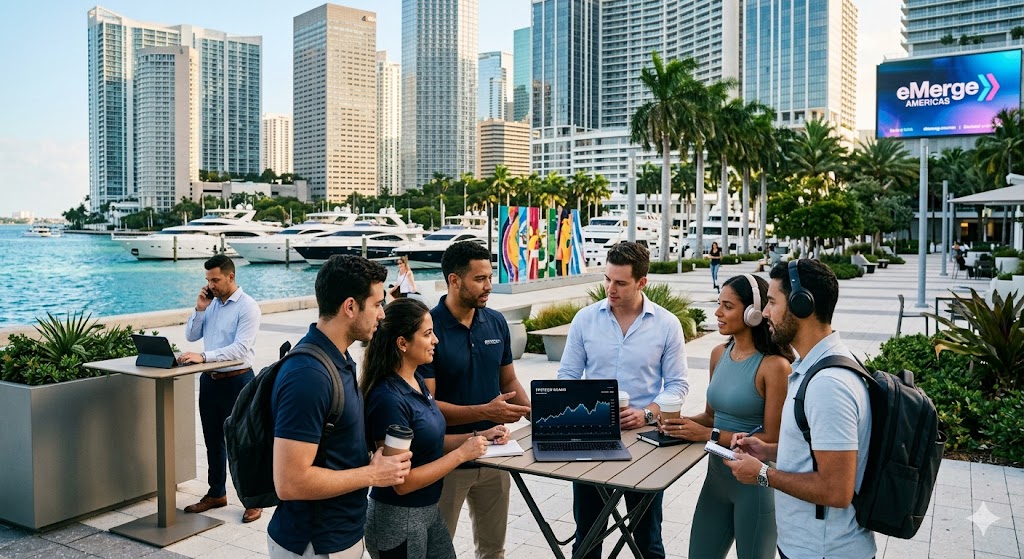
The $10 million Miami Tech Works program, funded by the Economic Development Administration, has placed hundreds of local residents in tech roles, with particular focus on AI skills. eMerge Americas, the region’s flagship annual tech conference, functions as both a talent showcase and a deal-making engine that brings founders and investors face to face. University of Miami and Florida International University are both scaling STEM programs. The incoming Vanderbilt graduate campus in West Palm Beach will add graduate-level engineering and AI talent directly into the market by the end of the decade.
The talent advantage is also geographic in a way that’s easy to underestimate. Miami’s international airport is one of the busiest in the Western Hemisphere. Non-stop flights connect the city to virtually every major global innovation hub — São Paulo, Bogotá, Mexico City, Madrid, London, Tel Aviv. For companies building global teams or serving international markets, Miami’s connectivity is a genuine operational advantage that Silicon Valley, tucked in the corner of Northern California, simply cannot match.
The Lifestyle Is Not a Bonus — It’s a Retention Strategy
In the post-pandemic era of talent wars and remote work flexibility, quality of life is not a soft benefit. It is a hard recruiting tool. And on this dimension, South Florida is playing a different game than any other tech hub in the country.
The pitch is real and it is considerable: year-round sunshine, world-class beaches and water sports, extraordinary dining and nightlife, no state income tax (already covered, but worth repeating), a genuinely international cultural scene, Michelin-starred restaurants, the global art world descending for Art Basel, and a pace of outdoor life — paddleboarding before work, a walk on the beach at sunset, a boat on Biscayne Bay on weekends — that no amount of money can replicate in the Bay Area or New York.
The lifestyle calculation for tech professionals has fundamentally shifted. The romanticization of the 80-hour week in a gray San Francisco apartment has given way to something more honest: people want to build great companies and live great lives, and they increasingly believe those two things are not in conflict. South Florida makes that belief feel less like an aspiration and more like a daily reality.
The Honest Caveats
South Florida’s tech narrative is compelling — but intellectually honest coverage requires acknowledging the challenges.
The talent pipeline, while growing, is not yet deep enough to support the region’s ambitions. Building great companies requires thousands of experienced engineers, product managers, and technical leaders, and most of those people are still concentrated in the Bay Area, New York, and Seattle. Recruiting senior technical talent to Miami often still requires relocation packages, remote flexibility, or salaries premium enough to attract people from established hubs.
Housing affordability, while better than San Francisco, is tightening rapidly. The same migration that makes South Florida exciting for the region’s economy is pricing out younger workers and entry-level tech talent. Miami consistently ranks among the least affordable cities in the country relative to local wages.
And the ecosystem, while impressive by any objective measure, has not yet produced the density of $10B+ exits and serial founder networks that make Silicon Valley self-reinforcing. That kind of generational compounding takes decades. The region is early in that process.
The Verdict
“Florida is the new California,” a South Florida county commissioner said earlier this year. That’s a line designed for a headline. The reality is more nuanced and, arguably, more interesting.
South Florida is not replacing Silicon Valley. Silicon Valley will remain the world’s most valuable concentration of deep technology, institutional VC, and engineering talent for the foreseeable future. What South Florida is doing is becoming a genuine alternative — a place where a serious founder, a senior engineer, or an ambitious executive can build a meaningful career and company without making the financial, lifestyle, and tax sacrifices that life in the Bay Area now demands.
For the first time in the history of American tech, that sentence is genuinely true. The institutions have moved. The capital is deployed. The infrastructure is being built — literally, in the form of office towers, university campuses, and air taxi networks. The talent is arriving.
The question is no longer whether South Florida belongs in the conversation about America’s great tech hubs. It does. The question now is how far and how fast it rises — and whether it can build the kind of enduring, self-reinforcing ecosystem that turns a migration moment into a permanent shift in the geography of American innovation.
The smart money — and there is a lot of it, and it has already moved — is betting yes.
Are you a tech professional considering a move to South Florida? Share your thoughts in the comments below — or reach out to discuss what the region’s growth means for your career or business.
About the Author