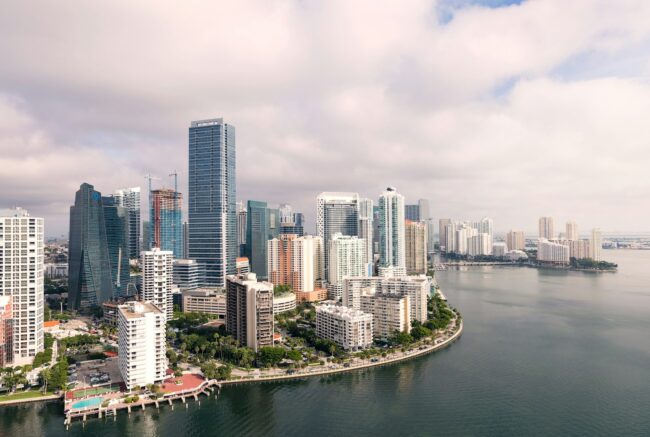
Downtown Miami and Brickell from the air. Source: Ryan Parker/Unsplash, Unsplash License.
Quick Answer: Florida’s preliminary October 2026 unemployment rate fell to 4.3%, its fifth straight monthly decline, against a U.S. rate of 4.1%. The newest local detail, for September 2026, put the Miami-Fort Lauderdale-West Palm Beach metro at 3.2%, the lowest in the state, and Miami-Dade County at 1.9%. Payroll growth in South Florida is still slow: the metro had about 0.4% more jobs than a year earlier.
The newest labor data shows South Florida’s jobless rate falling sharply in early fall, while the number of jobs in the region has barely grown. Preliminary October 2026 statewide estimates from the U.S. Bureau of Labor Statistics put Florida’s seasonally adjusted unemployment rate at 4.3%. That is down from 4.4% in September and 4.8% in May. The most recent metro and county figures cover September 2026. They show the three-county metro at 3.2%, down from 3.7% in August and 3.6% a year earlier. That was the lowest metro rate in the state.
The jobs side looks different. Total nonfarm payrolls in the Miami-Fort Lauderdale-West Palm Beach metro were 0.4% higher in September than a year earlier. Statewide payrolls grew 1.0% in October. Health care and education are doing most of the hiring in the region. Financial activities, information and construction are shrinking. This report covers the newest release: Florida’s October estimates and the September local data published with them. Earlier scorecards do not include these figures.
What did the newest Florida jobs report show for October 2026?
BLS figures for Florida show 11,120,500 people in the civilian labor force in October 2026 (preliminary, seasonally adjusted). Of those, 10,643,100 were employed and 477,400 were unemployed. That works out to an unemployment rate of 4.3%. In September, the state reported about 489,000 unemployed residents and a 4.4% rate, so roughly 11,600 fewer Floridians were counted as unemployed in October.
The rate has now fallen every month since May:
- May 2026: 4.8%
- June 2026: 4.7%
- July 2026: 4.6%
- August 2026: 4.5%
- September 2026: 4.4%
- October 2026 (preliminary): 4.3%
Florida’s total nonfarm employment was 10,043,200 in October, up 1.0% from a year earlier. Professional and business services grew fastest among the major industries (2.4%), followed by education and health services (2.1%) and leisure and hospitality (1.3%). Financial activities fell 1.5% and other services fell 0.2%.
How does Florida compare with the U.S.?
The national October Employment Situation report came out November 6, 2026. It put the U.S. unemployment rate at 4.1%, little changed from September. Nonfarm payrolls rose by 165,000, well above the 48,000 average monthly gain of the prior 12 months, and August and September were revised up by a combined 84,000. Most of the national gains came in professional and business services (+70,000), health care (+42,000), transportation and warehousing (+25,000) and manufacturing (+19,000). The national labor force participation rate was 61.9%, and 7.1 million people were unemployed.
Florida’s rate is still 0.2 point above the U.S. rate. The gap has narrowed since spring, though. In July, the state rate was 4.6% and the national rate was 4.1%.
How low is unemployment in South Florida right now?
The latest local figures cover September 2026 and are not seasonally adjusted. The Miami-Fort Lauderdale-West Palm Beach metro posted a 3.2% unemployment rate, the lowest of any Florida metro. Orlando-Kissimmee-Sanford was at 4.2%, Tampa-St. Petersburg-Clearwater at 4.3%, and Jacksonville at 4.5%. Port St. Lucie, the metro just north of Palm Beach County, was at 4.9%.
The metro’s civilian labor force reached 3,302,700 in September, up from 3,289,700 in August and 3,259,500 in May. Employment rose to 3,197,100 and unemployment fell to 105,500. In August, 121,800 residents were unemployed. The September drop of about 16,300 jobless residents in one month is the main reason the rate fell half a point.
What are the unemployment rates in Miami-Dade, Broward, Palm Beach and Monroe?
County results differ widely. Miami-Dade’s September rate was 1.9%, down from 2.7% in August and 2.9% in September 2025. Broward’s rate was 4.1%, about the same as a year earlier (4.0%). Palm Beach County’s rate was 4.4%, up slightly from 4.3% a year earlier. Monroe County, which covers the Florida Keys, was at 3.1%, compared with 3.2% in September 2025.
| Area | Sept 2026 | Aug 2026 | Sept 2025 | Change vs. year ago |
|---|---|---|---|---|
| Miami-Dade County | 1.9% | 2.7% | 2.9% | -1.0 pt |
| Broward County | 4.1% | 4.4% | 4.0% | +0.1 pt |
| Palm Beach County | 4.4% | 4.6% | 4.3% | +0.1 pt |
| Monroe County (Keys) | 3.1% | 3.3% | 3.2% | -0.1 pt |
| Miami-Fort Lauderdale-West Palm Beach metro | 3.2% | 3.7% | 3.6% | -0.4 pt |
| Florida (seasonally adjusted) | 4.4% | 4.5% | n/a | October 2026: 4.3% |
Source: U.S. Bureau of Labor Statistics, Local Area Unemployment Statistics, via Federal Reserve Bank of St. Louis (FRED/ALFRED). County and metro rates are not seasonally adjusted. September 2026 figures are preliminary.
Miami-Dade’s rate has been the lowest of the four counties all year. Between January and August it stayed between 2.4% and 3.1%, so September’s 1.9% is unusually low. Not-seasonally-adjusted county rates can swing from month to month, and September is a preliminary estimate that may be revised. Revisions do happen. Palm Beach’s July rate was first reported at 4.8% and now shows 4.7%.
Why are Broward and Palm Beach above the metro average?
The most detailed county breakdown in this report is the July 2026 release summarized by CareerSource Broward. In July, Broward’s labor force was 1,067,539, down 8,491 (0.8%) from a year earlier. Palm Beach’s was 768,882, down 4,133 (0.5%). Miami-Dade’s grew by 1,877 to 1,431,927. That July report also showed payroll jobs in the Miami-Miami Beach-Kendall division up 10,800 from a year earlier, to 1,343,400. The Fort Lauderdale-Pompano Beach-Sunrise division was down 400, at 908,200. The West Palm Beach-Boca Raton-Delray Beach division was up 3,700, at 697,300.
Layoffs also hit Broward hard this year. The News Service of Florida reported that the Florida Department of Commerce received 220 WARN layoff notices covering about 16,000 layoffs in the first 10 months of 2026. About 30% of those layoffs came from the closure of Dania Beach-based Spirit Airlines in early May. The official data don’t show how much of Broward’s weaker year can be traced to Spirit. Still, a single closure accounting for nearly a third of the state’s noticed layoffs is a large shock for one county.
Which South Florida industries are adding and losing jobs?
The metro had 2,965,600 nonfarm jobs in September (preliminary, not seasonally adjusted), up 0.4% from a year earlier. That works out to roughly 12,000 more jobs. Growth has been weak all year. Metro payrolls were 0.3% below the prior year in May and up between 0.1% and 0.3% in June through August.
| Industry (metro) | Sept 2026 jobs (thousands) | Aug 2026 (thousands) | 12-month change |
|---|---|---|---|
| Total nonfarm | 2,965.6 | 2,962.6 | +0.4% |
| Trade, transportation and utilities | 649.0 | 645.7 | +0.2% |
| Professional and business services | 529.4 | 530.9 | +0.4% |
| Education and health services | 483.6 | 477.7 | +2.6% |
| Leisure and hospitality | 339.5 | 342.3 | +0.8% |
| Government | 322.2 | 321.4 | +0.4% |
| Financial activities | 214.6 | 216.1 | -2.4% |
| Construction | 159.2 | 159.5 | -0.7% |
| Other services | 114.9 | 115.5 | -0.1% |
| Manufacturing | 101.5 | 101.4 | +0.7% |
| Information | 50.8 | 51.2 | -1.2% |
Source: U.S. Bureau of Labor Statistics, Economy at a Glance, Miami-Fort Lauderdale-West Palm Beach, FL. Not seasonally adjusted; September 2026 preliminary. Mining and logging (0.9 thousand) omitted.
Is health care still carrying the region?
Yes. Education and health services added about 5,900 jobs from August to September and were up 2.6% from a year earlier, the fastest growth of any major industry in the metro. That sector has grown faster than the overall metro every month since May, with year-over-year gains of 1.4% to 2.8%. Statewide, education and health services added 40,300 jobs over the year to September, almost all in health care and social assistance, according to the News Service of Florida’s account of the state report.
Why is financial services shrinking?
Financial activities, which include banking, insurance and real estate, had 214,600 metro jobs in September, down 2.4% from a year earlier. That is the steepest decline of any major industry in the region. The sector has been 2.1% to 2.7% below year-ago levels every month from May through September. The weakness is statewide: Florida lost 15,800 financial activities jobs over the year to September, and October payrolls in the sector were still 1.5% lower than a year earlier. Information jobs, a much smaller category, were down 1.2% in the metro.
What about tourism and construction?
Leisure and hospitality payrolls were up 0.8% from a year earlier, at 339,500. Because these figures are not seasonally adjusted, the drop from 353,700 in May follows the usual summer slowdown before the winter season begins. Construction had 159,200 jobs, down 0.7% from a year earlier, after being down in four of the five months from May through September. Statewide, construction grew 0.8% over the year to October.
What else does this release tell South Florida employers?
The data point to a market with little hiring and few layoffs. Bryan Cutsinger, a Florida Atlantic University business professor, called South Florida’s market “less like a downturn than a low-hire, no-fire market,” according to the News Service of Florida. The FAU report found that wages are rising and new business formation remains strong, but employment growth has flattened.
Weekly claims are also modest. The U.S. Department of Labor estimated 5,047 initial unemployment claims in Florida in the latest week covered in a November 12 report, up from a revised 4,476 the week before. Both figures are below the state’s 2026 weekly average of about 5,700, which is itself below the 2025 average of just over 6,100. WARN notices through October covered about 16,000 layoffs, fewer than the nearly 17,500 in the same period of 2025.
For small employers, finding workers remains a bigger issue than letting them go. The NFIB said labor quality or availability was its Florida members’ top concern for the third straight month, according to an NFIB report released in mid-October alongside the September state jobs data. NFIB Florida Executive Director Bill Herrle said growing economic uncertainty is making it harder for owners to plan.
Are there gaps in the data to watch?
Yes. FRED’s county unemployment series for Miami-Dade, Broward, Palm Beach and Monroe show no published value for October 2025. When local October 2026 figures come out, a clean year-over-year comparison for that month may be harder to make. Readers should also expect the September local numbers, including Miami-Dade’s 1.9%, to be revised in later releases.
Brian’s Take
The headline number is good news, and South Florida deserves credit for having the lowest jobless rate in the state. But I read these reports for the gap between the unemployment rate and the payroll count, and right now that gap is wide. A metro rate of 3.2% sitting next to 0.4% job growth tells me the region is tight on workers, not booming in hiring. When small business owners name labor availability as their top concern three months running, that fits.
The industry mix matters more to me than the headline. Health care is adding jobs every month. Finance, one of South Florida’s higher-paying sectors, has been running more than 2% below last year’s level since spring, and construction is flat to down. If I ran a business here, I would plan for steady wage pressure in service roles and a slow market in office-based financial work, and I would treat Miami-Dade’s 1.9% as a preliminary estimate until the revisions come in.
Broward is the county I’m watching. A shrinking labor force, a flat payroll count and an airline closure in Dania Beach tied to roughly 30% of Florida’s WARN layoffs this year add up to a different story than the one in Miami-Dade, even though both counties are in the same metro.
Frequently Asked Questions
What is Florida’s unemployment rate for October 2026?
The preliminary seasonally adjusted rate is 4.3%, down from 4.4% in September and 4.8% in May. About 477,400 Floridians were unemployed out of a labor force of roughly 11.1 million.
What is the unemployment rate in the Miami-Fort Lauderdale-West Palm Beach metro?
The newest local figure, for September 2026, is 3.2% (not seasonally adjusted). That is down from 3.7% in August and 3.6% a year earlier, and it is the lowest among Florida’s metro areas.
Which South Florida county has the lowest unemployment?
Miami-Dade, at a preliminary 1.9% in September 2026. Monroe was 3.1%, Broward 4.1% and Palm Beach 4.4%.
How many jobs does South Florida have?
The metro had 2,965,600 nonfarm jobs in September 2026, up 0.4% from a year earlier. Statewide payrolls were 10,043,200 in October, up 1.0%.
Which industries are growing fastest in South Florida?
Education and health services grew fastest, up 2.6% year over year. Manufacturing (+0.7%) and leisure and hospitality (+0.8%) also grew. Financial activities (-2.4%), information (-1.2%) and construction (-0.7%) declined.
How does Florida compare with the national unemployment rate?
Florida’s October rate of 4.3% is 0.2 point above the U.S. rate of 4.1%. The U.S. economy added 165,000 jobs in October.
Sources and Further Reading
- Economy at a Glance: Florida — U.S. Bureau of Labor Statistics
- Economy at a Glance: Miami-Fort Lauderdale-West Palm Beach, FL — U.S. Bureau of Labor Statistics
- The Employment Situation, October 2026 — U.S. Bureau of Labor Statistics
- Unemployment Rate by Metropolitan Statistical Area, Florida, September 2026; and county unemployment rate series for Miami-Dade, Broward, Palm Beach and Monroe counties — Federal Reserve Bank of St. Louis (FRED/ALFRED), from BLS Local Area Unemployment Statistics
- Broward County July 2026 Unemployment Data — CareerSource Broward
- Florida jobless rate dips in September — News Service of Florida via WLRN
- Florida unemployment claims show slight increase — News Service of Florida via Florida Trend
About the Author