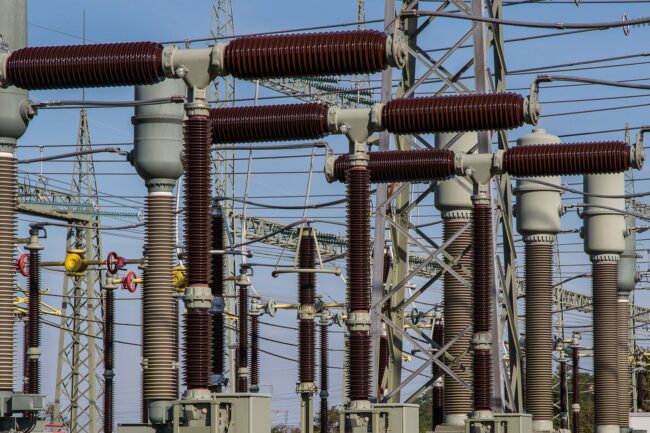
High-voltage substation equipment. Source: Pixabay, via Pexels. License: Pexels License.
Quick Answer: The Florida Public Service Commission unanimously approved Florida Power & Light’s four-year settlement on Nov. 20, 2025. It raises base revenue by $945 million in 2026 and $705 million in 2027, with solar and battery additions in 2027 through 2029, at a 10.95% return on equity. FPL’s own brief projects small commercial bills rising about 2.32% a year and larger commercial and industrial bills about 2% to 2.6% a year through 2029. Its 2027 fuel cut and Hurricane Isaias surcharge still await regulators.
For South Florida offices, restaurants, warehouses, hotels and factories, the biggest utility cost decision of the decade is already made. Florida Power & Light’s 2026-2029 base rate agreement took effect on Jan. 1, 2026. Most businesses from Palm Beach County through Miami-Dade now pay rates set by that deal, plus fuel, storm and other charges that regulators reset each year. Nearly a year in, early billing data show how commercial customers are faring, and the next annual adjustments are before the Florida Public Service Commission (PSC).
What did the Florida PSC actually approve, and when?
FPL gave the commission notice by letter on Jan. 2, 2025, and filed its petition for new base rates on Feb. 28, 2025. The original request sought $1.545 billion in new annual revenue for 2026 and $927 million more for 2027, along with automatic recovery of solar and battery projects in 2028 and 2029. The Office of Public Counsel, the state’s statutory customer advocate, estimated the original plan would have cost customers about $9.8 billion more over four years than existing rates.
On Aug. 20, 2025, FPL and a coalition of mostly commercial and industrial customer groups filed a settlement that cut those numbers. Signers included the Florida Industrial Power Users Group, the Florida Retail Federation, Walmart, Wawa, RaceTrac, Circle K and federal executive agencies. The Office of Public Counsel and several consumer and environmental groups did not sign.
The commission held hearings on the original filing and the settlement starting Oct. 6, 2025, then voted unanimously on Nov. 20, 2025, to approve the settlement. The written Final Order, No. PSC-2026-0022-S-EI, was issued Jan. 22, 2026. Opponents estimate the approved plan’s cumulative increases at about $6.9 billion over four years.
What is the status of legal challenges?
The Office of Public Counsel filed a notice of administrative appeal with the Florida Supreme Court on Feb. 17, 2026. Opponents also asked the commission to reconsider. The PSC heard that request at its April 7, 2026, conference and declined to reconsider, in Order No. PSC-2026-0117-FOF-EI issued April 27, 2026. The rates remain in effect while the appeal proceeds. There is precedent here: in July 2025 the Supreme Court upheld FPL’s previous 2021 settlement after an earlier remand.
| Key fact | Detail |
|---|---|
| Docket | 20250011-EI, Florida Public Service Commission |
| Petition filed | Feb. 28, 2025 |
| Settlement filed | Aug. 20, 2025 |
| Commission vote | Nov. 20, 2025 (unanimous) |
| Final order | PSC-2026-0022-S-EI, issued Jan. 22, 2026 |
| Term | Jan. 1, 2026, through Dec. 31, 2029 (minimum) |
| Return on equity | 10.95% midpoint; 9.95% to 11.95% range |
| Equity ratio | 59.6% of investor sources |
| Appeal | Public Counsel notice to Florida Supreme Court, Feb. 17, 2026 |
How much new revenue does the plan give FPL each year?
The settlement has two fixed base rate steps and a series of solar and battery additions. In its post-hearing brief, FPL said the 2026 step is 39% below its request and the 2027 step is 24% below it, about a 30% cut to the original revenue request overall.
| Year | FPL’s February 2025 request | Approved settlement |
|---|---|---|
| 2026 | $1.545 billion | $945 million base increase |
| 2027 | $927 million | $705 million base increase, plus about 1,192 MW of solar |
| 2028 | Solar and battery recovery | About 1,490 MW solar and 600 MW battery storage |
| 2029 | Solar and battery recovery | About 1,788 MW solar and 600 MW battery storage |
The solar and battery steps run through a Solar and Battery Base Rate Adjustment mechanism; the agreement does not put a dollar figure on them.
What return on equity did regulators allow?
The settlement sets a 10.95% midpoint return on equity, with an earnings range of 9.95% to 11.95%, and applies the midpoint to clause proceedings as well as base rates. FPL had requested an 11.9% midpoint; its prior authorized midpoint was 10.8%. The 59.6% equity ratio is unchanged. Commissioner Gabriella Passidomo Smith called the ROE the “big kahuna” of the case. Food & Water Watch calls it the highest in the contiguous United States.
What is the Rate Stabilization Mechanism?
The new Rate Stabilization Mechanism replaces FPL’s old Reserve Surplus Amortization Mechanism and works almost identically. The PSC’s April 2026 order estimates its funding at $1.452 billion, including $1.155 billion of unprotected deferred tax liability, an estimated $153.5 million carried over from the old mechanism, and 2025 investment tax credits from a 522 MW battery project. The mechanism ends after Dec. 31, 2029, unless extended.
How are commercial and industrial bills affected?
The rate design favors residential customers on purpose. Under the settlement’s modified equal-percentage allocation, the residential class increase is capped at 95% of the adjusted system average. Non-residential classes absorb the difference on an equal-percentage basis. FPL’s brief says residential customers get the lowest increase of any rate class.
FPL’s post-hearing brief, filed Nov. 10, 2025, gives these projected average annual increases through the end of the decade, measured against average monthly bills when the brief was filed:
| Customer group | Projected bill growth through 2029 |
|---|---|
| Residential, peninsular Florida | About 2% per year |
| General Service (small commercial) | 2.32% average per year |
| Commercial and industrial, peninsular FPL area | About 2% to 2.6% compound annual growth |
| Commercial and industrial, Northwest Florida | About 0.8% to 1.2% compound annual growth |
Every commercial and industrial range for the peninsular service area, which includes South Florida, sits above the residential rate. Northwest Florida business rates rise more slowly because, starting in 2027, former Gulf Power customers and peninsular customers pay the same rates.
What do 2026 billing figures show so far?
FPL’s quarterly statistics through June 30, 2026, give an early read. Average commercial prices rose more than three times as fast as residential prices in the first half. These averages include fuel and other charges, so they do not isolate the base rate change.
| Class (six months ended June 30) | 2025 avg. price | 2026 avg. price | Change |
|---|---|---|---|
| Residential | 14.71 cents/kWh | 14.97 cents/kWh | +1.8% |
| Commercial | 10.99 cents/kWh | 11.61 cents/kWh | +5.6% |
| Industrial | 7.79 cents/kWh | 8.18 cents/kWh | +5.0% |
| All retail | 12.51 cents/kWh | 13.07 cents/kWh | +4.5% |
Commercial customers bought 25,659 million kWh in the first half of 2026, up 1.8% from a year earlier. FPL ended June with about 668,000 commercial accounts, up from 659,000, and roughly 13,000 industrial accounts.
What provisions matter most to large business users?
- Interruptible credits: Customers on the Commercial/Industrial Load Control (CILC) and Commercial/Industrial Demand Reduction (CDR) programs receive a $9.75 per kW credit in 2026. The credit rises with each later solar and battery adjustment.
- Large-load tariffs: New tariffs cover new or incremental loads of 50 MW or more at an 85% or higher load factor, the size range that covers large data centers. They require a 70% minimum take-or-pay demand charge and financial security: a parent guaranty covering five years of revenue for BBB-rated or better companies, or a letter of credit or surety bond covering ten years for lower-rated ones. The Vandolah plant acquisition cannot be used to serve data center or hyperscaler customers exclusively.
- Fuel and trading gains: FPL agreed not to use financial natural gas hedging during the minimum term, and customers receive 100% of annual asset optimization gains above $150 million through the fuel clause.
Without hedging, fuel charges track natural gas prices more directly, up or down.
What is the typical residential bill, and what does 2027 look like?
Residential figures are the most detailed bill projections FPL has published for the plan. A typical 1,000-kWh peninsular bill went from $134.14 to $136.64 in January 2026, an increase of $2.50 a month, or about 2%. In Northwest Florida the typical bill fell from $143.60 to $141.36.
| Period | Peninsular Florida, 1,000 kWh | Status |
|---|---|---|
| 2025 (before plan) | $134.14 | Actual |
| January 2026 | $136.64 | In effect |
| January 2027 | $143.05 earlier projection; $141.87 proposed | Proposed Oct. 30, 2026, pending PSC |
| January 2028 | $146.24 | FPL projection at approval |
| December 2029 | $148.15 | FPL projection at approval |
How do the fuel and storm charges change in 2027?
On Oct. 30, 2026, FPL filed its annual clause proposals. They would cut the fuel charge because projected natural gas costs are lower, and add a temporary storm surcharge of $3.48 a month per 1,000 kWh for residential customers, from January through December 2027. The surcharge would pay for part of the restoration after Hurricane Isaias and partly refill the storm reserve. Isaias struck near Destin on Oct. 9, 2026, cutting power to about 435,000 customers.
Together, the changes would put the typical peninsular residential bill at $141.87 in January 2027, $1.18 a month below the $143.05 FPL projected when the plan was approved. That figure already includes the storm surcharge. FPL has not published the total Isaias cost or the surcharge rates for commercial classes. The PSC’s published calendar, marked subject to revision, lists the FPL-only fuel clause docket for an agenda conference in the week of Nov. 30, 2026.
How does the plan handle future hurricanes?
Under the settlement, FPL can start interim recovery of named-storm costs 60 days after filing. Standard 12-month recovery applies while the charge stays at or below $5.00 per 1,000 kWh on residential bills, and costs above that cap can be deferred. The storm reserve replenishment target is $300 million.
Which South Florida businesses does this cover?
FPL had about 6.147 million accounts as of June 30, 2026, serving about 12 million people. In southeast Florida, the PSC held in-person customer hearings in Miami Gardens and Hollywood and at the Solid Waste Authority of Palm Beach County in West Palm Beach in late May 2025, reflecting FPL’s large customer base in Miami-Dade, Broward and Palm Beach counties.
The footprint stops short of Key West. Keys Energy Services, the utility board of the City of Key West, serves the area from the Seven Mile Bridge to Key West, so businesses in the Lower Keys do not pay FPL rates.
FPL is also building capacity that these rates fund. On Nov. 9, 2026, it announced the 400 MW, 1,600 MWh Lansing Smith battery in Bay County, bringing its system battery capacity to nearly 2 GW. FPL expects to add about 335,000 customers by 2029.
What should South Florida businesses watch next?
- The PSC’s December decision on FPL’s 2027 fuel factors and the Isaias surcharge, including the per-kWh rates for commercial classes.
- The $705 million 2027 base step and approval of about 1,192 MW of 2027 solar.
- The Florida Supreme Court appeal brought by the Office of Public Counsel.
Frequently Asked Questions
When did FPL’s new base rates take effect?
Jan. 1, 2026. The PSC approved the settlement on Nov. 20, 2025, and issued the final order on Jan. 22, 2026. The minimum term runs through Dec. 31, 2029.
How much will small business bills rise?
FPL’s post-hearing brief projects General Service small commercial bills rising an average of 2.32% a year through the end of the decade. Larger commercial and industrial classes in the peninsular area are projected at about 2% to 2.6% a year.
Is the hurricane surcharge approved for 2027?
Not yet. FPL proposed a $3.48 monthly residential charge per 1,000 kWh for 2027, paired with a lower fuel charge, on Oct. 30, 2026. Both await a PSC decision.
Do Key West businesses pay FPL rates?
No. Keys Energy Services serves from the Seven Mile Bridge to Key West, so FPL’s base rate plan does not apply there.
Is the rate plan being challenged?
Yes. The Office of Public Counsel filed an appeal with the Florida Supreme Court on Feb. 17, 2026. The PSC declined to reconsider its approval in April 2026, and the rates remain in effect.
Sources and Further Reading
- Order No. PSC-2026-0117-FOF-EI, Docket No. 20250011-EI, Florida Public Service Commission
- Order No. PSC-2026-0022-S-EI, Final Order Approving 2025 Stipulation and Settlement Agreement, Florida Public Service Commission
- Post-Hearing Settlement Brief of Florida Power & Light Company, Florida Public Service Commission docket filing
- Notice of Customer Service Hearings, Docket No. 20250011-EI, Florida Public Service Commission
- Commission Calendar, Florida Public Service Commission
- NextEra Energy and FPL Form 8-K Exhibit 99 on the 2025 rate settlement, U.S. Securities and Exchange Commission
- Florida regulators approve FPL rate agreement, NextEra Energy investor relations
- FPL Statistics, Second Quarter 2026, NextEra Energy investor relations
- FPL projects 2027 residential bills will be lower than previously expected, FPL Newsroom
- Florida Power & Light reaches new milestone with largest-capacity battery energy storage project, FPL Newsroom
- Approved 2026-2029 rate agreement customer summary, Florida Power & Light
- Florida approves FPL’s biggest rate hike in history, WLRN
- FPL reaches settlement deal with major businesses, groups on rate increase, WLRN
- FPL Rate Settlement Approved, Florida Municipal Electric Association
- Justices Reject Challenge to FPL Settlement, Florida Municipal Electric Association
- Power & Light rate hike challenged at Florida Supreme Court, Florida Record
- PSC Denies Reconsideration of FPL Rate Case, Food & Water Watch
- The Keys have no power grid, they have an extension cord, WUSF
About the Author