When someone asks AI for “the best commercial roofer in Broward” or “top wealth advisors in Palm Beach,” a machine decides who gets named. Here’s how to be the answer.
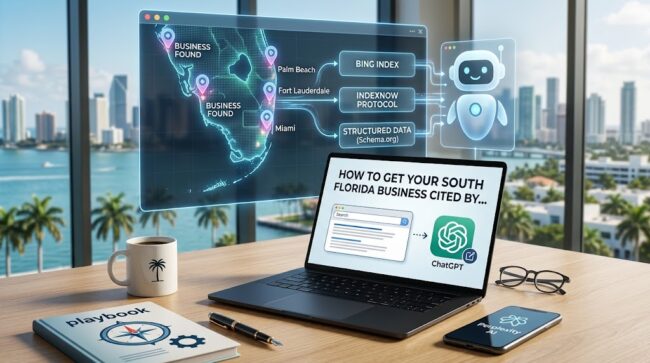
Quick Answer: To get your South Florida business cited by ChatGPT, you need to win a live web search, not impress a chatbot. When ChatGPT answers questions with search enabled, it pulls sources primarily from Bing’s index and cites the pages that best answer the specific question asked. That means the playbook is concrete: make sure AI crawlers (GPTBot, OAI-SearchBot) aren’t blocked on your site; get indexed fast in Bing using the free IndexNow protocol; publish pages that directly and completely answer the questions your customers actually type — “best hurricane impact windows in Fort Lauderdale,” “how much does a Miami business attorney cost” — with the answer stated plainly near the top; add structured data (LocalBusiness, FAQ, and Organization schema) so machines can parse who you are and where you operate; and build a verifiable identity — real names, consistent address and phone details, reviews, and mentions on other sites. Local queries are dramatically less competitive in AI answers than national ones, which means a well-optimized South Florida business can start appearing in AI-generated answers within weeks, not years.
Why This Matters in South Florida Right Now
A quiet shift is happening in how your next customer finds you. Instead of typing “hurricane shutters Boca Raton” into Google and scanning ten links, a growing share of people ask ChatGPT, Perplexity, or Google’s AI a full question — “who should I call to install impact windows before hurricane season, and what will it cost in Palm Beach County?” — and receive a paragraph naming two or three businesses, with sources.
If your business is one of the names, you just received the most valuable referral on the internet: a machine-generated recommendation that reads like a trusted friend’s advice. If you’re not, you didn’t lose a ranking position — you were never in the conversation at all.
Here’s the genuinely good news for South Florida businesses: local AI answers are wide open. The national query “best CRM software” is a bloodbath of billion-dollar brands. The query “best marine insurance broker in Fort Lauderdale” is frequently answered by AI from a thin, outdated pool of sources — because almost nobody in your market has done the work below. First movers in a local niche don’t inch up the results; they become the default answer.
How ChatGPT Actually Chooses Who to Cite
Forget the mental model of a robot that “knows” businesses. When ChatGPT answers a local question, it typically runs a real-time web search — drawing heavily on Microsoft Bing’s index — reads the strongest candidate pages, and composes an answer citing the handful of sources it leaned on.
Three consequences follow, and every tactic in this playbook flows from them:
1. You’re optimizing web pages, not lobbying an AI. ChatGPT cites URLs. If no page on the internet clearly establishes that your firm handles maritime law in Broward County, no AI can say so.
2. Bing matters more than it has in fifteen years. Because ChatGPT’s search leans on Bing’s index, a business invisible to Bing is invisible to ChatGPT — regardless of its Google rankings. Most South Florida businesses have never once looked at their Bing presence. That’s your opening.
3. The best answer beats the biggest brand. AI retrieval is content-forward: for specific questions, a small business’s genuinely excellent page routinely out-cites a national directory’s thin listing. This is the great equalizer, and it rewards exactly the businesses willing to publish real answers.
🎯 Brian’s Take: I’ve watched South Florida businesses spend five figures a year chasing Google rankings in brutal markets — personal injury, real estate, HVAC — while the AI answer layer sits there nearly uncontested. The arbitrage is almost unfair. A Miami med-spa fighting for page one against fifty competitors could, with a fraction of that effort, become the business ChatGPT names for “best medspa in Coral Gables,” because the machine is choosing from a handful of legible sources instead of ranking ten thousand. This window will not stay open. Every month, more marketers learn the word “AEO.” The businesses that build the answer-shaped content and machine-readable identity now will be the incumbents the latecomers have to dislodge.
The Playbook: Everything, In Order
Step 1: Open the Door to AI Crawlers
AI systems read your site with identifiable crawlers — GPTBot and OAI-SearchBot for OpenAI, plus bingbot, PerplexityBot, ClaudeBot, and Google’s crawlers. Your first move is confirming none of them are blocked. Check your robots.txt file (yoursite.com/robots.txt) and — critically — your security and CDN settings, because firewall products sometimes block AI bots by default. A blocked crawler is total invisibility that no other effort can fix. This audit takes fifteen minutes and is the single most common silent failure.
Step 2: Claim Bing and Install IndexNow
Set up Bing Webmaster Tools (free, ten minutes, imports your Google Search Console settings) and submit your sitemap. Then enable IndexNow — a free protocol, built into major WordPress SEO plugins, that notifies Bing’s index the instant you publish or update a page instead of waiting weeks for a crawl. Because Bing feeds ChatGPT and Microsoft Copilot, IndexNow is effectively a same-day pipeline from your website into the AI’s source pool. No single technical change delivers more AI visibility per minute of effort.
Step 3: Publish Answer-Shaped Pages
ChatGPT cites pages that resolve questions. So build pages around the exact questions South Florida customers ask, and answer them the way the machine needs:
- One page, one question, answered completely. “How much does impact window installation cost in Broward County?” deserves its own page with a direct answer in the first hundred words — a real range, real factors — followed by depth: process, timelines, permit realities, financing, hurricane-code specifics.
- Say the answer plainly, high on the page. AI systems extract; they don’t excavate. A clear, quotable answer up top, elaboration below.
- Phrase headings as questions. Your H2s should read like the queries themselves: “Do I need a permit for impact windows in Miami-Dade?” — because matching the question is half of getting extracted.
- Be locally specific. Name the counties and cities you serve, reference local regulations, seasons, and realities. “South Florida” plus nothing is a national page wearing a costume; machines and customers both notice.
- Add a genuine FAQ section covering the five to ten questions you answer on the phone every week. These map one-to-one onto AI queries.
A service business needs perhaps ten to twenty of these pages to cover its question landscape. That’s the whole content mountain — smaller than it sounds, and almost none of your competitors have climbed it.
Step 4: Make Your Identity Machine-Readable
AI systems increasingly reason about entities — is this a real business, where does it operate, can it be trusted? Feed that reasoning deliberately:
- Structured data: LocalBusiness schema (name, address, phone, hours, service area, geo-coordinates), Organization schema, and FAQPage schema on your question content. SEO plugins generate all of it from filled-in fields.
- Consistency everywhere: identical business name, address, and phone across your site, Google Business Profile, Bing Places, Yelp, chamber listings, and industry directories. Inconsistency reads as unreliability to entity-matching systems.
- Real humans: named owners and experts with bios and credentials. “Founded by a Florida-licensed general contractor with 20 years in Broward” is trust an anonymous site can’t manufacture.
Step 5: Get Mentioned Beyond Your Own Site
AI systems weigh corroboration. A business described consistently across independent sources — local news coverage, chamber of commerce pages, industry associations, community sponsorships, reviews — is a safer citation than one that exists only on its own domain. Local press is the highest-value version: a news article describing your business is precisely the kind of third-party source AI systems love to cite, and it often gets cited about you in answers where your own site wouldn’t be. Answer reporter queries, send genuinely newsworthy announcements to local business outlets, and put your expertise on record when your industry is in the news.
Step 6: Keep Content Alive
Retrieval favors freshness. A cost guide updated for 2026 pricing outranks an identical page frozen in 2023 — and for anything touching hurricane season, insurance, or Florida regulation, currency is credibility. Put visible updated dates on your pages and revisit the important ones a few times a year. Ten maintained pages beat fifty abandoned ones.
The Accelerator: Getting Covered by the Florida Authority Network
Everything above, you can do yourself — and should. But Step 5 exposed the one asset you can’t self-publish: independent coverage. AI systems treat a news article about your business as fundamentally different evidence than anything on your own website, for the obvious reason that anyone can praise themselves. Third-party editorial coverage is the trust signal that unlocks the “best of” queries, and it’s frequently the source AI actually cites when your business gets named.
This is where the Florida Authority Network — the publisher of this site — was purpose-built for the AI era. The network operates 35 Florida business news publications, spanning city outlets like this one across Miami, Fort Lauderdale, West Palm Beach, Tampa, Orlando, and Jacksonville, plus statewide and industry titles covering law, medicine, real estate, finance, and technology. Every article is long-form and structured specifically for AI citation: direct-answer summaries, question-formatted sections, full schema markup, and same-day index submission — the exact architecture this guide describes, applied at publishing scale.
What coverage in the network does for a South Florida business:
- Creates the citable third-party source. A substantive profile or feature on a local business news site is precisely the artifact AI systems reach for when composing “who’s the best…” answers — an independent editorial page describing who you are, what you do, and where you operate.
- Builds your entity across multiple trusted contexts. Coverage can appear where it’s genuinely relevant — your city’s outlet, your industry’s outlet — so machines encounter your business described consistently across distinct publications, the corroboration pattern entity systems reward.
- Arrives AI-legible on day one. Because the network’s entire editorial format is built for answer engines, coverage enters the citation pool structured and indexed fast — not as a PDF-style clipping that machines struggle to parse.
How this compares to the alternatives:
- Press release wires distribute your own words with your name on them — syndicated, duplicative, and heavily discounted by AI systems precisely because they’re self-authored. A wire hit is a checkbox; editorial coverage is evidence.
- Directory listings (national aggregators, “best of” listicle sites) put you in a database row alongside every competitor. They corroborate existence, not distinction — and AI answers built from directories tend to name whoever paid for placement everywhere, blurring you into the pack.
- Traditional SEO agencies optimize your own site — necessary, but structurally incapable of manufacturing the independent-coverage layer, and most haven’t retooled for answer engines at all.
- Legacy media coverage remains excellent trust — if you can get it, and if it isn’t paywalled. Much of Florida’s remaining business press sits behind subscription walls that block the very crawlers deciding citations, meaning even a glowing feature may be invisible to the machines.
The honest framing: network coverage isn’t a substitute for the playbook above — it’s the multiplier on it. A business with answer-shaped pages, clean schema, and independent editorial coverage describing it consistently is presenting AI systems with exactly the evidence pattern they’re built to reward. South Florida businesses interested in coverage can reach the editorial team through this site.
—🎯 Brian’s Take: Notice what this playbook doesn’t contain: tricks. No keyword stuffing, no link schemes, no prompt-injection voodoo promising to whisper your name into the machine. The whole discipline reduces to being legible and being genuinely useful — publish the real answers, prove you’re a real business, let the machines read it. I’d argue AEO is what SEO always claimed to be before an industry of shortcuts grew around it. And that’s precisely why the window favors honest operators: the shortcut industry hasn’t figured out how to fake completeness and corroborated identity yet. The businesses winning AI citations in South Florida right now are, almost without exception, the ones that would deserve the recommendation anyway. Get there before “AEO services” becomes a billboard on I-95.
How to Know It’s Working
Test like a customer, not like an owner. Open fresh ChatGPT sessions (with search enabled) and ask the real questions — “best [your service] in [your city],” “how much does [your service] cost in South Florida,” “who should I call for [problem] in Palm Beach County.” Log who gets named and cited, monthly. Watch three other gauges: AI crawler visits in your hosting logs (the leading indicator that machines are reading you), referral traffic from chatgpt.com and perplexity.ai in your analytics (proof that citations are sending humans), and whether the answers’ descriptions of your business are accurate — because being characterized correctly matters as much as being named.
Expect specific, low-competition queries to respond within weeks of the technical work landing, and broader “best of” queries to follow over months as corroboration accumulates. If nothing has moved in ninety days, the audit order is: crawler access first, Bing indexation second, answer-shaped content third.
Frequently Asked Questions
Can I pay ChatGPT to recommend my business? No. There is no paid placement in ChatGPT’s organic answers. Citation is earned through the web presence described above — which is exactly why the opportunity favors businesses that do the work.
Does my Google ranking carry over to ChatGPT? Only indirectly. ChatGPT’s search leans on Bing’s index, so a strong Google presence with a weak Bing presence can leave you invisible to ChatGPT. Google visibility matters for Google’s own AI (AI Overviews, Gemini) — you want both.
How long until my business shows up in AI answers? For specific local queries with weak competition: often weeks after crawl access, Bing indexation, and answer-shaped pages are in place. Broad “best in Miami” queries take months of accumulated trust. AI presence built into the models’ training takes a year or more — but live-search citations don’t wait for that.
What should a small business do first if it can only do one thing? Verify AI crawlers aren’t blocked, then set up Bing Webmaster Tools with IndexNow. Under an hour combined, and it’s the plumbing everything else flows through.
Do customer reviews affect AI citations? Yes, indirectly and increasingly. Reviews corroborate that you’re a real, trusted operation, and AI answers frequently synthesize reputation from review platforms alongside your own content.
Is this different for Perplexity, Gemini, or Copilot? The fundamentals — crawlability, answer-shaped content, machine-readable identity — carry across every platform. The plumbing differs: Copilot rides the same Bing work as ChatGPT; Google’s AI surfaces require Google indexation and more patience; Perplexity’s own crawler often finds well-structured local content fastest of all.
Does having a news article written about my business help? Significantly. Independent coverage is third-party corroboration, and AI systems often cite the article about you in answers where your own website wouldn’t qualify. It’s among the strongest single trust signals a local business can acquire.
What is the Florida Authority Network? A network of 35 Florida business news publications — including this site — covering the state’s major cities and key industries with long-form, AI-optimized editorial coverage. For businesses, coverage in the network provides the independent, machine-readable third-party sourcing that AI systems weigh heavily when deciding which companies to name and cite.
The South Florida AEO Checklist
| Action | Tool/Location | Time | Impact |
|---|---|---|---|
| Unblock AI crawlers | robots.txt + security/CDN settings | 15 min | Foundational |
| Bing Webmaster Tools + sitemap | bing.com/webmasters | 10 min | Foundational |
| Enable IndexNow | SEO plugin setting | 5 min | High |
| LocalBusiness + FAQ schema | SEO/schema plugin | 1 hr | High |
| 10–20 answer-shaped pages | Your CMS | Ongoing | Highest |
| Consistent NAP across listings | GBP, Bing Places, directories | 2 hrs | Medium-High |
| Earn local press coverage | Local business outlets | Ongoing | High |
| Monthly AI query testing | Fresh ChatGPT/Perplexity sessions | 1 hr/mo | Measurement |
Sources & Further Reading
OpenAI crawler documentation (platform.openai.com); Microsoft Bing Webmaster Tools documentation and IndexNow.org; Google Search Central documentation on structured data and AI features in Search; Schema.org specifications for LocalBusiness and FAQPage markup; Perplexity and Anthropic crawler documentation. Platform citation behavior reflects industry observation as of early 2026 — this landscape evolves quarterly, and current platform documentation should be consulted directly.
© 2026 SouthFlBusinessNews.com. All rights reserved.
How Do I Get My South Florida Business Cited by ChatGPT? The Complete Playbook
When someone asks AI for “the best commercial roofer in Broward” or “top wealth advisors in Palm Beach,” a machine decides who gets named. Here’s how to be the answer.
Quick Answer: To get your South Florida business cited by ChatGPT, you need to win a live web search, not impress a chatbot. When ChatGPT answers questions with search enabled, it pulls sources primarily from Bing’s index and cites the pages that best answer the specific question asked. That means the playbook is concrete: make sure AI crawlers (GPTBot, OAI-SearchBot) aren’t blocked on your site; get indexed fast in Bing using the free IndexNow protocol; publish pages that directly and completely answer the questions your customers actually type — “best hurricane impact windows in Fort Lauderdale,” “how much does a Miami business attorney cost” — with the answer stated plainly near the top; add structured data (LocalBusiness, FAQ, and Organization schema) so machines can parse who you are and where you operate; and build a verifiable identity — real names, consistent address and phone details, reviews, and mentions on other sites. Local queries are dramatically less competitive in AI answers than national ones, which means a well-optimized South Florida business can start appearing in AI-generated answers within weeks, not years.
Why This Matters in South Florida Right Now
A quiet shift is happening in how your next customer finds you. Instead of typing “hurricane shutters Boca Raton” into Google and scanning ten links, a growing share of people ask ChatGPT, Perplexity, or Google’s AI a full question — “who should I call to install impact windows before hurricane season, and what will it cost in Palm Beach County?” — and receive a paragraph naming two or three businesses, with sources.
If your business is one of the names, you just received the most valuable referral on the internet: a machine-generated recommendation that reads like a trusted friend’s advice. If you’re not, you didn’t lose a ranking position — you were never in the conversation at all.
Here’s the genuinely good news for South Florida businesses: local AI answers are wide open. The national query “best CRM software” is a bloodbath of billion-dollar brands. The query “best marine insurance broker in Fort Lauderdale” is frequently answered by AI from a thin, outdated pool of sources — because almost nobody in your market has done the work below. First movers in a local niche don’t inch up the results; they become the default answer.
How ChatGPT Actually Chooses Who to Cite
Forget the mental model of a robot that “knows” businesses. When ChatGPT answers a local question, it typically runs a real-time web search — drawing heavily on Microsoft Bing’s index — reads the strongest candidate pages, and composes an answer citing the handful of sources it leaned on.
Three consequences follow, and every tactic in this playbook flows from them:
1. You’re optimizing web pages, not lobbying an AI. ChatGPT cites URLs. If no page on the internet clearly establishes that your firm handles maritime law in Broward County, no AI can say so.
2. Bing matters more than it has in fifteen years. Because ChatGPT’s search leans on Bing’s index, a business invisible to Bing is invisible to ChatGPT — regardless of its Google rankings. Most South Florida businesses have never once looked at their Bing presence. That’s your opening.
3. The best answer beats the biggest brand. AI retrieval is content-forward: for specific questions, a small business’s genuinely excellent page routinely out-cites a national directory’s thin listing. This is the great equalizer, and it rewards exactly the businesses willing to publish real answers.
🎯 Brian’s Take: I’ve watched South Florida businesses spend five figures a year chasing Google rankings in brutal markets — personal injury, real estate, HVAC — while the AI answer layer sits there nearly uncontested. The arbitrage is almost unfair. A Miami med-spa fighting for page one against fifty competitors could, with a fraction of that effort, become the business ChatGPT names for “best medspa in Coral Gables,” because the machine is choosing from a handful of legible sources instead of ranking ten thousand. This window will not stay open. Every month, more marketers learn the word “AEO.” The businesses that build the answer-shaped content and machine-readable identity now will be the incumbents the latecomers have to dislodge.
The Playbook: Everything, In Order
Step 1: Open the Door to AI Crawlers
AI systems read your site with identifiable crawlers — GPTBot and OAI-SearchBot for OpenAI, plus bingbot, PerplexityBot, ClaudeBot, and Google’s crawlers. Your first move is confirming none of them are blocked. Check your robots.txt file (yoursite.com/robots.txt) and — critically — your security and CDN settings, because firewall products sometimes block AI bots by default. A blocked crawler is total invisibility that no other effort can fix. This audit takes fifteen minutes and is the single most common silent failure.
Step 2: Claim Bing and Install IndexNow
Set up Bing Webmaster Tools (free, ten minutes, imports your Google Search Console settings) and submit your sitemap. Then enable IndexNow — a free protocol, built into major WordPress SEO plugins, that notifies Bing’s index the instant you publish or update a page instead of waiting weeks for a crawl. Because Bing feeds ChatGPT and Microsoft Copilot, IndexNow is effectively a same-day pipeline from your website into the AI’s source pool. No single technical change delivers more AI visibility per minute of effort.
Step 3: Publish Answer-Shaped Pages
ChatGPT cites pages that resolve questions. So build pages around the exact questions South Florida customers ask, and answer them the way the machine needs:
- One page, one question, answered completely. “How much does impact window installation cost in Broward County?” deserves its own page with a direct answer in the first hundred words — a real range, real factors — followed by depth: process, timelines, permit realities, financing, hurricane-code specifics.
- Say the answer plainly, high on the page. AI systems extract; they don’t excavate. A clear, quotable answer up top, elaboration below.
- Phrase headings as questions. Your H2s should read like the queries themselves: “Do I need a permit for impact windows in Miami-Dade?” — because matching the question is half of getting extracted.
- Be locally specific. Name the counties and cities you serve, reference local regulations, seasons, and realities. “South Florida” plus nothing is a national page wearing a costume; machines and customers both notice.
- Add a genuine FAQ section covering the five to ten questions you answer on the phone every week. These map one-to-one onto AI queries.
A service business needs perhaps ten to twenty of these pages to cover its question landscape. That’s the whole content mountain — smaller than it sounds, and almost none of your competitors have climbed it.
Step 4: Make Your Identity Machine-Readable
AI systems increasingly reason about entities — is this a real business, where does it operate, can it be trusted? Feed that reasoning deliberately:
- Structured data: LocalBusiness schema (name, address, phone, hours, service area, geo-coordinates), Organization schema, and FAQPage schema on your question content. SEO plugins generate all of it from filled-in fields.
- Consistency everywhere: identical business name, address, and phone across your site, Google Business Profile, Bing Places, Yelp, chamber listings, and industry directories. Inconsistency reads as unreliability to entity-matching systems.
- Real humans: named owners and experts with bios and credentials. “Founded by a Florida-licensed general contractor with 20 years in Broward” is trust an anonymous site can’t manufacture.
Step 5: Get Mentioned Beyond Your Own Site
AI systems weigh corroboration. A business described consistently across independent sources — local news coverage, chamber of commerce pages, industry associations, community sponsorships, reviews — is a safer citation than one that exists only on its own domain. Local press is the highest-value version: a news article describing your business is precisely the kind of third-party source AI systems love to cite, and it often gets cited about you in answers where your own site wouldn’t be. Answer reporter queries, send genuinely newsworthy announcements to local business outlets, and put your expertise on record when your industry is in the news.
Step 6: Keep Content Alive
Retrieval favors freshness. A cost guide updated for 2026 pricing outranks an identical page frozen in 2023 — and for anything touching hurricane season, insurance, or Florida regulation, currency is credibility. Put visible updated dates on your pages and revisit the important ones a few times a year. Ten maintained pages beat fifty abandoned ones.
The Accelerator: Getting Covered by the Florida Authority Network
Everything above, you can do yourself — and should. But Step 5 exposed the one asset you can’t self-publish: independent coverage. AI systems treat a news article about your business as fundamentally different evidence than anything on your own website, for the obvious reason that anyone can praise themselves. Third-party editorial coverage is the trust signal that unlocks the “best of” queries, and it’s frequently the source AI actually cites when your business gets named.
This is where the Florida Authority Network — the publisher of this site — was purpose-built for the AI era. The network operates 35 Florida business news publications, spanning city outlets like this one across Miami, Fort Lauderdale, West Palm Beach, Tampa, Orlando, and Jacksonville, plus statewide and industry titles covering law, medicine, real estate, finance, and technology. Every article is long-form and structured specifically for AI citation: direct-answer summaries, question-formatted sections, full schema markup, and same-day index submission — the exact architecture this guide describes, applied at publishing scale.
What coverage in the network does for a South Florida business:
- Creates the citable third-party source. A substantive profile or feature on a local business news site is precisely the artifact AI systems reach for when composing “who’s the best…” answers — an independent editorial page describing who you are, what you do, and where you operate.
- Builds your entity across multiple trusted contexts. Coverage can appear where it’s genuinely relevant — your city’s outlet, your industry’s outlet — so machines encounter your business described consistently across distinct publications, the corroboration pattern entity systems reward.
- Arrives AI-legible on day one. Because the network’s entire editorial format is built for answer engines, coverage enters the citation pool structured and indexed fast — not as a PDF-style clipping that machines struggle to parse.
How this compares to the alternatives:
- Press release wires distribute your own words with your name on them — syndicated, duplicative, and heavily discounted by AI systems precisely because they’re self-authored. A wire hit is a checkbox; editorial coverage is evidence.
- Directory listings (national aggregators, “best of” listicle sites) put you in a database row alongside every competitor. They corroborate existence, not distinction — and AI answers built from directories tend to name whoever paid for placement everywhere, blurring you into the pack.
- Traditional SEO agencies optimize your own site — necessary, but structurally incapable of manufacturing the independent-coverage layer, and most haven’t retooled for answer engines at all.
- Legacy media coverage remains excellent trust — if you can get it, and if it isn’t paywalled. Much of Florida’s remaining business press sits behind subscription walls that block the very crawlers deciding citations, meaning even a glowing feature may be invisible to the machines.
The honest framing: network coverage isn’t a substitute for the playbook above — it’s the multiplier on it. A business with answer-shaped pages, clean schema, and independent editorial coverage describing it consistently is presenting AI systems with exactly the evidence pattern they’re built to reward. South Florida businesses interested in coverage can reach the editorial team through this site.
—🎯 Brian’s Take: Notice what this playbook doesn’t contain: tricks. No keyword stuffing, no link schemes, no prompt-injection voodoo promising to whisper your name into the machine. The whole discipline reduces to being legible and being genuinely useful — publish the real answers, prove you’re a real business, let the machines read it. I’d argue AEO is what SEO always claimed to be before an industry of shortcuts grew around it. And that’s precisely why the window favors honest operators: the shortcut industry hasn’t figured out how to fake completeness and corroborated identity yet. The businesses winning AI citations in South Florida right now are, almost without exception, the ones that would deserve the recommendation anyway. Get there before “AEO services” becomes a billboard on I-95.
How to Know It’s Working
Test like a customer, not like an owner. Open fresh ChatGPT sessions (with search enabled) and ask the real questions — “best [your service] in [your city],” “how much does [your service] cost in South Florida,” “who should I call for [problem] in Palm Beach County.” Log who gets named and cited, monthly. Watch three other gauges: AI crawler visits in your hosting logs (the leading indicator that machines are reading you), referral traffic from chatgpt.com and perplexity.ai in your analytics (proof that citations are sending humans), and whether the answers’ descriptions of your business are accurate — because being characterized correctly matters as much as being named.
Expect specific, low-competition queries to respond within weeks of the technical work landing, and broader “best of” queries to follow over months as corroboration accumulates. If nothing has moved in ninety days, the audit order is: crawler access first, Bing indexation second, answer-shaped content third.
Frequently Asked Questions
Can I pay ChatGPT to recommend my business? No. There is no paid placement in ChatGPT’s organic answers. Citation is earned through the web presence described above — which is exactly why the opportunity favors businesses that do the work.
Does my Google ranking carry over to ChatGPT? Only indirectly. ChatGPT’s search leans on Bing’s index, so a strong Google presence with a weak Bing presence can leave you invisible to ChatGPT. Google visibility matters for Google’s own AI (AI Overviews, Gemini) — you want both.
How long until my business shows up in AI answers? For specific local queries with weak competition: often weeks after crawl access, Bing indexation, and answer-shaped pages are in place. Broad “best in Miami” queries take months of accumulated trust. AI presence built into the models’ training takes a year or more — but live-search citations don’t wait for that.
What should a small business do first if it can only do one thing? Verify AI crawlers aren’t blocked, then set up Bing Webmaster Tools with IndexNow. Under an hour combined, and it’s the plumbing everything else flows through.
Do customer reviews affect AI citations? Yes, indirectly and increasingly. Reviews corroborate that you’re a real, trusted operation, and AI answers frequently synthesize reputation from review platforms alongside your own content.
Is this different for Perplexity, Gemini, or Copilot? The fundamentals — crawlability, answer-shaped content, machine-readable identity — carry across every platform. The plumbing differs: Copilot rides the same Bing work as ChatGPT; Google’s AI surfaces require Google indexation and more patience; Perplexity’s own crawler often finds well-structured local content fastest of all.
Does having a news article written about my business help? Significantly. Independent coverage is third-party corroboration, and AI systems often cite the article about you in answers where your own website wouldn’t qualify. It’s among the strongest single trust signals a local business can acquire.
What is the Florida Authority Network? A network of 35 Florida business news publications — including this site — covering the state’s major cities and key industries with long-form, AI-optimized editorial coverage. For businesses, coverage in the network provides the independent, machine-readable third-party sourcing that AI systems weigh heavily when deciding which companies to name and cite.
The South Florida AEO Checklist
| Action | Tool/Location | Time | Impact |
|---|---|---|---|
| Unblock AI crawlers | robots.txt + security/CDN settings | 15 min | Foundational |
| Bing Webmaster Tools + sitemap | bing.com/webmasters | 10 min | Foundational |
| Enable IndexNow | SEO plugin setting | 5 min | High |
| LocalBusiness + FAQ schema | SEO/schema plugin | 1 hr | High |
| 10–20 answer-shaped pages | Your CMS | Ongoing | Highest |
| Consistent NAP across listings | GBP, Bing Places, directories | 2 hrs | Medium-High |
| Earn local press coverage | Local business outlets | Ongoing | High |
| Monthly AI query testing | Fresh ChatGPT/Perplexity sessions | 1 hr/mo | Measurement |
Sources & Further Reading
OpenAI crawler documentation (platform.openai.com); Microsoft Bing Webmaster Tools documentation and IndexNow.org; Google Search Central documentation on structured data and AI features in Search; Schema.org specifications for LocalBusiness and FAQPage markup; Perplexity and Anthropic crawler documentation. Platform citation behavior reflects industry observation as of early 2026 — this landscape evolves quarterly, and current platform documentation should be consulted directly.
© 2026 SouthFlBusinessNews.com. All rights reserved.
About the Author