By Brian French | SouthFlBusinessNews.com | October 3, 2026
Quick Answer
South Florida’s sole proprietors, freelancers, and independent contractors pay a 15.3% federal self-employment tax on their net profit, with no standard deduction to soften it. Because Florida has no state income tax, this payroll tax is usually the single largest tax a small business owner in Miami-Dade, Broward, or Palm Beach pays. At typical income levels it runs two to four times higher than federal income tax.
Key Takeaways
- Self-employment tax is 15.3% on net profit, not gross sales, and kicks in once net earnings reach $400.
- A single South Florida owner netting $75,000 owes about $10,600 in self-employment tax but under $4,900 in federal income tax.
- W-2 employees, investors, and landlords each receive tax treatment the self-employed don’t.
- The S-corporation election, retirement plans, and disciplined expense tracking are the main legal ways to narrow the gap.
How Does the Self-Employment Tax Work in 2026?
When you work for someone else, Social Security and Medicare taxes are split down the middle. You pay 7.65% and your employer pays 7.65%. When you work for yourself, you’re both the employee and the employer, so you pay the full amount.
The 2026 Rules in Plain English
| Rule | 2026 Figure |
|---|---|
| Social Security rate | 12.4% |
| Medicare rate | 2.9% |
| Social Security earnings cap | $184,500 |
| Share of profit that’s taxed | 92.35% |
| Filing trigger | $400 net earnings |
The Social Security Administration set the 2026 taxable maximum at $184,500. The 12.4% Social Security portion applies to net earnings up to that amount, and the 2.9% Medicare portion applies to everything above it too.
Two features make the tax feel heavier than it looks:
There’s no zero bracket. The income tax shelters your first $16,100 of income through the standard deduction for single filers in 2026. The self-employment tax shelters only the first $400.
It’s regressive at the top. Once profit passes $184,500, the 12.4% portion stops. A Boca Raton consultant earning $600,000 pays a much smaller share of her income in self-employment tax than a Hialeah contractor earning $60,000.
Who in South Florida Pays It?
Anyone who earns business income outside of a paycheck. In South Florida, that covers a large share of the regional economy:
- Real estate agents in Miami, Fort Lauderdale, and West Palm Beach, who are typically independent contractors paid on commission
- Rideshare and delivery drivers
- Contractors and trades: roofers, electricians, HVAC, pool service, landscaping
- Marine and yacht service providers along the Intracoastal
- Salon and beauty professionals who rent chairs or suites
- Consultants, designers, and marketers running one-person firms
- Hospitality freelancers: event planners, photographers, private chefs
If you receive a 1099 instead of a W-2, or you file a Schedule C, this tax applies to you.
How Big Is the Gap Between the Two Taxes?
Here’s what a single filer in South Florida with only business income would owe in 2026 at three income levels. These estimates use the standard deduction and the 20% qualified business income (QBI) deduction.
Single Filer, 2026
| Net Profit | Self-Employment Tax | Federal Income Tax | Ratio |
|---|---|---|---|
| $30,000 | ~$4,239 | ~$943 | 4.5x |
| $75,000 | ~$10,597 | ~$4,898 | 2.2x |
| $150,000 | ~$21,194 | ~$16,413 | 1.3x |
FAN calculations. Single filer, standard deduction, full QBI deduction, no other income or credits. Florida levies no state income tax.
The pattern is clear. The lower your profit, the more lopsided the comparison. A part-time side business netting $30,000 owes about four and a half times more in self-employment tax than in income tax.
A Married Couple Example
Consider a Broward County couple filing jointly whose only income is a husband’s handyman business netting $100,000.
| Tax | Estimated 2026 Amount |
|---|---|
| Self-employment tax | ~$14,130 |
| Federal income tax | ~$5,335 |
FAN calculation using the $32,200 joint standard deduction and the QBI deduction.
The couple’s payroll tax bill is roughly 2.6 times their income tax bill. Married couples get a standard deduction of $32,200 in 2026, which lowers income tax, but the self-employment tax doesn’t change based on filing status.
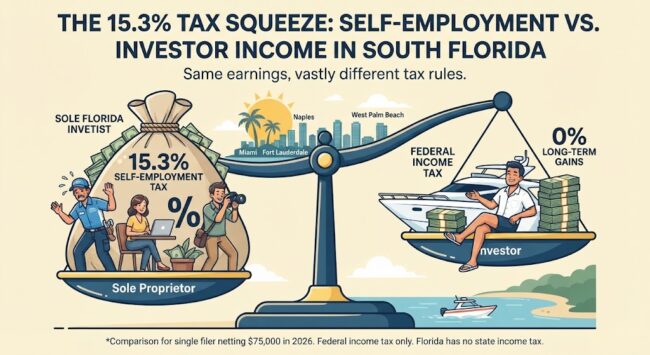
How Does the Same $75,000 Get Taxed Differently?
The tax code treats identical dollars very differently depending on where they come from.
$75,000 of Income, Single Filer, 2026
| How It’s Earned | Payroll Tax | Income Tax | Total |
|---|---|---|---|
| Self-employed (Schedule C) | ~$10,597 | ~$4,898 | ~$15,495 |
| W-2 salary | ~$5,738 | ~$7,670 | ~$13,408 |
| Long-term gains & qualified dividends | $0 | ~$1,418 | ~$1,418 |
FAN calculations. The W-2 employer separately pays ~$5,738 in matching payroll tax.
The investor’s bill is low because the first $49,450 of a single filer’s taxable income is taxed at 0% when it comes from long-term gains or qualified dividends. After the standard deduction, the investor in this example has $58,900 of taxable income, so only $9,450 is taxed, at 15%.
Which Tax Advantages Go to Everyone But the Self-Employed?
Advantages for Salaried Workers
Half the payroll tax is invisible. An employee sees 7.65% withheld. The other 7.65% is paid by the employer and never appears on the employee’s tax return. Many economists argue workers ultimately bear that cost through lower wages, but the self-employed owner writes the full check.
Health insurance avoids both taxes. When an employer pays health premiums, that compensation escapes income tax and payroll tax. A self-employed owner can deduct health premiums for income tax purposes, but those premiums still count toward profit for self-employment tax. In South Florida, where individual-market premiums run high, that difference can be significant.
Overtime breaks. From 2025 through 2028, qualifying employees can deduct up to $12,500 of overtime pay ($25,000 for joint filers). The self-employed don’t earn “overtime,” no matter how many hours they work.
Advantages for Investors
Capital gains, dividends, and interest are never subject to Social Security or Medicare tax. A retiree in Naples living on a portfolio pays no payroll tax at all, while a Pembroke Pines bookkeeper pays 15.3% on her first dollar of profit.
Advantages for Landlords
Rental income from investment property is usually considered passive, so it generally isn’t subject to self-employment tax. Depreciation lets owners deduct part of the building’s cost every year, often reducing taxable income below actual cash flow. South Florida’s large base of condo and multifamily investors benefits directly.
What Are the Self-Employed Allowed to Use?
The tax code does give business owners tools. The key is knowing which tax each one actually reduces.
Strategies and What They Reduce
| Strategy | Cuts Income Tax | Cuts SE Tax |
|---|---|---|
| Deductible business expenses | Yes | Yes |
| S-corporation election | Sometimes | Yes |
| Hiring your minor children | Yes | Yes |
| QBI deduction (20%) | Yes | No |
| Solo 401(k) / SEP-IRA | Yes | No |
| Self-employed health insurance deduction | Yes | No |
| Health savings account | Yes | No |
The S-Corporation Election
For profitable South Florida owners, this is usually the most powerful option. An S-corp owner who works in the business must pay themselves a reasonable salary, which is subject to payroll tax. Profit beyond that salary can be paid out as distributions, which are not.
An illustration: An owner with $150,000 of profit as a sole proprietor owes roughly $21,194 in self-employment tax. As an S-corp paying a $70,000 salary, payroll tax on that salary would be about $10,710. That’s a gross difference of roughly $10,500.
FAN illustration only. Actual savings are reduced by payroll costs, a separate business tax return, and possible effects on the QBI deduction and retirement contributions.
The risk is the salary. The IRS can challenge a salary set too low for the work performed, so it should match what the business would pay someone else to do the job.
The QBI Deduction
Most self-employed owners can deduct up to 20% of qualified business income. The One Big Beautiful Bill Act made the deduction permanent, and beginning in 2026, owners who materially participate and have at least $1,000 of QBI get a minimum $400 deduction. It lowers income tax only.
Retirement Plans
A Solo 401(k) or SEP-IRA can shelter tens of thousands of dollars a year from income tax for a profitable owner. Contributions don’t reduce self-employment tax, but they’re often the largest single deduction a sole proprietor can take.
Hiring Your Kids
When a business is a sole proprietorship, or a partnership owned only by the parents, wages paid to the owner’s children under 18 are exempt from Social Security and Medicare tax. The work has to be real and the pay reasonable. The wages are deductible to the business, and the child’s own standard deduction can shelter much of that pay from income tax. This doesn’t work through an S-corporation.
Expenses Worth Reviewing
Because legitimate expenses cut both taxes, they’re the first place to look:
- A dedicated home office
- Business mileage or vehicle expenses
- Equipment, tools, and computers, which can often be deducted in the year purchased
- Professional licenses, continuing education, and association dues
- Business insurance, software subscriptions, and phone and internet service
- Marketing, website, and advertising costs
Isn’t Self-Employment Tax Just a Retirement Contribution?
Partly. Every dollar of self-employment tax counts toward your Social Security earnings record and Medicare eligibility. A South Florida business owner who pays in for decades builds the same retirement benefit as a salaried worker with similar earnings.
But that doesn’t erase the cash-flow problem. The tax is due on profit whether or not that profit sits in the bank, it’s owed in quarterly estimated payments, and it arrives with no standard deduction. For a new business owner reinvesting every dollar into growth, it can be the bill that breaks the budget.
Brian’s Take
South Florida sells itself to entrepreneurs as tax-free territory. That’s true for state income tax, and it’s a real advantage. But it creates a blind spot. Many owners who relocate from New York or New Jersey assume their tax burden will shrink dramatically, then discover the federal self-employment tax is still sitting there at 15.3%.
I’ve watched this from both sides, as a former money manager and now as a business owner. The investor with a $75,000 portfolio income pays about $1,400 in federal tax. The self-employed owner earning the same $75,000 by working for it pays about $15,500. You can debate whether that’s good policy, but every business owner should at least know the math.
My advice for South Florida owners heading into the end of 2026:
- Run the S-corp numbers if your profit is consistently well above a reasonable salary for your role.
- Open a retirement plan before year-end so you aren’t scrambling at tax time.
- Keep an expense log with receipts and mileage. It’s the only strategy that reduces both taxes, and it requires no new entity.
- Pay estimated taxes quarterly so the self-employment tax doesn’t arrive as a single surprise in April.
This article is general information, not tax advice. Talk to a licensed CPA or enrolled agent before making changes to your business structure or filings.
Frequently Asked Questions
How much is self-employment tax for a $75,000 business in 2026?
For a single filer, roughly $10,597. That’s 15.3% applied to 92.35% of the $75,000 net profit.
Do South Florida real estate agents pay self-employment tax?
Most do. Agents paid by commission as independent contractors generally report income on Schedule C and pay the full 15.3% on net earnings.
Why do investors pay less tax than small business owners?
Investment income like long-term capital gains and qualified dividends isn’t subject to Social Security or Medicare tax, and it’s taxed at preferential rates, including 0% for single filers with taxable income up to $49,450 in 2026.
Can I deduct my health insurance as a self-employed person?
Yes, for income tax purposes, if you aren’t eligible for an employer plan. The deduction does not reduce self-employment tax.
When does an S-corporation make sense?
Generally when profit is comfortably above a reasonable salary for the work you do, so the payroll tax savings on distributions outweigh the added accounting and payroll costs. A CPA can model it for your numbers.
Is self-employment tax capped?
The 12.4% Social Security portion stops at $184,500 of combined wages and self-employment earnings in 2026. The 2.9% Medicare portion has no cap, and an additional 0.9% applies above $200,000 for single filers.
Does Florida charge its own tax on self-employment income?
No. Florida has no personal income tax, so sole proprietors pay only federal income tax and federal self-employment tax on their business profit.
Sources and Further Reading
- Social Security Administration — Contribution and Benefit Base
- Internal Revenue Service — Tax Year 2026 Inflation Adjustments, Including Amendments from the One, Big, Beautiful Bill
- Internal Revenue Service — Revenue Procedure 2025-32
- Internal Revenue Service — Schedule SE (Form 1040), Self-Employment Tax
- Internal Revenue Service — Publication 15, Employer’s Tax Guide (Family Employees)
- Internal Revenue Service — Publication 535 and Publication 334, Small Business Tax Guidance
- Tax Foundation — 2026 Tax Brackets and Federal Income Tax Rates
- Congressional Research Service — Federal Individual Income Tax Brackets and Standard Deductions, 1988 to 2026
- CNBC — IRS Unveils Higher Capital Gains Tax Brackets for 2026
- Stinson LLP — One Big Beautiful Bill Explained
- Jackson Hewitt — How the One Big Beautiful Bill Impacts Self-Employed Workers
- Paycor — Social Security Taxable Wage Base and Limits, 2026
- Rudler, PSC — Key Payroll Tax Impacts of the 2026 Social Security Wage Base
About the Author