By Brian French | SouthFLBusinessNews.com | September 9, 2026
Quick Answer
Miami-Dade, Broward, Palm Beach, and Monroe counties cannot regulate worker heat exposure. Florida Statute § 448.111, enacted through HB 433 in 2024 in direct response to a proposed Miami-Dade ordinance, strips local governments of that power. What South Florida employers answer to instead is federal OSHA, which on April 10, 2026 reissued its heat National Emphasis Program for five years, expanded the target list to 55 industries, and instructed inspectors to run unannounced heat inspections whenever the National Weather Service Miami office issues a heat advisory. With Miami-Dade’s official heat season running May 1 through October 31 and advisories now triggered at a 105°F heat index, tri-county employers in construction, agriculture, marine trades, logistics, and hospitality are the most inspection-exposed outdoor workforce in the state.
The Ordinance That Triggered a State Law
South Florida is the reason Florida has a heat preemption statute. In 2023, Miami-Dade commissioners took up a worker-backed ordinance that would have required county contractors in construction and agriculture to provide water, 10-minute shaded breaks every two hours, and heat training. The measure was deferred repeatedly under pressure from builders and growers, and in early 2024 the Legislature passed HB 433 to make sure it could never return. Governor DeSantis signed it in April 2024, and the preemption took effect July 1 of that year.
The result is a policy inversion unique to this region. Miami-Dade employs the nation’s first Chief Heat Officer, publishes an annual heat season action plan, and runs public cooling campaigns, yet cannot legally require a landscaping contractor working county property to hand out water. Any protections South Florida workers receive come from federal enforcement or from employers acting voluntarily.
Why the Tri-County Area Is an Enforcement Target
Three factors put South Florida at the top of OSHA’s list this summer:
The advisory threshold is lower here. The NWS Miami office lowered its heat advisory criteria to a heat index of 105°F for two hours or more, down from 108°F, meaning advisories are issued far more often in Miami-Dade, Broward, and Palm Beach than in most of the country. Under the 2026 emphasis program, each advisory day is an inspection trigger.
The industry mix matches the target list. The revised program directs inspection priorities to 55 high-risk industries in indoor and outdoor work settings. South Florida’s economy concentrates the ones that matter: high-rise and infrastructure construction from Brickell to West Palm, row-crop and nursery agriculture in Homestead and the Redland, port and marine operations at PortMiami and Port Everglades, air cargo and last-mile warehousing around MIA and FLL, and outdoor tourism labor across Miami Beach, the Keys, and the cruise terminals.
The federal offices are here. OSHA’s Fort Lauderdale Area Office covers Miami-Dade, Broward, Palm Beach, and Monroe counties and has historically produced one of the highest heat-related citation counts of any office in the Southeast.
The Rules South Florida Employers Actually Face
General Duty Clause. Absent a federal heat standard, OSHA cites heat cases under Section 5(a)(1) of the OSH Act, which obligates employers to abate recognized hazards likely to cause death or serious harm. The agency has used this authority in South Florida after fatalities on roofing jobs, in agricultural fields, and inside unventilated warehouses.
The 2026 NEP, CPL 03-00-024. Beyond advisory-day inspections, the directive tells compliance officers to expand any inspection already underway when they see heat hazards on heat priority days, and it introduces two reorganized appendices, one for evaluating heat programs and another for citation guidance. The second appendix matters: it standardizes what a citable heat violation looks like, reducing the discretion South Florida employers once relied on.
Proposed federal rule as benchmark. OSHA’s draft Heat Injury and Illness Prevention standard remains frozen, but its thresholds are the yardstick inspectors apply. An initial trigger at 80°F heat index calls for drinking water, break areas, and acclimatization for new or returning workers; a high heat trigger at 90°F adds mandatory 15-minute paid rest breaks every two hours and observation for signs of heat illness. In Miami, the 80°F trigger is met before sunrise most summer days, and the 90°F trigger by 9 a.m.
Standards already on the books. Construction sanitation rules require potable water on every site; agricultural field sanitation rules under 29 CFR 1928.110 require water, toilets, and handwashing within a quarter mile of workers, a provision heavily enforced in Homestead growing operations; and injury recordkeeping rules require heat illnesses involving medical treatment or lost time to appear on the OSHA 300 log.
Where the Money Is at Risk
| Risk Channel | South Florida Context |
|---|---|
| OSHA penalty | $16k+ serious, $160k+ willful, per violation |
| Comp claim | Heat stroke claims commonly $50k–$150k |
| Experience mod | Three-year premium impact after a claim |
| GC pass-through | Controlling employer cited for sub’s crew |
| Civil suit | Only if § 440.11 intentional-tort bar is cleared |
| Public contracts | County vendor debarment after citations |
| Reputation | OSHA publishes news releases on heat deaths |
Workers’ compensation remains the injured worker’s exclusive remedy against a Florida employer, and heat exhaustion, heat stroke, and kidney injury from dehydration are compensable under Chapter 440. The narrow civil exception applies only when an employer knew injury was virtually certain and concealed the danger. South Florida plaintiffs’ firms have tested that standard in heat cases involving prior incidents on the same crew and ignored complaints; the bar is high but not theoretical.
General contractors on the region’s condominium and infrastructure projects carry the added exposure of OSHA’s multi-employer worksite doctrine. A GC that controls the site can be cited for a drywall or stucco subcontractor’s failure to provide water and shade, and under Florida’s statutory employer rule the GC becomes liable for comp benefits if the sub is uninsured.
What a Defensible Program Looks Like in Miami-Dade
The employers in the region who have stopped worrying about inspections share a common structure. It is not required by Florida law, but it is what OSHA’s evaluation appendix is built to check.
Site-based measurement. A wet-bulb globe temperature meter or heat index reading taken on the job site at the start of each shift and at midday. Airport readings understate conditions on a concrete deck in Doral or a cleared lot in Florida City by five to ten degrees.
Written plan with a named coordinator. One document per site, in English, Spanish, and Haitian Creole for most tri-county crews, identifying triggers, controls, emergency steps, and the person authorized to stop work.
Water logistics. One quart per worker per hour, staged within a short walk of the task, with supervisors prompting consumption rather than waiting for workers to ask. Electrolyte options for long shifts.
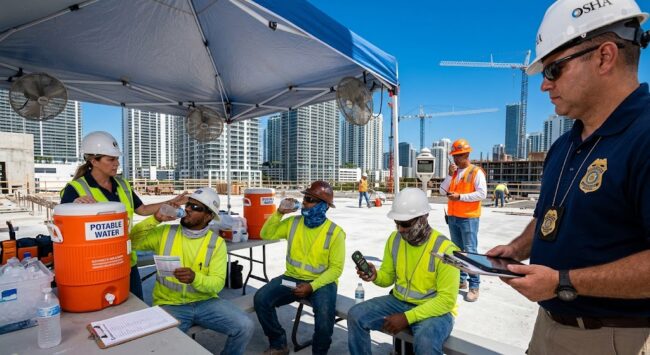
Shade and cooling. Pop-up canopies, air-conditioned trailers or vehicles, and misting fans on high-rise decks where canopies are impractical.
Paid breaks tied to the index. Fifteen minutes every two hours once the heat index hits 90°F, more often above 100°F or for workers in Tyvek, respirators, or harnesses.
Acclimatization schedule. New hires and workers returning from a week or more away ramp over five to seven days. South Florida’s high seasonal turnover in landscaping and construction makes this the most frequently missing element.
Observation and stop-work authority. Buddy pairing and supervisor training to recognize confusion, staggering, and cessation of sweating, with explicit authority to halt work without calling the office first.
Emergency cooling on site. Ice, water, and shade staged for immediate cooling before transport. The Miami-Dade and Broward fire-rescue response window is short, but cooling in the first minutes is what determines outcomes.
Schedule shifts. June through September start times of 5 or 6 a.m. are now standard among the region’s larger paving, roofing, and utility contractors, with heavy tasks front-loaded.
Sector Watch: South Florida
Construction. The region’s tower crane count and infrastructure pipeline, including Brightline-adjacent development, PortMiami expansion, and the I-95 and I-395 corridors, mean thousands of workers on exposed decks daily. Roofing and concrete remain the leading sources of heat fatalities.
Agriculture. Homestead and Redland growers face NEP inspections layered on federal field sanitation and H-2A housing rules, and the workforce has been thinned by immigration enforcement, increasing the share of newly hired, unacclimatized workers.
Marine and port trades. Dock, container yard, boatyard, and cruise terminal labor at PortMiami, Port Everglades, and the Miami River yards was added to the expanded target list.
Logistics. Air cargo handlers at MIA, the nation’s largest international freight airport, and warehouse crews across Medley, Doral, and Pompano operate in facilities where indoor temperatures now fall within NEP scope.
Hospitality and tourism. Beach concessions, golf course maintenance, marina staff, event setup crews, and valet operations across Miami Beach, Fort Lauderdale, and the Keys are newly named industries under the 2026 program.
Brian’s Take
South Florida spent two years fighting over whether a county could require a water break, and the state answered no. Meanwhile the federal government quietly built the most aggressive heat inspection regime in its history and pointed it at the exact industries that lobbied against the Miami-Dade ordinance. The employers who won the political fight in Tallahassee did not win the compliance fight; they moved it from a county inspector to a federal one with larger penalties and a press office.
The regional economics favor doing the program anyway. A tri-county contractor with a written plan, meters, canopies, and a Spanish-language training record will close most NEP inspections without a citation. One without them risks a $16,000 serious violation on the first visit, a repeat violation on the second, and the loss of county and municipal contracts that increasingly screen for OSHA history. Against that, the total cost of a heat program for a 40-person crew is a rounding error on a South Florida construction budget.
The labor market is doing the rest. In a region where crews can pick between employers, the firms known for August hospital runs are the ones short on workers in September. Heat safety in Miami has become a recruiting line item whether the Legislature says so or not.
Frequently Asked Questions
Can Miami-Dade or Broward County require heat breaks for outdoor workers?
No. Florida Statute § 448.111, enacted in 2024, preempts any local heat exposure requirement. The proposed Miami-Dade ordinance was the direct cause of the law.
What heat index triggers a heat advisory in South Florida?
The NWS Miami office issues heat advisories at a heat index of 105°F sustained for two hours or more, a lower threshold than most of the country. Each advisory day is an inspection trigger under OSHA’s 2026 emphasis program.
Does OSHA have a South Florida office?
Yes. The Fort Lauderdale Area Office covers Miami-Dade, Broward, Palm Beach, and Monroe counties.
Are indoor warehouses covered by the heat emphasis program?
Yes. The program covers indoor and outdoor heat hazards, and South Florida’s logistics and air cargo facilities are within its expanded industry list.
Is a heat illness a workers’ comp claim in Florida?
Yes. Heat-related injuries arising in the course of employment are compensable under Chapter 440, and comp is generally the worker’s only remedy against the employer.
Can a general contractor be cited for a subcontractor’s heat violation?
Yes. OSHA’s multi-employer worksite doctrine allows citation of the controlling employer on a site, which is routine on South Florida high-rise projects.
Does the preemption law stop employers from adopting their own heat rules?
No. Section 448.111 restricts local governments, not private employers. Voluntary programs remain the standard defense in an OSHA inspection.
Sources and Further Reading
- Florida Statutes § 448.111, Preemption of Heat Exposure Requirements – https://www.leg.state.fl.us/statutes/index.cfm?App_mode=Display_Statute&URL=0400-0499/0448/Sections/0448.111.html
- Florida Senate, HB 433 (2024), Employment Regulations – https://www.flsenate.gov/Session/Bill/2024/433
- OSHA, US Department of Labor Updates National Emphasis Program to Protect Workers from Indoor, Outdoor Heat Hazards (April 10, 2026) – https://www.osha.gov/news/newsreleases/osha-national-news-release/20260410
- OSHA, CPL 03-00-024, National Emphasis Program – Outdoor and Indoor Heat-Related Hazards – https://www.osha.gov/enforcement/directives
- Ogletree Deakins, OSHA Revives National Emphasis Program for Heat-Related Illness (2026) – https://ogletree.com/insights-resources/blog-posts/osha-revives-national-emphasis-program-for-heat-related-illness/
- Workplace Compliance Insights, OSHA Updates Heat NEP: 55 High-Risk Industries (April 2026) – https://workplacecomplianceinsights.com/articles/osha-updates-heat-nep-55-industries-2026/
- OSHA, Heat Injury and Illness Prevention Rulemaking – https://www.osha.gov/heat-exposure/rulemaking/
- Miami-Dade County, Office of Resilience, Extreme Heat Action Plan – https://www.miamidade.gov/global/economy/resilience/extreme-heat.page
- National Weather Service Miami-South Florida, Heat Safety and Advisory Criteria – https://www.weather.gov/mfl/
- Florida Statutes § 440.11, Exclusiveness of Liability – https://www.leg.state.fl.us/statutes/index.cfm?App_mode=Display_Statute&URL=0400-0499/0440/Sections/0440.11.html
- OSHA, 29 CFR 1928.110, Field Sanitation – https://www.osha.gov/laws-regs/regulations/standardnumber/1928/1928.110
- OSHA Fort Lauderdale Area Office – https://www.osha.gov/contactus/bystate/FL/areaoffice
About the Author