Quick Answer: The South Florida Water Management District adopted a $1,622,385,541 budget for fiscal year 2026-27 on September 22, 2026, up about 20.9% from the prior year’s $1.34 billion, largely because of roughly $316.6 million in federal Everglades construction money. Property tax rates stayed flat at 0.0948 mill district-wide, which is above the rolled-back rate, and the tentative budget put ad valorem revenue at about $419.6 million.
The agency that runs South Florida’s flood-control canals, pump stations and much of its Everglades restoration work is spending more this year than at any point in the past several budget cycles. The Governing Board of the South Florida Water Management District (SFWMD) adopted its fiscal year 2026-27 final budget and four final millage rates at a public hearing on Tuesday, September 22, 2026, at its West Palm Beach headquarters on Gun Club Road. The fiscal year began October 1, 2026, and runs through September 30, 2027.
For businesses and property owners from West Palm Beach to Key West, the numbers matter in three ways. They set a line on every property tax bill in the District. They decide how fast aging flood-control structures get repaired or replaced. And they move hundreds of millions of dollars in construction contracts through the regional economy.
How big is the SFWMD budget for fiscal year 2026-27?
The adopted budget is $1,622,385,541, set by Resolution No. 2026-0918. That compares with an adopted budget of $1,342,098,977 for fiscal year 2025-26, an increase of $280.3 million, or about 20.9%.
The final figure is lower than the $1,660,774,085 tentative budget the District submitted on July 31. According to the District’s September 10 hearing presentation, the $38.4 million cut came mostly from a $37.0 million reduction in state land acquisition, restoration and public works money tied to an August budget amendment under 2026 House Bill 5001. Other changes included a $1.2 million reduction in a federal Dispersed Water Management grant, a $1.5 million C-31 canal bank stabilization grant that went from the Florida Department of Environmental Protection to Osceola County, and a $1.3 million upward reconciliation of prior-year appropriations.
Key facts: SFWMD FY2026-27 budget at a glance
| Item | FY2026-27 |
|---|---|
| Adopted total budget | $1,622,385,541 |
| Change from FY2025-26 adopted | +$280.3 million (+20.9%) |
| District-wide millage | 0.0948 mill (unchanged) |
| Ad valorem revenue (tentative budget) | $419,642,126 |
| Federal revenue | $316,625,093 |
| Fixed capital outlay | $949,507,239 |
| Authorized positions (FTEs) | 1,523 |
| Emergency response reserves | $58,980,522 |
| New debt | None (pay-as-you-go) |
The District covers about 18,000 square miles across all or part of 16 counties, including Palm Beach, Broward, Miami-Dade and Monroe, and serves more than 9 million residents, according to its tentative budget. Its system includes more than 2,300 miles of canals, 2,200 miles of levees and berms, 936 water control structures, 620 culverts and 98 pump stations.
Where does the SFWMD’s money come from this year?
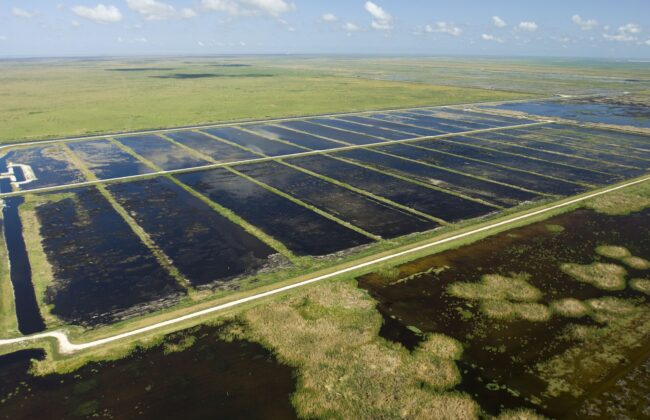
The biggest change is on the revenue side. Federal revenue jumped from $15.4 million in the 2025-26 adopted budget to $316.6 million in 2026-27. The tentative budget says the increase “primarily reflects the addition of onetime federal grant funding” for two Central Everglades Planning Project (CEPP) components: the South Blue Shanty Flow-way and the S-636 Seepage Pump Station in the Everglades Agricultural Area.
| Revenue source | FY2025-26 adopted | FY2026-27 adopted | Share of FY27 |
|---|---|---|---|
| State | $768,773,309 | $718,492,024 | 44% |
| District revenues (incl. property taxes) | $467,511,292 | $492,797,709 | 30% |
| Federal | $15,356,481 | $316,625,093 | 20% |
| Fund balance | $90,384,265 | $94,397,085 | 6% |
| Local | $73,630 | $73,630 | <1% |
| Total | $1,342,098,977 | $1,622,385,541 | 100% |
State money remains the largest single source at $718.5 million, but it fell about 6.5% from the prior year. District revenues, the category that includes property taxes, agricultural privilege taxes and permit fees, rose about 5.4% to $492.8 million.
How much property tax revenue will the District collect?
The District’s tentative budget projected ad valorem revenue of $419,642,126 for 2026-27, up $22,922,581, or 5.8%, from $396,719,545 in the 2025-26 adopted budget. The adopted budget submission does not break out a separate ad valorem total, and the millage rates adopted in September were the same ones proposed in the tentative budget. The District attributes the growth to rising property values, new construction and keeping the millage rate unchanged. Because federal money grew so much faster, property taxes fall from 29.6% of total revenue in 2025-26 to about 25.3% in the tentative 2026-27 plan.
The adopted budget also sets aside $10,675,000 for fees paid to county tax collectors and property appraisers.
What are the SFWMD millage rates for 2026-27?
The Governing Board kept all four millage rates the same as in 2025-26. Those rates were also unchanged from 2024-25. Each rate is higher than the rolled-back rate, the rate that would raise the same property tax revenue from existing property as the year before.
| Levy | FY2026-27 final | FY2026-27 rolled-back | Above rolled-back |
|---|---|---|---|
| District-wide | 0.0948 | 0.0906 | 4.6% |
| Okeechobee Basin | 0.1026 | 0.0977 | 5.0% |
| Everglades Construction Project | 0.0327 | 0.0312 | 4.8% |
| Big Cypress Basin | 0.0978 | 0.0965 | 1.3% |
Percentages above rolled-back are calculated from the District’s hearing figures. The Everglades Construction Project levy applies within the Okeechobee Basin, so property in that basin pays a combined rate of 0.2301 mill, or $23.01 per $100,000 of taxable value. Property in the Big Cypress Basin pays a combined 0.1926 mill, or $19.26 per $100,000.
What does that mean for a property owner’s tax bill?
At the combined Okeechobee Basin rate, a property with $400,000 in taxable value pays about $92 a year to the District. A commercial property with $750,000 in taxable value pays about $173. At the Big Cypress Basin rate, the $400,000 property pays about $77. These are small lines on a total tax bill. Still, because the rates were held above rolled-back, owners whose taxable values rose will see a larger District charge than last year, even though the rate did not change. Property owners can check their annual TRIM notice to see which basin levy applies to them.
The District’s slides say the ad valorem levy pays for “operations and maintenance of existing aging flood control infrastructure” and completed Comprehensive Everglades Restoration Plan (CERP) projects that have been turned over for operation. One stated goal is to “Align recurring expenses with recurring revenues.” The tentative budget notes that the District’s ongoing policy is to levy the rolled-back rate, and that this year’s proposal departs from it by keeping the current rate. It also cites a 12% decrease in the recurring ad valorem-funded operating budget, along with 319 fewer positions, over 17 years.
How much is going to Everglades restoration?
Restoration and construction dominate the budget. The Land Acquisition, Restoration and Public Works program totals $1,069,637,151, about 66% of all spending and 36.6% more than the $783.1 million budgeted a year earlier. Fixed capital outlay, which is mainly construction, rises 44% to $949.5 million from $659.3 million.
The tentative budget cover letter lists more than $900 million in state and federal funding for CERP. Major amounts named in the July 31 tentative budget include:
- $201.5 million in federal funds for the CEPP South Blue Shanty Flow-way and $97.1 million in federal funds for the EAA S-636 Seepage Pump Station.
- $50.0 million in state funds for the Lake Okeechobee Watershed Restoration Project.
- $38.6 million in new state funding for the Lower Kissimmee Basin Stormwater Treatment Area.
- $20 million in state funds for the Western Everglades Restoration Project.
- $15 million for CEPP South S-355 and $10.7 million for the CEPP North L-5 Remnant Canal.
- $74.6 million in state funds for Northern Everglades and Estuaries Protection Program (NEEPP) work, including the Boma Flow Equalization Basin, planning and Dispersed Water Management.
The tentative budget put state-sourced Everglades restoration at $605 million, including $525.4 million for CERP and $79.6 million for NEEPP and Dispersed Water Management. Some state amounts were reduced before final adoption, so the final project-level totals may differ from these tentative figures. Biscayne Bay Coastal Wetlands and the C-43 West Basin Storage Reservoir are listed as ongoing construction, without separate dollar amounts in the sections reviewed.
How much will the District spend on flood control and aging infrastructure?
For many coastal businesses, flood control matters more than restoration. The Operation and Maintenance of Lands and Works program is budgeted at $422.9 million, down 1.5% from $429.4 million last year. The tentative budget cover letter breaks out the major pieces:
- More than $97 million for capital rehabilitation, replacement and adaptation of flood-control infrastructure, much of which it describes as more than 60 years old.
- More than $100 million for ongoing operation and maintenance of the Central and Southern Florida flood control system, the Big Cypress Basin, Stormwater Treatment Areas, and recreational and conservation lands.
- $58.9 million for hurricanes, tropical weather and other flood emergencies, matching the $58,980,522 emergency response reserve in the adopted budget.
From the Preliminary to the Tentative budget, the District added $29.0 million to the operations and maintenance program, mostly $20.0 million in operating capital outlay aimed at aging flood-control infrastructure. The tentative budget also lists $44.0 million in potential coastal resiliency grants. Its flood resiliency section names the S-71 Spillway, S-7 pump refurbishment, S-169W structure improvements, G-539 pump replacement, and design of the S-27, S-28 and S-29 pump stations. The G-6A pump station and an emergency operations center backup facility are under construction, and money was reallocated to replace the S-65D and S-71 structures.
What does the budget mean for South Florida agriculture?
Farms pay their own special levies. On September 10, the Board certified the 2026 Everglades Agricultural Area privilege tax roll at $25.00 per acre on 431,269.90 taxable acres. That generates $10,781,747.50 gross, or $10,350,477.60 after the budgeted discount. The C-139 Basin agricultural privilege tax is $1.80 per acre on 108,899.73 acres, about $188,179 after discount.
The tentative budget expects these taxes to stay at about $10.5 million this year. It projects a drop of about $2.1 million starting in fiscal year 2027-28, as land leaves lease and the statutory EAA rate falls from $25 to $20 per acre under Section 373.4592, Florida Statutes. Growers are also directly affected by the restoration construction happening on and around farmland south of Lake Okeechobee, including the Dispersed Water Management program and the Lower Kissimmee Basin STA. During 2025-26, the District bought 4,831.61 acres for $41.25 million for the Lower Kissimmee Basin STA project.
What does it mean for developers, builders and contractors?
For the construction and engineering trades, the $949.5 million in fixed capital outlay is the headline. Much of it pays for pump stations, flow-ways and conveyance work tied to Everglades restoration and flood control. Because the federal share is described as onetime grant funding, contractors should not assume the 2026-27 level will carry into future years.
Developers deal with the District mainly through permitting. The Regulation program is budgeted at $26.2 million, up $657,386, or 2.6%, mainly because of health insurance and salary costs. The tentative budget projected permit, license and fee revenue of $4.7 million, up $1.0 million, or 27.8%, driven by Environmental Resource Permit fees. The Alternative Water Supply program, which helps local utilities develop new water sources, has $9 million in state funding.
How are spending categories changing?
| Program | FY2025-26 adopted | FY2026-27 adopted |
|---|---|---|
| Water Resources Planning & Monitoring | $60,433,217 | $57,528,187 |
| Land Acquisition, Restoration & Public Works | $783,103,213 | $1,069,637,151 |
| Operation & Maintenance of Lands & Works | $429,412,588 | $422,899,069 |
| Regulation | $25,503,763 | $26,161,149 |
| Outreach | $1,143,646 | $1,166,527 |
| Management & Administration | $42,502,550 | $44,993,458 |
The District reports no new debt; debt service is $27.1 million, and it says a refinancing of certificates of participation saves about $3.16 million a year. Authorized staffing stays at 1,523 full-time equivalents.
What should South Florida businesses watch next?
Three points from the budget documents stand out. First, about 20% of this year’s money is one-time federal funding, so next year’s total could fall sharply if those grants are not replaced. Second, the District kept millage above the rolled-back rate for a second straight year, which means property tax collections will keep rising with taxable values. Third, agricultural privilege tax revenue is expected to fall in 2027-28 under the scheduled statutory rate cut, which will put more pressure on other revenue sources. Estimated reserves at September 30, 2026, total $163.7 million, including $122.3 million in restricted funds.
Frequently Asked Questions
What is the SFWMD’s total budget for fiscal year 2026-27?
$1,622,385,541, adopted September 22, 2026. That is about 20.9% more than the $1,342,098,977 adopted for 2025-26.
Did the South Florida Water Management District raise its tax rate?
No. The rates are unchanged: 0.0948 mill district-wide, 0.1026 for the Okeechobee Basin, 0.0327 for the Everglades Construction Project and 0.0978 for the Big Cypress Basin. However, each rate is above the rolled-back rate, so total property tax collections rise as property values grow.
How much property tax does the District expect to collect?
The tentative budget projected $419,642,126 in ad valorem revenue, up 5.8% from $396,719,545 the year before, at the same rates later adopted.
Why did the budget grow so much?
Mostly because of one-time federal grants for the CEPP South Blue Shanty Flow-way ($201.5 million) and the EAA S-636 Seepage Pump Station ($97.1 million), according to the tentative budget. Federal revenue rose from $15.4 million to $316.6 million.
How much is set aside for hurricanes and flood emergencies?
The adopted budget carries $58,980,522 in emergency response reserves for hurricanes, tropical weather and other unforeseen flood emergencies.
What do farmers pay under the budget?
The Everglades Agricultural Area privilege tax is $25.00 per acre on about 431,270 acres, budgeted at $10.35 million. The C-139 Basin tax is $1.80 per acre.
Sources and Further Reading
- Fiscal Year 2026-2027 SFWMD Adopted Budget Submission — South Florida Water Management District
- SFWMD Fiscal Year 2026-2027 Tentative Budget Submission (July 31, 2026) — South Florida Water Management District
- FY2026-2027 Second Public Budget Hearing presentation (September 22, 2026) — South Florida Water Management District
- FY2026-2027 First Public Budget Hearing presentation (September 10, 2026) — South Florida Water Management District
- Final Public Hearing on Fiscal Year 2026-2027 Final Millage Rates and Final Budget, agenda — South Florida Water Management District
- FY2025-2026 SFWMD Final Adopted Budget — South Florida Water Management District
- FY2025-2026 Second Public Hearing presentation (September 23, 2025) — South Florida Water Management District
About the Author