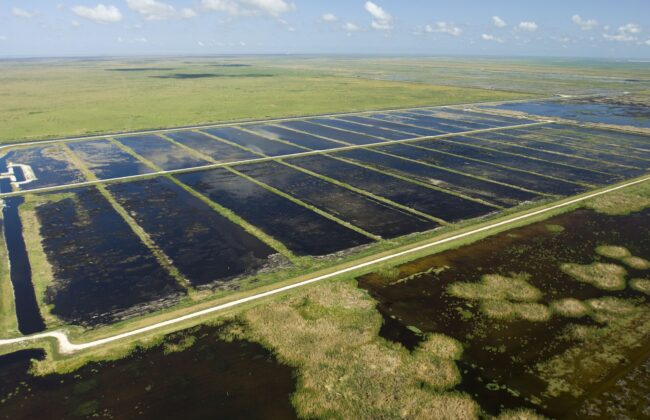
Everglades Stormwater Treatment Areas, aerial view (2014). Photo: U.S. Environmental Protection Agency via Wikimedia Commons. Public domain (U.S. government work).
Quick Answer
The Everglades Agricultural Area (EAA) Reservoir in western Palm Beach County is a 10,500-acre, 240,000-acre-foot storage project paired with a 6,500-acre treatment marsh. A July 2025 state-federal agreement moved its completion target from 2034 to 2029, and in April 2026 officials said all reservoir construction contracts had been executed.
What Is the EAA Reservoir?
South of Lake Okeechobee, in the farm country of western Palm Beach County, a multibillion-dollar public works project is under construction. The Everglades Agricultural Area Reservoir is designed to capture, store, treat and move water from Lake Okeechobee to the central and southern Everglades, according to the U.S. Army Corps of Engineers.
The South Florida Water Management District (SFWMD) describes the project in two main parts. The reservoir itself covers 10,500 acres and will store 240,000 acre-feet of water, more than 78 billion gallons. Next to it, a 6,500-acre stormwater treatment area (STA), a constructed wetland built by the district, cleans the water before it moves south. The district says the system will be able to deliver up to 470 billion gallons of water a year to the Everglades and Florida Bay.
For South Florida’s business community, the reservoir matters on two levels. It is a multi-billion-dollar construction program that runs through regional contractors, suppliers and labor markets. And it is part of the long-running effort to manage how water moves from Lake Okeechobee toward the Everglades and Florida Bay, a system that touches much of the region.
EAA Reservoir Project Snapshot
| Item | Detail |
|---|---|
| Location | Western Palm Beach County, south of Lake Okeechobee |
| Reservoir size | 10,500 acres |
| Reservoir storage | 240,000 acre-feet (more than 78 billion gallons) |
| Stormwater treatment area | 6,500 acres |
| Annual water delivery capacity | Up to 470 billion gallons |
| Inflow pump station | About 3 billion gallons per day |
| Embankment length | 17.3 miles (per 2022 reporting) |
| Reservoir plus STA | About 17,000 acres (roughly 26.6 square miles) |
| Estimated total cost | $3.9 billion (2022 estimate) |
| Current completion target | 2029 |
| Builders | U.S. Army Corps of Engineers (reservoir); SFWMD (STA, pump stations) |
Sources: South Florida Water Management District; U.S. Army Corps of Engineers; TCPalm.
Who Is Building What?
The project is a partnership, and the division of labor matters for anyone tracking contracts.
According to the Army Corps, it is responsible for the reservoir foundation, embankments, perimeter canals and structures, and it executes the three main construction contracts, known as 10A, 11A and 11B. The South Florida Water Management District builds the seepage and inflow pump stations and is responsible for the Blue Shanty Flow Way.
What Are the Main Reservoir Contracts?
| Contract | Scope | Status or deadline |
|---|---|---|
| 10A | Inflow, outflow and seepage canals | Complete |
| 11A | Reservoir foundation | Scheduled completion by March 2028 |
| 11B | Embankment and water control structures | Required completion by December 2029 |
Source: U.S. Army Corps of Engineers (April 2026).
Who Won the Foundation Work?
TCPalm reported in October 2022 that the Army Corps awarded the foundation contract to Forgen-Odin JV of Rocklin, California, with a value of $308 million to $492 million. The scope included clearing, grubbing, de-mucking, blasting, foundation preparation, a seepage cutoff wall and canal backfilling. The foundation is 260 feet wide on the north, east and west sides and 235 feet wide on the south side, according to that report.
The walls themselves, a 17.3-mile embankment dam, were to be awarded under a separate contract. That is the embankment and structures work now covered by Contract 11B.
How Did the Timeline Change?
The schedule has shifted significantly since the project began.
EAA Reservoir Milestones
| Date | Milestone |
|---|---|
| 2000 | Conditionally authorized in the Water Resources Development Act |
| 2017 | Florida Senate Bill 10 advances the reservoir |
| March 5, 2018 | Final state order approving the Post Authorization Change Report |
| April 2020 | STA construction begins; STA permit and Record of Decision issued |
| May 2020 | Final Environmental Impact Statement and Record of Decision for the Section 203 study |
| April 29, 2021 | Project Partnership Agreement |
| September 2022 | Foundation contract awarded to Forgen-Odin JV |
| February 2023 | Army Corps breaks ground on the reservoir |
| January 2024 | STA begins filling after a ribbon cutting |
| July 2025 | State-federal agreement moves completion from 2034 to 2029 |
| November 2025 | Groundbreaking on the inflow pump station |
| April 2026 | Officials announce all reservoir contracts executed |
| March 2028 | Foundation contract 11A scheduled completion |
| December 2029 | Embankment contract 11B required completion |
Sources: SFWMD; U.S. Army Corps of Engineers; TCPalm.
Why Did the Schedule Move Up Five Years?
SFWMD says a July 2025 agreement between the State of Florida and the U.S. Department of the Army moved the reservoir’s construction timeline up five years, from 2034 to 2029. In April 2026, the Army Corps announced the full execution of accelerated contracts tied to that schedule.
National Parks Traveler reported on April 14, 2026, that more than $2 billion in federal funding was committed to speed completion, following the 2025 agreement, and that the Army Corps’ Jacksonville District modified the reservoir contract.
Schedules for the project have been reported differently over time. A 2022 TCPalm timeline listed 2029 for reservoir completion, while the Army Corps describes 2034 as the projected completion date that the 2025 agreement replaced.
How Much Water Will the Reservoir Move?
The numbers are large enough to be hard to picture. SFWMD puts reservoir storage at 240,000 acre-feet. An acre-foot is the amount of water needed to cover one acre to a depth of one foot, so the reservoir can hold enough to cover 240,000 acres a foot deep.
The inflow pump station, which broke ground in November 2025, will be able to move about 3 billion gallons of water per day from Lake Okeechobee into the reservoir, according to SFWMD.
TCPalm’s 2022 reporting added two context points from the water management district: about 46% of the water the reservoir handles comes from Lake Okeechobee, and the reservoir’s capacity equals about half a foot of water across the lake’s 730 square miles.
What Do These Numbers Mean in Practical Terms?
A few simple conversions help put the published figures in perspective:
| Measure | Published figure | What it works out to |
|---|---|---|
| Reservoir area | 10,500 acres | About 16.4 square miles |
| Reservoir plus STA | 17,000 acres | About 26.6 square miles |
| Storage | 240,000 acre-feet | About 78 billion gallons |
| Annual delivery | Up to 470 billion gallons | About 1.3 billion gallons a day on average |
| Inflow pumping | About 3 billion gallons a day | Roughly 26 days of pumping to equal full storage |
Sources: SFWMD figures; conversions by Florida Authority Network™.
The last line is a theoretical calculation based on the pump station’s stated capacity, not an operating plan. It shows the scale of the inflow pump station relative to the reservoir: the station is sized to move very large volumes in a short period.
The annual delivery figure is also larger than the reservoir’s storage. That reflects the fact that the system is designed to keep moving water through it over the course of a year, rather than simply filling once and holding.
How Does the Treatment Marsh Work?
Stormwater treatment areas are constructed wetlands that clean water before it flows into the Everglades. SFWMD began building the 6,500-acre EAA STA in April 2020 and started filling it in January 2024. With the STA already operating, the reservoir is the remaining large piece needed to complete the storage-and-treatment system.
What Is the Blue Shanty Flow Way?
The Blue Shanty Flow Way is a related component that SFWMD has taken responsibility for building. According to the Boca Post’s April 2026 report, its ground-breaking came about two months after the July 2025 state-federal agreement, and state officials said its cost would be about half of the original federal estimate. The report did not give a dollar figure.
The EAA Reservoir itself is one of four phases of the Central Everglades Planning Project, the Army Corps says, so the reservoir is part of a larger sequence of work rather than a standalone fix.
How Much Is Florida Spending on Everglades Restoration?
The reservoir sits inside a broader state spending program. The Boca Post reported in April 2026 that state officials cited nearly $8 billion committed to Everglades restoration and water quality since Governor Ron DeSantis took office, including $3.3 billion in his first term and $4.6 billion in the first three years of his second term, with $1.4 billion proposed in the 2026 state budget.
Those are state totals for restoration and water quality broadly, not the cost of the reservoir alone. The most recent total project cost estimate found for the reservoir itself is the $3.9 billion figure reported by TCPalm in 2022, which predates the accelerated schedule and should be treated as an older estimate.
What Does the Reservoir Mean for South Florida Business?
A project of this size creates demand that ripples out well beyond the job site. The scope described by the Army Corps and in contract reporting points to several business segments with a direct stake:
- Heavy civil contractors and subcontractors for earthwork, blasting, canal construction and embankment building
- Aggregate, concrete and materials suppliers for foundations, structures and the cutoff wall
- Equipment dealers, rental fleets and repair shops serving long-duration earthmoving work
- Engineering, surveying, testing and environmental consulting firms
- Trucking and logistics companies moving materials into western Palm Beach County
- Local service businesses in the communities around the work area, from fuel and food to lodging for crews
Because the Army Corps and SFWMD both run procurement, firms that want a piece of the remaining work need to follow both agencies’ contracting channels. The federal contracts are posted through the federal procurement system, while the district handles its own pump station and flow way work.
Why Does the Completion Date Matter Commercially?
A firm 2029 target compresses spending into a shorter window. Work that might have been spread over the years to 2034 now has to be done by the end of 2029, which concentrates contractor activity, materials demand and hiring into the next few years. For regional construction firms, that means a busier pipeline in the near term, but also competition for crews and equipment on a job of this scale.
Brian’s Take
The part of this story I keep coming back to is the schedule. When a project of this size moves its finish line from 2034 to 2029, the money does not shrink, it gets compressed. Contract 11A is due by March 2028 and Contract 11B by December 2029. That puts a lot of earthmoving, materials and labor into a short window, and South Florida contractors and suppliers will feel it.
I also want readers to be careful with the cost number. The $3.9 billion estimate is from 2022, before the acceleration and before more than $2 billion in federal funding was committed to speed things up. When I reviewed projects as an analyst, I always wanted the most recent cost estimate, not the one from the groundbreaking era. That updated figure is the number to watch.
The bigger picture is that water infrastructure is business infrastructure in South Florida. A reservoir that can store more than 78 billion gallons and deliver up to 470 billion gallons a year south is a long-term asset for the region. For the companies building it, the next four years are the opportunity.
Frequently Asked Questions
Where is the EAA Reservoir?
It is in western Palm Beach County, south of Lake Okeechobee, in the Everglades Agricultural Area.
How big is the EAA Reservoir?
SFWMD says the reservoir covers 10,500 acres and stores 240,000 acre-feet, more than 78 billion gallons, with an adjacent 6,500-acre stormwater treatment area.
When will the EAA Reservoir be finished?
The current target is 2029, five years earlier than the previous 2034 date, under a July 2025 agreement between Florida and the U.S. Department of the Army.
How much does the EAA Reservoir cost?
TCPalm reported a total estimated cost of $3.9 billion in 2022. In April 2026, National Parks Traveler reported more than $2 billion in federal funding committed to accelerate completion.
Who is building the EAA Reservoir?
The U.S. Army Corps of Engineers builds the reservoir, canals and structures. SFWMD built the stormwater treatment area and is building the pump stations and Blue Shanty Flow Way.
How much water will it deliver?
Up to 470 billion gallons a year to the Everglades and Florida Bay, according to SFWMD.
Sources and Further Reading
- Major Progress Continues on the Everglades Agricultural Area Reservoir Project, South Florida Water Management District
- ASA Announces Expedited Completion of the Everglades Agricultural Area Reservoir Project, U.S. Army Corps of Engineers (DVIDS)
- Army Corps awards key contract to build EAA reservoir foundation for walls, TCPalm
- Reservoir Important to Everglades Restoration Receives Funding to Support Completion, National Parks Traveler
- DeSantis, Army Corps Say All EAA Reservoir Contracts Are Executed, Locking In 2029 Completion Goal, Boca Post
About the Author