FOR IMMEDIATE RELEASE
Ten Years, One Question: Can South Florida Train Builders as Fast as It Draws Them on Paper?
ABC Florida East Coast Chapter says the region’s 2036 skyline is being decided now — in apprenticeship classrooms, not just architecture studios
Coconut Creek, FL — Ask an economist what will shape Southeast Florida over the coming decade and the answers arrive quickly: migration, capital flows, interest rates, insurance markets, sea-level policy. Ask a general contractor the same question and the answer is shorter. People. Specifically: whether the region can produce enough trained electricians, mechanical technicians, plumbers, and field supervisors to physically execute the future everyone else is busy financing and permitting.
The ABC Florida East Coast Chapter — whose ABC Institute campus in Coconut Creek has served the tri-county commercial construction industry for decades — is making the contractor’s answer its public argument. In the chapter’s assessment, apprenticeship is no longer a workforce program tucked inside the construction industry. It is regional infrastructure, as consequential to what Miami-Dade, Broward, and Palm Beach counties become by 2036 as any highway interchange or transmission line, and it deserves to be planned, funded, and discussed that way.
What follows is that argument in full — the bottlenecks, the mechanics, the trades, and the stakes.
Three Bottlenecks, One Root Cause
Anyone tracking Southeast Florida’s development pipeline eventually notices the same three frictions repeating across otherwise unrelated projects.
The first is time. Projects take longer than their pro formas assumed — not because materials fail to arrive or financing falls through, but because the crews required to run three concurrent floors simply cannot be assembled, so work proceeds on two.
The second is cost. Scarce labor commands premium wages, subcontractor bids widen to price in staffing risk, and extended schedules accrue carrying costs daily. Those escalations do not vanish; they surface in condo prices, office rents, hotel rates, and public project budgets across the region.
The third is refusal. The least visible friction is the project that never starts — the contractor who declines to bid because accepting would stretch field supervision past the breaking point. No press release announces the building that wasn’t pursued, but the region absorbs its absence all the same.
Three frictions, one root cause: the supply of qualified construction labor has not kept pace with the region’s appetite to build. And unlike interest rates or migration patterns, this is the one growth constraint Southeast Florida can directly manufacture its way out of — because skilled workers are not found. They are made, deliberately, over years, through exactly one proven mechanism.
What Apprenticeship Actually Is — and Why Nothing Substitutes for It
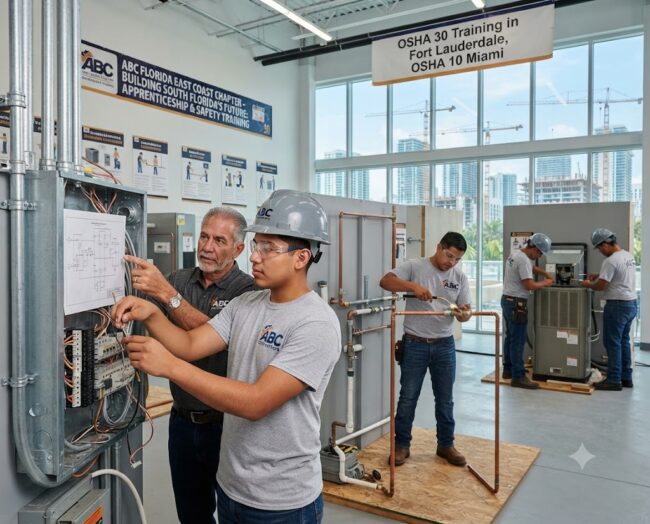
The word “apprenticeship” suffers from vagueness in public conversation, so precision is worth the space. A registered apprenticeship is a formal, state-recognized program combining paid full-time employment under a sponsoring contractor with structured technical instruction — at the ABC Institute, delivered in evening classes — and a documented ledger of on-the-job hours accumulated year over year until the apprentice reaches journey-level standing, typically across a four-year arc with wage increases scheduled along the way.
Three features distinguish it from every alternative training format.
It is verified. Progress is not self-reported enthusiasm; it is thousands of logged field hours plus classroom hours, documented with the employer and the program. When a graduate presents the credential, an employer anywhere in the country knows precisely what stands behind it.
It is transmitted. The competencies that make a journey-level tradesperson — reading a site’s risks, sequencing work among trades, diagnosing the fault that the meter alone won’t reveal — pass from experienced workers to newer ones in the only setting where they can: live production. Apprenticeship institutionalizes that transmission before the region’s most experienced generation retires and takes its judgment along.
It is solvent. The apprentice is paid throughout, graduates without educational debt, and the sponsoring employer recovers its investment in the form of a worker trained to its own standards. No participant in the arrangement is waiting on a subsidy for the model to function — which is why it has survived every economic cycle for a century.
The chapter’s education catalog is built around this engine, with placement assistance connecting qualifying applicants who lack a sponsoring employer to member contractors actively seeking apprentices — a detail that converts enrollment from a leap of faith into a defined employment pathway.
The Front Door: Safety Credentials
Before the trades themselves, the industry asks one thing of everyone who walks onto a commercial site: demonstrated safety literacy. Over the past decade, the OSHA Outreach courses have hardened from recommendation into regional expectation, and they now function as the front door to the entire career path described in this release.
For the newcomer, the 10-hour Outreach course covers the hazard categories responsible for most construction casualties nationally — falls, struck-by events, electrical contact, caught-in/between incidents — along with protective systems, equipment standards, and worker rights. Its practical value in this labor market is blunt: hiring managers move credentialed applicants forward first. A candidate who completes osha 10 certification miami hiring supervisors ask about has converted ten classroom hours into a portable, verifiable signal of job-readiness that follows them across every employer in the tri-county market.
For the leadership tier, the 30-hour Outreach course is the supervision standard — the deeper curriculum in site governance that foremen, superintendents, and safety coordinators carry into roles where their decisions protect entire crews. Excavation oversight, fall protection planning, scaffold and electrical safety management, hazard communication, inspection and documentation duties: this is the content that separates someone who works safely from someone qualified to run a safe site. Field leaders who complete osha 30 training fort lauderdale employers now list in supervisory job requirements are positioning themselves for the exact roles the region is shortest on — and their companies gain the incident records, insurance standing, and owner-prequalification strength that increasingly determine who wins major work.
The growth connection is arithmetic: more simultaneous job sites means more aggregate exposure, and only a proportionally trained workforce keeps the region’s building pace from carrying a rising human cost. Safety education at scale is the license under which the boom operates.
Three Trades, Three Futures
Every craft matters, but three programs in the chapter’s catalog map with particular directness onto what Southeast Florida is becoming.
The Electrical Future
Watch where the region’s investment is flowing — vertical residential, healthcare campuses with redundant life-safety power, logistics and data facilities, transit electrification, EV infrastructure, grid modernization — and a pattern emerges: nearly all of it is electrically intensive, and all of it terminates in work that only qualified electrical workers may legally perform. The chapter’s electrical apprenticeship builds that qualification systematically: National Electrical Code study, circuit theory, raceway and conductor installation, motor controls, transformers, grounding — each unit exercised the next morning on an active commercial project under journey-level oversight. For a candidate surveying the decade ahead, an electrician apprenticeship south florida member firms sponsor amounts to a paid, four-year seat in the trade positioned closest to everything the region plans to build — with compensation at the top tier of the crafts and a licensure runway beyond.
The Mechanical Future
South Florida is the rare market where the HVAC trade’s demand curve is set by latitude. Climate control here is not seasonal comfort; it is the operating condition of every school, hospital, courthouse, warehouse, and office in the region, and the humidity management that preserves the building stock itself. The commercial discipline — chilled-water plants, cooling towers, rooftop systems, building automation, ventilation engineering, federal refrigerant certification — rewards deep training, and the installed base requiring that expertise grows permanently with every certificate of occupancy the region issues. An hvac apprenticeship fort lauderdale sponsoring contractors fund through the program’s paid structure is therefore among the most durable career positions the regional economy offers: the work cannot leave, the demand cannot pause, and the equipment never stops aging.
The Plumbing Future
The plumbing trade carries the region’s least glamorous and most non-negotiable systems: potable water protected by backflow prevention, medical gas in an expanding healthcare footprint, sanitary and storm drainage engineered for tropical rainfall, and the fixture infrastructure of high-occupancy buildings. It is also among the most heavily code-governed crafts on any site, which is precisely why mastery takes years of combined instruction and supervised field repetition. The chapter’s program delivers that mastery on the standard paid model, and for candidates in the trade’s most supply-constrained local market, a plumbing apprenticeship broward county area employers recruit from directly represents a debt-free, four-year passage into licensed-track work that no algorithm and no offshore labor pool can perform.
The Comparison Families Are Not Hearing
Somewhere in nearly every South Florida household with a teenager, a version of the same conversation is underway: what comes after high school? The chapter contends that one of the strongest answers available is systematically underrepresented in that conversation.
Set the two dominant paths side by side over the same five years. The degree route: four years of tuition outlays and forgone full-time income, followed by a job search. The apprenticeship route: four years of full-time wages rising on a set schedule, tuition-free evening instruction, and graduation directly into journey-level pay in a trade with structural demand — with supervision, project management, and eventually contracting ownership as the visible next rungs. For many students the degree remains the right instrument for the right goals. But only one of these paths pays a young person to become an expert, and in a metropolitan area where cost of living compounds every financial decision, that inversion — earning through the training years instead of borrowing through them — reshapes a young adult’s entire first decade.
There is also the question of who gets access to the region’s prosperity. Trade careers cannot be relocated to cheaper labor markets; their wages are earned on local sites and spent in local economies. A robust apprenticeship pipeline is therefore one of the few mechanisms that converts a building boom into broadly held middle-class opportunity for the region’s own residents — economic mobility infrastructure, running quietly beneath the market cycle.
Beyond Tradition: Who the Pipeline Is Really For
The stereotype of the apprentice — eighteen years old, straight from a high school shop class — describes only a fraction of the modern intake. The chapter points to the fuller picture: veterans converting military discipline and mechanical aptitude into civilian credentials; career-changers exiting industries that stopped growing; workers already employed on job sites who want formal standing behind their experience; and yes, recent graduates who ran the numbers on debt-financed education and chose differently. The model’s paid structure is what makes this breadth possible — retraining ordinarily fails because adults cannot stop earning, and apprenticeship is the one educational format that never asks them to. For a region that must enlarge its skilled workforce rather than merely bid it away from other markets, that accessibility is the entire strategy.
Finishing School for Field Leadership
A workforce plan that stops at journey-level solves half the problem. The other half — the shortage contractors mention with the most urgency — is field leadership: the foremen and superintendents who convert drawings, schedules, and crews into safe daily production. The chapter’s foreman certification and supervisory development coursework exists as the pipeline’s finishing stage, identifying accomplished tradespeople and adding the planning, communication, cost-awareness, and crew-management capabilities that leadership actually requires. Layered onto supervision-level safety credentials, it gives the region a renewable answer to the question of who will run the sites of 2030 — drawn from the same pipeline that staffed them in 2026.
For the Region’s Employers: Arithmetic, Not Altruism
To member contractors, the chapter frames all of the above in operational language. In a market where labor is the binding constraint, training is capacity planning: the firm that develops apprentices and credentials its crews is manufacturing its ability to say yes to next year’s work. The competitive spillovers compound — documented safety training strengthens the prequalification packages owners increasingly audit, credentialed supervision lowers incident and insurance exposure, and internally developed talent is retained talent in an industry where poaching is the default recruitment strategy. Workforce development, in this framing, is not corporate citizenship. It is production strategy — and the chapter’s programs exist so firms of any size can execute it without building an education operation alone.
Where the Work Is Coming From: A Sector Map
The case for pipeline urgency sharpens when the demand is broken out by sector, because the projects on Southeast Florida’s horizon are not interchangeable — they are progressively more trade-intensive.
Healthcare leads the list. Hospital systems across the tri-county region are in a sustained expansion and modernization phase, and healthcare construction is the most mechanically and electrically demanding building type in the industry — redundant power, medical gas, precision climate control, and code oversight at every joint. Each new tower of patient rooms is, from a workforce perspective, a multi-year consumption of exactly the trades in shortest supply.
Logistics and port-driven industrial follows. The freight economy surrounding the region’s seaports and airports continues to generate warehouse, cold-storage, and distribution development — building types that look simple from the highway and are anything but from the mechanical room, where refrigeration plants and heavy electrical service define the project.
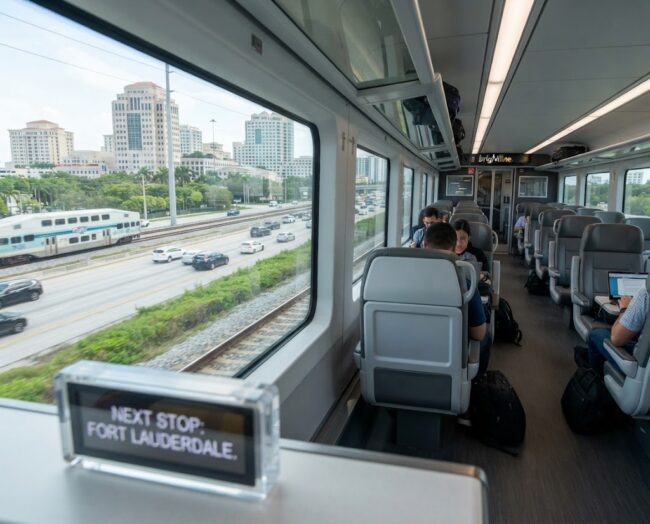
Transit and public infrastructure adds a compounding layer: rail expansion, roadway programs, utility hardening, school construction, and the resilience investments — drainage, elevation, envelope upgrades — that climate policy is steadily converting from studies into contracts. Public work carries its own certification and safety documentation expectations, which routes still more demand toward formally credentialed workers and supervisors.
And beneath all of it runs the region’s permanent baseline: the residential and commercial stock already standing, which ages every year and generates renovation, replacement, and service work that never appears in development pipelines but employs thousands of tradespeople continuously. The sectors differ; the requirement converges. Every line on the map ends at a trained workforce.
The Competition Nobody Maps: Other Regions Want the Same Workers
There is a final pressure worth naming, because it converts the pipeline from advisable to urgent: Southeast Florida is not training in a vacuum. Every high-growth metropolitan region in the Sun Belt is confronting the same shortage, and skilled trades credentials are among the most portable qualifications in the American economy. A journey-level electrician certified in Broward County can be productive in Nashville, Phoenix, or Charlotte within a week of arriving — and those markets recruit accordingly.
Regions respond to that competition in one of two ways. They bid — importing talent with wage premiums that further inflate local construction costs — or they build, producing their own workforce at sufficient scale that the market clears locally. The bidding strategy is a treadmill; the building strategy is an asset. Every apprentice the region trains is a worker whose roots, employer relationships, and career ladder are anchored here, and whose replacement cost never has to be paid to a competing metro. In a national labor market this tight, a region’s apprenticeship capacity is quietly a measure of its economic self-sufficiency.
The Decade Is Being Decided Now
Development cycles create an illusion of abundance — as though the towers rising today prove the system is working. But the workforce building the current cycle was trained during the last one, and the workforce that will build 2032’s pipeline must begin its training now, because the manufacturing lead time on a journey-level tradesperson is four years and cannot be compressed by capital or urgency. Regions that understand this treat their training institutions the way they treat their ports and highways: as the systems everything else depends on.
The chapter is currently enrolling across its full catalog — safety courses, registered craft apprenticeships, foreman certification, and continuing education — and extends a standing invitation to the three groups this release has addressed: individuals ready to be paid while they master a trade, professionals ready to credential their experience and step toward leadership, and employers ready to sponsor the workforce their own growth requires.
Southeast Florida has never lacked ambition on paper. Whether the next decade’s renderings become the next decade’s skyline is a question of hands — trained, certified, and led. The training is where the future actually starts.
Safety and industry resources: https://abceastflorida.com/industry-resources/ Education and apprenticeship catalog: https://abceastflorida.com/services/education/
About ABC Florida East Coast Chapter
The ABC Florida East Coast Chapter is part of Associated Builders and Contractors, the national construction industry trade association organized around the merit shop philosophy — the conviction that construction work should be awarded through open competition on the basis of merit, regardless of labor affiliation. Operating the ABC Institute campus in Coconut Creek, the chapter provides registered apprenticeship, safety, leadership, and continuing education programming to the commercial construction industry of Miami-Dade, Broward, and Palm Beach counties, together with advocacy, networking, and business services for member contractors across Southeast Florida.
Contact
ABC Florida East Coast Chapter Corporate Office 3730 Coconut Creek Pkwy, Suite 200 Coconut Creek, FL 33066 Phone: (954) 951-3911 Web: https://abceastflorida.com/
About the Author