South Florida Business: How HCI College’s Dual-Campus Footprint is Powering the Regional Healthcare Economy
The South Florida macroeconomic landscape is undergoing a profound structural shift. As traditional commercial real estate, tech investment, and hospitality sectors adapt to changing market forces, healthcare has solidified its position as the ultimate growth engine for the regional economy. Driven by a historic influx of new residents, a unique demographic curve, and an expanding network of medical facilities across Broward and Palm Beach counties, the demand for qualified medical professionals has reached an unprecedented peak.
For South Florida residents seeking a stable, rewarding career trajectory that offers high long-term security, the medical sector provides a unique path. Landing a successful corporate role in this fast-paced industry takes more than good intentions; it requires an educational foundation that is rigorous, structured, and fully aligned with state licensing and regulatory bodies.
HCI College (www.hci.edu) serves as an academic and economic anchor in this changing market. Operating two modern, fully optimized campus locations in Fort Lauderdale and West Palm Beach, the institution provides the targeted training, experiential laboratory environments, and corporate healthcare connections needed to transition ambitious students into working professionals. By focusing its programs exclusively on core, high-impact clinical competencies, the college breaks down complex medical education into practical, career-oriented tracks that take significantly less time to complete than a traditional four-year university degree.
The Macroeconomic Catalyst: The Massive Structural Shortage Driving Florida Healthcare Demand
To analyze the immense economic value of a degree or diploma from HCI College, one must evaluate the broader business landscape of the Sunshine State. Healthcare in Florida is not just a static social service; it is a massive, multi-billion-dollar growth engine expanding continuously year over year. Multiple macroeconomic factors converge to make South Florida one of the most dynamic, resilient, and active employment markets in the United States, presenting incredible opportunities for residents looking for maximum geographic flexibility and long-term job security within the state.
Crucially, healthcare jobs in Florida are in such high demand that holding a valid Florida state medical license grants professionals unparalleled intra-state mobility. Once an individual obtains a license through the Florida Board of Nursing or the Department of Health, those professional credentials are valid from the panhandle down to the keys. Because the entire state faces systemic healthcare labor deficits, a licensed professional trained in South Florida can seamlessly transition their career to Central Florida, the Gulf Coast, or North Florida without having to navigate complex out-of-state endorsement paperwork, retake exams, or wait months for state board approvals. Whether a professional wants to move from the busier corridors of Broward County to the rapid-growth communities of Palm Beach, or cross the state to the booming Tampa Bay and Orlando metro areas, healthcare facilities everywhere are actively recruiting.
This severe, state-wide shortage means that qualified, licensed healthcare workers moving between Florida cities often enjoy rapid job placement, internal corporate transfer opportunities within large hospital networks, sign-on bonuses, and highly competitive compensation packages wherever they land. While traditional corporate sectors cope with localized economic downturns, inflation, or automation risks, the healthcare sector maintains an exceptionally low unemployment rate across all 67 Florida counties. Human illness, injury, and aging continue completely independent of local real estate trends or regional market shifts. Because hospitals, medical complexes, and urgent care networks must maintain strict staffing ratios to guarantee safe patient care, a Florida nursing or medical assistant credential functions as a universal passport to immediate employment anywhere in the state.
The primary force behind this massive, statewide employment demand is Florida’s unique demographic curve. The state has long been the premier national destination for retirees and senior citizens, resulting in a population distribution with a high percentage of individuals over the age of 65 distributed across both urban and rural counties. As the massive baby-boomer generation continues to age, their reliance on the medical infrastructure increases exponentially. Older adults exhibit a higher prevalence of complex, chronic conditions—including cardiovascular diseases, metabolic syndromes, orthopedic degeneration, and cognitive declines—that require continuous, sophisticated management. Consequently, local hospitals, specialized clinics, memory care centers, and home health corporations from coast to coast are forced to scale up their operational capacities continuously to keep up, driving the unemployment rate for specialized personnel down to historic lows.
Beyond the retirement demographic, Florida is experiencing sustained general population inflows. This continuous population growth expands the baseline client pool for all tiers of healthcare, from pediatric practices and maternal-newborn units to emergency trauma networks and preventive outpatient clinics. This state-level expansion has triggered an influx of capital investment. Major hospital conglomerates, private equity healthcare consortiums, and national urgent care franchises are constructing state-of-the-art facilities in every major Florida region. Because a modern medical facility with cutting-edge diagnostic imaging and advanced telemetry units is non-functional without a steady pipeline of certified human capital, licensed practical nurses, registered nurses, and medical assistants represent the indispensable operational core of these facilities. By earning your professional credentials through an accredited regional institution like HCI College, you align your career trajectory with an economic sector that lets you live and work wherever you choose within the state.
The Fast-Track Advantage: Maximizing Career Velocity and Minimizing Opportunity Cost
Attending a specialized career college offers a streamlined, modern approach to technical training that traditional institutions struggle to match. While traditional four-year regional universities often require extensive general studies courses—such as art history, creative writing, or theoretical sociology—that delay hands-on clinical exposure, institutions like HCI College optimize the learning curve to value your time and capital. From your initial academic terms, your time is focused directly on the skills, terminology, physical techniques, and psychological frameworks used right at the patient’s bedside or inside ambulatory clinics.
Every clinical lecture, simulation lab session, and testing template is engineered to prepare you for the real-world scenarios you will encounter when you move out of the classroom and into active institutional care networks. For many non-traditional students, professionals looking to change careers, or parents managing family households, spending four years out of the workforce to earn a degree is financially impossible. By cutting out the fluff and focusing exclusively on what is required to pass state licensing boards and execute safe clinical care, HCI College allows students to earn their degrees and diplomas in a fraction of the time.
This accelerated timeline drastically lowers your opportunity cost. Instead of spending years paying tuition without generating income, HCI College students graduate rapidly and enter the professional workforce ahead of schedule. Earning a professional salary years sooner means you can begin paying down educational debts, investing in real estate, building retirement accounts, and climbing the corporate seniority ladder inside major South Florida healthcare systems while traditional university students are still sitting in general lecture halls.
Earning the Gold Standard in Nursing: The Associate of Science in Nursing (ASN)
While there are many entry-level pathways into the healthcare landscape, the Associate of Science in Nursing (ASN) degree remains one of the most versatile and financially rewarding investments available in the modern economy. Registered Nurses (RNs) operate with an expanded legal scope of practice that places them at the absolute center of clinical decision-making. RNs are responsible for performing comprehensive physical and psychological assessments, analyzing complex diagnostic data, managing sophisticated medical machinery, executing advanced therapeutic procedures, and coordinating care across large, multidisciplinary medical teams.
HCI College meets this professional corporate demand through its comprehensive Associate of Science in Nursing (ASN) degree program. The architecture of this program relies on a rigorous blend of cognitive theory, technological literacy, and mechanical precision. For students preparing to take on this demanding curriculum, enrolling in foundational Pre RN nursing classes Fort Lauderdale is highly recommended. These preparatory scientific courses establish the rigorous foundation in advanced human anatomy, physiological chemistry, pathophysiology, and microbiology required to excel in the core nursing program. Mastering these foundational sciences ensures that when you advance to complex topics like pharmacology or advanced cardiac care, you understand the underlying cellular mechanics rather than just memorizing facts, preventing you from falling behind when the curriculum increases in complexity.
Enrolling in an accredited RN school Fort Lauderdale such as HCI College means entering an academic community that values critical thinking, evidence-based practice, and ethical accountability. The ASN curriculum guides students systematically through various critical medical specialties, including pediatric healthcare, maternal-infant nursing, acute psychiatric interventions, and high-acuity medical-surgical nursing. Students are trained to look past a patient’s immediate physical symptoms and assess their overall well-being, taking into account socioeconomic background, mental health, and cultural preferences. This comprehensive approach ensures that graduates are prepared to challenge the National Council Licensure Examination for Registered Nurses (NCLEX-RN) and transition into roles across emergency trauma wards, intensive care units, or outpatient surgical networks.
Furthermore, the ASN degree functions as an enduring foundation for future academic progression. In the modern healthcare environment, nursing education is an ongoing journey. Having an accredited ASN degree from HCI College positions you perfectly to transition into Bachelor of Science in Nursing (BSN) completion programs or pursue master’s-level specialties, including Nurse Practitioner (NP), Certified Registered Nurse Anesthetist (CRNA), or Clinical Nurse Educator roles. The long-term career flexibility afforded by an RN designation ensures that your skills remain highly marketable no matter how the broader economic climate shifts.
Mastering Practical Nursing: The Accelerated LPN Blueprint
For individuals seeking an efficient, direct, and hands-on entry point into professional clinical care, the Practical Nursing diploma program serves as an exceptional vocational vehicle. Licensed Practical Nurses (LPNs) operate at the foundational level of direct patient engagement, translating complex clinical care plans into actionable bedside interventions. Working under the direct supervision of registered nurses and licensed physicians, LPNs perform essential medical duties that form the baseline of patient safety and comfort. These tasks include measuring vital signs, collecting diagnostic specimens, managing complex wound care protocols, monitoring nutritional intake, and administering therapeutic medications.
For residents of Broward County looking to enter this career path, obtaining premier Fort Lauderdale LPN training provides a direct route into the workforce. The LPN curriculum at HCI College is an intensive, fast-paced educational experience engineered to blend cognitive theory with mechanical precision. Students enrolled in a Fort Lauderdale LPN training course do not merely absorb information passively from text blocks; they are consistently challenged to apply safety concepts, pharmacological calculations, and physiological principles to realistic care scenarios. This continuous loop of theory and practice ensures that clinical knowledge is deeply integrated and ready for deployment.
The architecture of the program relies heavily on high-fidelity learning environments. By participating in Fort Lauderdale nursing training classes, you gain direct access to clinical laboratories that replicate modern institutional care settings. These spaces are equipped with programmable patient simulators that mimic acute medical crises, allowing you to practice assessing vital signs, responding to emergencies, and organizing care priorities without risk to a human patient.
This experiential training bridges the gap between reading a textbook and standing confidently in front of a live patient in a high-stress medical environment. In these labs, mistakes become valuable learning opportunities managed under the watchful guidance of supportive instructors, ensuring that you are fully competent before practicing on real individuals.
Graduating and completing your LPN nurse training in Fort Lauderdale provides an immediate competitive edge within the regional job market. The comprehensive scope of the training ensures proficiency in critical clinical areas, including advanced intravenous (IV) therapy, geriatric care strategies, and multi-system medical-surgical nursing. For individuals reviewing educational institutions throughout the region, choosing a top-tier Fort Lauderdale school for LPN or an established LPN training school South Fl is a vital career decision. HCI College addresses this societal need by providing a premier school for LPN in Fort Lauderdale that effectively accommodates non-traditional student schedules while maintaining strict academic and clinical standards.
The Core of Clinical Operations: Professional Medical Assistant Training
The healthcare ecosystem requires diverse professional roles to remain operationally sound and clinically effective. For individuals who prefer an integrated professional balance that blends direct clinical patient care with clerical administration, a career in medical assisting is an exceptional option. Medical assistants function as the versatile operational glue that stabilizes daily workflows inside multi-provider private practices, urgent care centers, specialist clinics, and outpatient diagnostic centers. They are unique healthcare workers trained to pivot seamlessly between clinical and administrative duties based on the immediate needs of the facility.
HCI College offers an intensive medical assistant training Fort Lauderdale program designed to cultivate this multi-disciplinary adaptability. The administrative portion of the program equips students with essential operational skills, including electronic health records (EHR) navigation, medical billing and coding mechanics, health insurance verification protocols, and front-office scheduling management. Simultaneously, the clinical training ensures proficiency in hands-on medical skills, such as preparing patients for examinations, collecting and processing laboratory specimens, executing venipunctures (phlebotomy), performing electrocardiograms (ECGs), and assisting physicians during minor, in-office surgical procedures.
This dual-domain proficiency makes medical assistants highly valuable to healthcare managers aiming to optimize efficiency and patient satisfaction. Medical assistants are typically the first and last point of contact for a patient during a medical visit, making their communication skills, empathy, and professional demeanor central to the patient experience. At HCI College, students are trained to master both technical accuracy and patient-centered communication, ensuring they can soothe anxious patients, explain complex preparation instructions clearly, and manage clinical schedules effectively. This versatile training path allows graduates to enter the expanding Florida medical job market rapidly, without the extensive clinical rotation blocks required by traditional nursing tracks.
The Clinical Rotation Framework: Translating Academic Concepts into Real-World Action
A truly comprehensive healthcare education cannot occur solely within the walls of a classroom or a mock campus laboratory. While textbooks provide the essential theoretical foundation and simulation labs offer a safe space for initial skill practice, clinical rotations introduce students to the unscripted reality of modern patient care. HCI College integrates a robust, structured clinical rotation framework into its nursing programs, partnering with leading hospitals, long-term care facilities, and community health centers throughout South Florida.
During these clinical rotations, students step out of the student role and into active, fast-paced medical environments under the direct supervision of licensed clinical instructors and seasoned preceptors. You are assigned to real patients, taking on the responsibility of monitoring their health status, preparing and administering treatments, updating electronic medical records, and collaborating with doctors, therapists, and pharmacists. This immersive environment forces you to think critically under pressure, manage your time effectively across multiple assignments, and adapt to changing patient conditions in real time.
Dietary logs, charting, medication updates, and direct patient interaction solidify your clinical competencies while providing an invaluable networking opportunity. While working inside these regional facilities, you are consistently observed by nursing directors, clinical coordinators, and unit managers who are actively looking to hire top-tier talent. By demonstrating strong technical skills, a proactive work ethic, punctuality, and deep compassion, HCI College students frequently secure employment offers weeks before graduation. This direct exposure to the regional healthcare employer network bridges the gap between graduation and full-time employment, giving graduates a distinct advantage as they enter the workforce.
Dual South Florida Campuses: Infrastructure Built for Student Accessibility
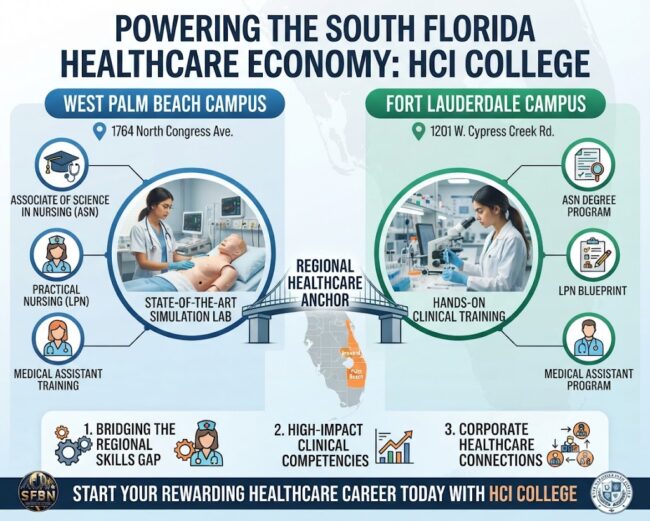
HCI College is dedicated to making professional healthcare training accessible and convenient for students across South Florida. To accomplish this mission, the college operates two modern, fully optimized campus locations. Both campuses feature professional-grade simulation laboratories, advanced computer learning centers, extensive libraries, and collaborative student spaces designed to mirror the physical layouts of modern medical institutions.
For individuals residing in Palm Beach County, Martin County, or northern South Florida communities, the West Palm Beach campus provides an exceptional academic environment:
West Palm Beach Campus
- Phone Number: (561) 586-0121
- Physical Address: 1764 North Congress Ave., West Palm Beach, FL 33409
- Location Marker: (Corner of Congress Ave. and Westgate Ave.)
For students based in Broward County, Miami-Dade County, or the southern coastal regions, the Fort Lauderdale campus provides a centrally located, modern educational hub:
Fort Lauderdale Campus
- Phone Number: (954) 626-0255
- Physical Address: 1201 W. Cypress Creek Rd., Suite 101, Fort Lauderdale, FL 33309
Each campus is fully staffed by an experienced faculty of licensed nurses, active medical practitioners, and dedicated academic advisors who bring decades of real-world insights directly to the classroom. This ensures that your instruction is grounded in current, day-to-day healthcare realities rather than outdated theories. The geographic distribution of these campuses ensures that whether you live in Boynton Beach, Jupiter, Sunrise, Coral Springs, or Hollywood, an HCI College campus is within a manageable commuting distance. This accessibility allows you to pursue a life-changing healthcare credential without uprooting your existing family commitments or leaving your current employment.
Mastering the Professional Licensure Process: Overcoming the NCLEX Milestone
Completing your required degree coursework and walking across the graduation stage are monumental personal achievements, but practicing as a professional nurse requires navigating the state-level regulatory licensure process. For nursing candidates, this means passing the National Council Licensure Examination (NCLEX-PN for practical nurses and NCLEX-RN for registered nurses). The NCLEX is a highly specialized computerized adaptive test designed to measure your ability to make safe, accurate clinical judgments under pressure. Rather than testing simple memorization, the exam utilizes complex behavioral algorithms to evaluate how you manage care, promote health maintenance, ensure psychosocial integrity, and handle physiological adaptation scenarios.
HCI College integrates NCLEX preparation directly into the core fabric of its nursing curricula from day one. Students are consistently exposed to board-style testing formats, advanced critical-thinking case studies, and structured review sessions throughout their academic journey. The college provides simulated testing environments that accurately mimic the time constraints, adaptive formatting, and mental pressure of the real exam. This continuous preparation builds test-taking stamina, minimizes performance anxiety, and equips graduates with the specific analytical strategies required to pass the board exam on their first attempt. Faculty members work closely with students to identify individual academic weaknesses and provide targeted remediation.
Once the NCLEX milestone is conquered, you must complete the formal licensing application process with the Florida Board of Nursing. This process requires submitting comprehensive fingerprint diagnostics for state and federal criminal background checks, verifying your graduation credentials from an approved program, and paying standard licensing fees.
HCI College does not abandon its graduates during this bureaucratic transition; the college’s dedicated academic advisors and student services teams provide step-by-step guidance through the paperwork, ensuring that your transition from graduate to fully credentialed, practicing professional nurse is as smooth and rapid as possible. This post-graduation support is a testament to the college’s dedication to your ultimate career success.
Corporate Social Responsibility and Institutional Support Systems
The journey through a rigorous healthcare program is an intensive pursuit that demands significant mental focus, time management, and financial planning. Recognizing the unique challenges faced by modern students, HCI College has developed a comprehensive institutional support system designed to remove barriers, provide resources, and cultivate student success from enrollment through job placement.
Financial planning is a vital part of this support structure. HCI College features a fully staffed financial aid department where experienced advisors work individually with students to explore options for funding their education. For those who qualify, federal financial aid programs—such as Federal Pell Grants, Federal Direct Subsidized and Unsubsidized Student Loans, and Parent PLUS Loans—serve as baseline funding mechanisms. Furthermore, financial advisors assist students in identifying external private scholarships, state grants, employer tuition reimbursement initiatives, and specialized veteran educational benefits (GI Bill). The college also provides flexible, internal institutional payment plans tailored to unique financial situations, making tuition predictable and manageable so students can focus on their studies.
Academic support is equally comprehensive. HCI College provides free peer tutoring networks, faculty-led review sessions, and extensive physical and digital learning resources within its campus libraries. If you encounter difficulties with complex pharmacological calculations, advanced physiological concepts, or medical terminology, you can easily access targeted help. Additionally, the Career Services department provides essential guidance as you prepare to enter the workforce. Career advisors conduct structured resume-building workshops, lead mock interview practice sessions, host on-campus healthcare networking events, and provide direct job placement assistance with leading hospitals, urgent care networks, and clinical complexes across Florida. This ensures you graduate not just with a degree, but with a clear path into a rewarding career.
Conclusion: Capitalizing on South Florida’s Unstoppable Healthcare Growth
Embarking on a career in healthcare requires dedication, resilience, technical discipline, and a deep-seated passion for human service. By partnering with HCI College, you give yourself the tools, mentorship, and hands-on experience necessary to excel in this demanding field. Whether you choose to pursue a Practical Nursing diploma, an Associate of Science in Nursing degree, or a Medical Assistant certificate, HCI College stands by your side as an enduring academic partner at every stage of your educational journey.
As the state of Florida continues its historic expansion, the medical sector will remain an engine of economic growth, career stability, and professional opportunity. The commitment you make to your education today will pay substantial dividends for decades to come, providing a career that offers excellent professional growth, financial security, and the deep satisfaction of knowing your daily work directly improves human lives.
Are you ready to take the first definitive step toward a secure, impactful, and fulfilling medical career? Contact the admissions department at either the West Palm Beach or Fort Lauderdale campus today to discuss upcoming start dates, programmatic entry requirements, financial aid structures, and personalized campus tours. Your journey toward becoming a licensed, successful healthcare professional begins with a single choice—make that choice today with HCI College.
About the Author