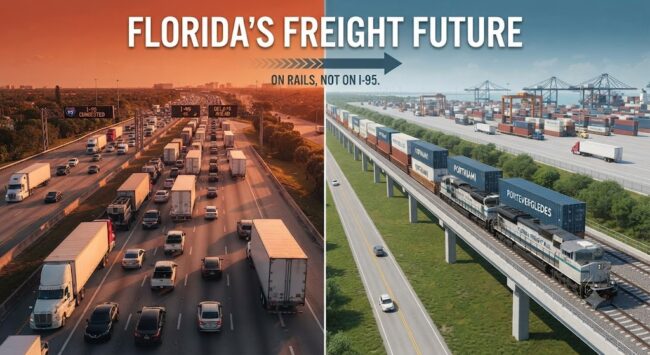
Every rush hour, South Florida’s highways turn into rolling parking lots behind a wall of 18-wheelers, and every hurricane season reminds us how fragile that single-lane, single-mode supply chain really is. There’s a better answer sitting right under our noses, and it’s been there for over a century: freight rail. It’s time this state stopped treating railroads like a relic and started treating them like the backbone of a modern, resilient economy.
What Billions in Rail Investment Actually Buys
Picture a serious, multi-billion-dollar commitment to Florida’s rail network: expanded intermodal yards near PortMiami and Port Everglades, double-tracked corridors through Hialeah and West Palm Beach, modernized signaling, and better connections into inland distribution hubs. That’s not a moonshot. It’s proven technology, scaled up. A single freight train can move the cargo of well over a hundred trucks in one trip, which means every dollar poured into rail capacity translates almost directly into fewer big rigs jockeying for position on the Turnpike and I-95.
Fewer trucks on the road isn’t just a convenience, it’s a safety win. Large commercial trucks are involved in a disproportionate share of serious highway crashes, and every container that moves by rail instead of by truck is one less multi-ton vehicle sharing lanes with daily commuters, school buses, and weekend drivers. Shifting volume onto rail is one of the most effective, least glamorous ways to make Florida’s roads measurably safer.
The Energy Math Favors Rail
Moving freight by rail is dramatically more energy-efficient per ton than moving it by truck, since steel wheels on steel rails face far less friction than rubber tires on asphalt, and a single locomotive can haul the load of dozens of trucks. That efficiency compounds at scale: less fuel burned per container, less wear on public roads, and less strain on infrastructure that taxpayers otherwise have to keep repaving. A real investment in rail capacity is, in effect, an investment in energy savings that pays dividends for decades.
Good Jobs, Built to Last
Rail careers, from engineers and conductors to signal technicians and yard operators, tend to be stable, well-compensated, and rooted in the communities they serve, offering a sharp contrast to an industry that’s often marked by turnover and outsourcing. A statewide push to modernize rail isn’t just about moving boxes faster, it’s about building a durable, skilled workforce for South Florida’s next generation.
Time to Make Rail Cool Again
Florida’s ports already sit next to rail lines built to handle exactly this kind of volume. The state doesn’t need a flashier truck or another lane added to an already-jammed highway. It needs the political and financial will to treat freight rail as critical infrastructure, worthy of the same bold investment energy typically reserved for flashy tech pitches. Do that, and Florida doesn’t just fix a congestion problem, it builds a quieter, safer, more efficient supply chain that the rest of the country will be trying to copy.
About the Author