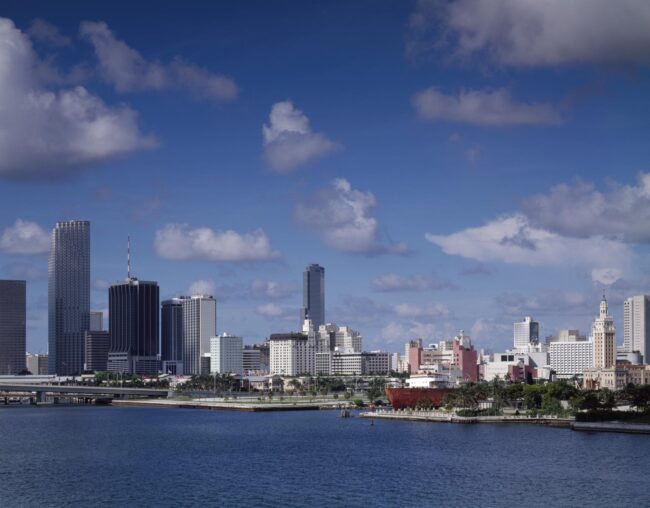
Skyline view of Miami, Florida. Source: Carol M. Highsmith Archive, Library of Congress / License: Public domain (no known restrictions on publication)
Quick Answer: FDIC Summary of Deposits data as of June 30, 2026 show $353.2 billion in deposits at 1,375 bank offices in Miami-Dade, Broward, Palm Beach and Monroe counties, up 3.7% from a year earlier. Bank of America, JPMorgan Chase and Wells Fargo hold the top three spots, while Miami-based City National Bank of Florida and Miami Lakes-based BankUnited are the largest locally headquartered banks by regional deposits.
South Florida’s bank deposit base grew faster than Florida’s as a whole over the 12 months ended June 30, 2026, according to the Federal Deposit Insurance Corporation’s annual Summary of Deposits (SOD). The FDIC released the 2026 survey results on September 18, 2026, covering more than 75,000 domestic offices of more than 4,200 FDIC-insured institutions.
This analysis uses the June 30, 2026 SOD data, the most recent available, and compares it with the June 30, 2025 and June 30, 2024 surveys. All dollar figures below come from FDIC branch-level SOD records summed for the four counties, unless another source is named.
How much money is deposited in South Florida banks?
Banks reported $353.2 billion in deposits at offices in the four-county region as of June 30, 2026. That was up from $340.7 billion in June 2025, an increase of about $12.5 billion, or 3.7%. A year earlier, the region had grown 2.0%, from $334.0 billion in June 2024.
Florida as a whole reported $876.6 billion in deposits across 4,283 offices in the 2026 survey, up 2.0% from $859.2 billion and 4,257 offices in 2025. The four South Florida counties therefore held about 40.3% of all deposits reported at Florida bank offices.
Nationally, the SOD branch records sum to about $19.05 trillion for June 2026, compared with $18.10 trillion in June 2025, a gain of roughly 5.2%. The national office count fell from 76,097 to 75,859. South Florida’s office count moved the other way, rising from 1,368 to 1,375.
| Snapshot (June 30, 2026) | Figure |
|---|---|
| Four-county deposits | $353.2 billion |
| Change from June 30, 2025 | +$12.5 billion (+3.7%) |
| Bank offices in region | 1,375 (vs. 1,368 in 2025) |
| Share of Florida deposits | About 40.3% |
| Florida deposit growth | +2.0% |
| Largest bank in region | Bank of America, $55.2 billion (15.6%) |
| Largest locally headquartered bank in region | City National Bank of Florida, $21.4 billion (6.1%) |
Source: FDIC, Summary of Deposits, June 30, 2025 and 2026 (calculations from branch-level records).
How do deposits compare by county?
Miami-Dade dominates the regional total. Its 585 offices reported $210.9 billion in deposits, about 59.7% of the four-county figure. Miami-Dade also added the most money in dollar terms, about $8.4 billion over the year.
Palm Beach County grew at nearly the same pace as Miami-Dade, rising 4.0% to $66.9 billion, and added five offices. Broward grew more slowly, up 2.2% to $71.0 billion, and lost one office. Monroe County, covering the Florida Keys, was essentially flat at $4.45 billion, down 0.3%, with 35 offices in both years.
| County | Deposits 2026 | Deposits 2025 | Change | Offices 2026 (2025) |
|---|---|---|---|---|
| Miami-Dade | $210.9B | $202.5B | +4.2% | 585 (582) |
| Broward | $71.0B | $69.5B | +2.2% | 368 (369) |
| Palm Beach | $66.9B | $64.3B | +4.0% | 387 (382) |
| Monroe | $4.45B | $4.46B | -0.3% | 35 (35) |
| Total | $353.2B | $340.7B | +3.7% | 1,375 (1,368) |
Source: FDIC, Summary of Deposits, June 30, 2025 and June 30, 2026.
Why is Miami-Dade’s average office so much larger?
Dividing deposits by offices gives an average of about $361 million per office in Miami-Dade, compared with about $193 million in Broward, $173 million in Palm Beach and $127 million in Monroe. Those averages are heavily influenced by a handful of very large offices.
The single largest office in the region in the 2026 survey was BankUnited’s Miami Lakes office, with $13.6 billion in reported deposits. City National Bank of Florida’s Coral Gables office reported $12.6 billion. Bradesco Bank reported its entire $5.0 billion regional total at one Coral Gables office. Main offices and headquarters locations often carry balances well beyond what a typical neighborhood branch gathers, so per-office averages are best read as a measure of where deposits are booked, not of retail branch productivity.
Which banks have the largest deposit market share in South Florida?
Four national banks hold about 45% of the region’s deposits. Bank of America leads with $55.2 billion at 159 offices, a 15.6% share. JPMorgan Chase follows with $43.7 billion at 173 offices, the largest branch network in the region. Wells Fargo is third at $37.7 billion and 161 offices, and Citibank is fourth at $22.3 billion with 56 offices.
| Bank (four counties) | Deposits 2026 | Share | YoY change | Offices |
|---|---|---|---|---|
| 1. Bank of America | $55.2B | 15.6% | +1.5% | 159 |
| 2. JPMorgan Chase | $43.7B | 12.4% | +4.8% | 173 |
| 3. Wells Fargo | $37.7B | 10.7% | -0.1% | 161 |
| 4. Citibank | $22.3B | 6.3% | +0.7% | 56 |
| 5. Truist | $21.8B | 6.2% | +4.4% | 119 |
| 6. City National Bank of Florida | $21.4B | 6.1% | +2.4% | 27 |
| 7. BankUnited | $19.5B | 5.5% | -3.3% | 36 |
| 8. TD Bank | $10.8B | 3.1% | -9.0% | 78 |
| 9. PNC | $10.1B | 2.8% | +14.6% | 67 |
| 10. Amerant Bank | $8.2B | 2.3% | +0.1% | 22 |
Source: FDIC, Summary of Deposits, June 30, 2025 and 2026; shares calculated against the four-county total.
Which banks gained and lost ground?
JPMorgan Chase added about $2.0 billion in regional deposits, the largest dollar gain among the top 10, and its market share edged up from 12.2% to 12.4%. PNC grew 14.6% to $10.1 billion and added four offices, reaching 67. Truist rose 4.4%.
TD Bank posted the steepest decline among the top 10, down 9.0% to $10.8 billion, with its office count falling from 80 to 78. BankUnited’s regional deposits fell 3.3% to $19.5 billion. Bank of America’s dollar total rose 1.5%, but because the market grew faster, its share slipped from 16.0% to 15.6%. Wells Fargo was flat in dollars and its share fell from 11.1% to 10.7%.
Just outside the top 10, two foreign-owned, Miami-area banks grew quickly. Bradesco Bank’s single Coral Gables office rose 18.2% to $5.0 billion, and Banesco USA’s five offices rose 30.8% to $4.3 billion.
Who leads each county?
Market leadership shifts by county, and locally headquartered banks matter most in Miami-Dade.
- Miami-Dade: Bank of America leads with $28.4 billion (13.4%), followed by JPMorgan Chase at $23.5 billion (11.1%). City National Bank of Florida ranks third with $18.6 billion (8.8%), just ahead of Wells Fargo at $18.4 billion (8.7%). BankUnited is fifth at $17.1 billion (8.1%), and Citibank sixth at $15.9 billion (7.5%). Amerant ranks eighth at $7.4 billion.
- Broward: Bank of America holds $15.8 billion (22.2%), the most concentrated position of any bank in any of the three large counties. JPMorgan Chase ($10.2 billion), Truist ($9.8 billion) and Wells Fargo ($9.5 billion) each hold between 13% and 15%.
- Palm Beach: The top four are tightly bunched: Bank of America $10.5 billion (15.7%), JPMorgan Chase $10.0 billion (15.0%), Wells Fargo $9.5 billion (14.2%) and PNC $8.3 billion (12.4%). Seacoast National Bank ranks eighth with $1.7 billion at 11 offices.
- Monroe: Regional and community banks lead. First Horizon Bank holds $1.21 billion (27.1%), Key West-based First State Bank $1.06 billion (23.8%) and Centennial Bank $829 million (18.6%). Bank of America is fourth with $595 million.
Which banks are headquartered in South Florida?
FDIC institution records list 30 active FDIC-insured banks with main offices in the four counties. Twenty are in Miami-Dade, five in Broward, three in Palm Beach and two in Monroe. Several often-cited Florida banks are not based in the region: Seacoast National Bank’s main office is in Stuart in Martin County, Centennial Bank is based in Conway, Arkansas, and First Horizon Bank is based in Memphis, Tennessee.
| Bank (main office) | Total assets, 6/30/26 | Regional SOD deposits | Parent |
|---|---|---|---|
| BankUnited (Miami Lakes) | $34.9B | $19.5B | BankUnited Inc., Miami Lakes |
| City National Bank of Florida (Miami) | $29.1B | $21.4B | Empresas Juan Yarur SpA, Santiago, Chile |
| Amerant Bank (Coral Gables) | $10.3B | $8.2B | Amerant Bancorp, Coral Gables |
| Ocean Bank (Miami) | $7.6B | $6.2B | Ocean Bankshares, Miami |
| Bradesco Bank (Coral Gables) | $6.1B | $5.0B | BBD Participacoes SA, Brazil |
| Banesco USA (Miami) | $6.0B | $4.3B | None listed by FDIC |
Source: FDIC, BankFind institution data (June 30, 2026 report date) and Summary of Deposits, June 30, 2026.
Together, those six banks held $64.6 billion in regional deposits, about 18.3% of the four-county market. Other Miami-Dade-based banks above $1 billion in assets include Emigrant Bank, Banco do Brasil Americas, U.S. Century Bank in Doral, Newtek Bank, Pibank, International Finance Bank, Pacific National Bank, Grove Bank & Trust and Helm Bank USA.
Outside Miami-Dade, locally based banks are much smaller. The largest Broward-based bank is OptimumBank in Fort Lauderdale, with $1.39 billion in assets. Palm Beach County’s largest is Anchor Bank in Palm Beach Gardens at $806 million, followed by Paradise Bank in Boca Raton and Bank of Belle Glade. In Monroe, First State Bank of Key West has $1.18 billion in assets and Gulf Atlantic Bank, also in Key West, has $253 million.
What do the latest quarterly results show for local public banks?
The SOD is a once-a-year snapshot. More recent filings from the two publicly traded, locally headquartered banks show deposit balances easing after June 30.
BankUnited reported third-quarter 2026 net income of $72.2 million, or $1.01 per diluted share, in its October 21, 2026 earnings release. Total deposits were $28.31 billion at September 30, 2026, down $570.3 million from June 30 and down $307.3 million from a year earlier. Non-interest-bearing deposits were $9.11 billion. Net interest margin was 3.16%, up 10 basis points from the prior quarter.
Amerant Bancorp reported third-quarter 2026 net income of $25.7 million, or $0.65 per diluted share, in its October 22, 2026 release. Total deposits were $8.25 billion at September 30, 2026, down $109.6 million, or 1.3%, from June 30. Net interest margin was 3.77% and return on assets was 1.00%. Total assets were $10.2 billion.
| Q3 2026 | BankUnited | Amerant |
|---|---|---|
| Net income | $72.2M | $25.7M |
| Diluted EPS | $1.01 | $0.65 |
| Total deposits, 9/30/26 | $28.31B | $8.25B |
| Deposit change vs. 6/30/26 | -$570.3M | -$109.6M |
| Net interest margin | 3.16% | 3.77% |
Source: BankUnited, Inc. and Amerant Bancorp Inc. third-quarter 2026 earnings releases (SEC Form 8-K exhibits).
For context, the FDIC’s Quarterly Banking Profile for the second quarter of 2026 reported that domestic deposits at insured institutions rose 0.8% in the quarter, the eighth straight quarterly increase, and that industry net interest margin was 3.32%.
Brian’s Take
The headline number is healthy. South Florida’s deposit base grew 3.7% in a year when Florida overall grew 2.0%, and the region now holds roughly four of every ten dollars on deposit at Florida bank offices. For local businesses, that means the funding base behind commercial lending here is large and still growing.
What stands out to me as a former investment manager and analyst is the split. The national banks keep getting bigger, with the top four holding about 45% of regional deposits, while the two largest home-grown public banks, BankUnited and Amerant, both reported lower deposits at September 30 than at June 30. Smaller businesses that value a local decision-maker should pay attention to how those local balance sheets hold up, because local banks are where many of those relationships live.
I would also read the county averages carefully. A few headquarters offices in Miami Lakes and Coral Gables carry tens of billions of dollars, which inflates Miami-Dade’s numbers. Broward and Palm Beach are served by a more evenly spread branch market, and the Keys depend heavily on a handful of regional and community banks.
Frequently Asked Questions
What is the FDIC Summary of Deposits?
It is an annual FDIC survey of deposits at every domestic office of FDIC-insured institutions, measured as of June 30. The 2026 results were released September 18, 2026.
How much in deposits do South Florida banks hold?
Offices in Miami-Dade, Broward, Palm Beach and Monroe counties reported $353.2 billion as of June 30, 2026, up 3.7% from $340.7 billion a year earlier.
Which bank has the most deposits in South Florida?
Bank of America, with $55.2 billion at 159 offices, or about 15.6% of the four-county market.
What is the largest bank headquartered in South Florida?
By total assets, BankUnited of Miami Lakes, at $34.9 billion as of June 30, 2026. By regional deposits, City National Bank of Florida leads locally based banks with $21.4 billion.
Is Seacoast Bank a South Florida bank?
Seacoast National Bank’s main office is in Stuart, Martin County, which is outside the four-county region. It holds $1.7 billion in Palm Beach County deposits.
Which county saw the fastest deposit growth?
Miami-Dade, up 4.2%, narrowly ahead of Palm Beach at 4.0%. Broward rose 2.2% and Monroe slipped 0.3%.
Sources and Further Reading
- Summary of Deposits, June 30, 2024, 2025 and 2026 branch data (BankFind Suite API) — Federal Deposit Insurance Corporation
- BankFind Suite institution data, June 30, 2026 report date — Federal Deposit Insurance Corporation
- FDIC Releases Results of Summary of Deposits Annual Survey (September 18, 2026) — Federal Deposit Insurance Corporation
- Quarterly Banking Profile, Second Quarter 2026 press release — Federal Deposit Insurance Corporation (via Compliance Alliance)
- BankUnited, Inc. Third Quarter 2026 Earnings Release, Form 8-K Exhibit 99.1 — U.S. Securities and Exchange Commission
- Amerant Bancorp Inc. Third Quarter 2026 Earnings Release, Form 8-K — U.S. Securities and Exchange Commission
About the Author